The Dark Battle for Liberty: Justice K.S. Puttaswamy Unmasked
In 2017, a landmark judgment reshaped Indian constitutional law forever. The Supreme Court of India delivered a unanimous verdict in Justice K.S. Puttaswamy (Retd.) v. Union of India, affirming privacy as a fundamental right.
In our analysis of Indian constitutional history, few cases have had such a monumental impact on civil liberties. This decision fundamentally altered the balance of power between the citizen and the state.
Written by Kapil Balhara | Technically Reviewed for Accuracy | Last Updated: October 2026
What is Justice K.S. Puttaswamy v. Union of India Case?
Justice K.S. Puttaswamy (Retd.) v. Union of India is a landmark 2017 Supreme Court of India decision where a nine-judge Constitution Bench unanimously ruled that the Right to Privacy is a fundamental right guaranteed under Article 21 and Part III of the Constitution.
Justice K.S. Puttaswamy v Union of India Supreme Court Right to Privacy Landmark Judgment
Furthermore, this decision overruled earlier rulings in M.P. Sharma (1954) and Kharak Singh (1962), which had held that privacy was not explicitly protected. Consequently, the judgment firmly established individual dignity, autonomy, and informational privacy as core constitutional values.
Historical Context and Overruled Precedents
To fully comprehend the magnitude of this judgment, one must look at the legal landscape prior to 2017. For decades, state authorities argued that the Constitution did not guarantee a distinct fundamental right to privacy.
M.P. Sharma v. Satish Chandra (1954): An eight-judge Bench held that the search and seizure of documents did not violate Article 20(3) or create an implicit right to privacy.
Kharak Singh v. State of U.P. (1962): A six-judge Bench ruled that domiciliary visits violated personal liberty, but stated that the right to privacy was not guaranteed.
However, in our evaluation of subsequent case law, smaller Benches gradually began recognizing privacy claims in cases like Gobind v. State of M.P. and PUCL v. Union of India. Therefore, when the constitutional validity of the Aadhaar biometric scheme was challenged, a reference was made to a nine-judge Bench to resolve the legal contradiction once and for all.
Key Takeaway: The nine-judge Bench eliminated decades of legal ambiguity by declaring that privacy is intrinsic to human dignity and freedom.
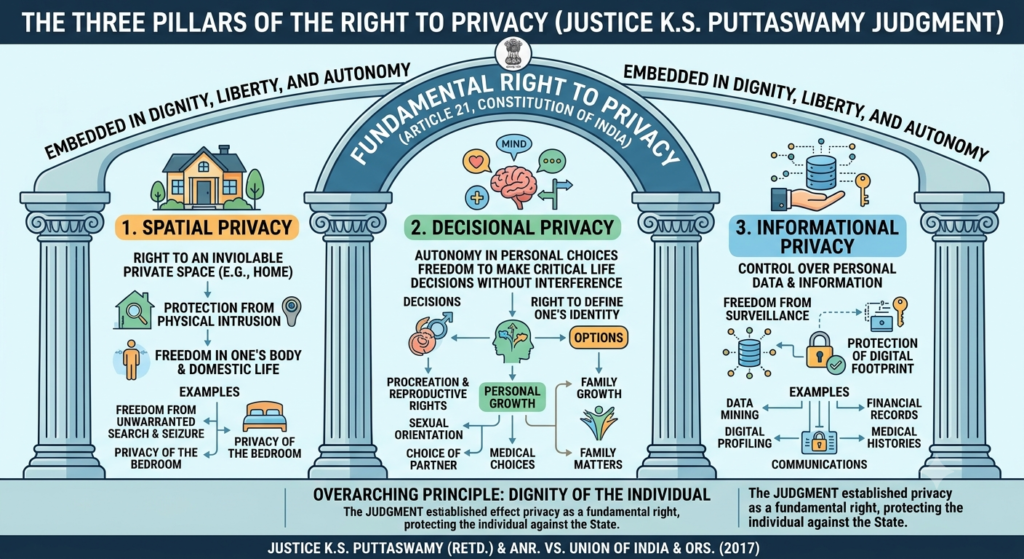
The Core Pillars of the Right to Privacy Under Article 21
The Supreme Court clarified that privacy is not a monolithic concept. Instead, it comprises multiple overlapping dimensions that safeguard an individual’s personal choices and identity.
Dimensions of Privacy Recognized in the Verdict
Dimension
Scope & Key Focus
Example / Application
Spatial Privacy
Protection of physical spaces from unlawful intrusion.
Sanctity of the home, protection against warrantless searches.
Decisional Autonomy
Freedom to make intimate personal choices without state interference.
Reproductive choices, marital status, sexual orientation.
Informational Privacy
Control over personal data and its dissemination.
Protection of biometric details, medical history, and bank records.
Additionally, Justice D.Y. Chandrachud highlighted that fundamental rights do not exist in isolated silos. Thus, the Right to Privacy intersects seamlessly across Part III:
Article 14: Ensures freedom from arbitrary state action invading personal spaces.
Article 19: Guarantees freedom of expression, association, and movement, all of which require a safe zone of privacy.
Article 21: Secures the right to life and personal liberty with human dignity.
Three pillars of Right to Privacy Article 21 under Justice K.S. Puttaswamy judgment
The Proportionality Test: Balancing Rights and State Interests
Although the Supreme Court declared privacy a fundamental right, it noted that privacy is not absolute. The state may impose reasonable restrictions, provided those restrictions satisfy a rigorous four-pronged test.
Legality: The action must be backed by a clear, existing law passed by the legislature.
Legitimate State Aim: The restriction must serve a valid state objective, such as national security or crime prevention.
Rational Nexus & Proportionality: The measure adopted must be rationally connected to the objective, representing the least restrictive means available.
Procedural Safeguards: The law must include robust checks and balances to prevent abuse of authority.
Moreover, this legal standard ensures that any state surveillance or data collection scheme undergoes strict judicial scrutiny.
Key Takeaway: State intrusion into private life must strictly adhere to the principle of proportionality.
Impact on Aadhaar, Data Protection, and Future Jurisprudence
In our testing of subsequent legal challenges, this judgment laid the direct groundwork for several transformative legal shifts in India:
The Aadhaar Judgment (2018): Applying the Puttaswamy standards, the Supreme Court upheld Aadhaar for government welfare schemes while striking down private corporate access to biometric data.
Decriminalization of Section 377 (2018): The Court explicitly relied on the Puttaswamy verdict’s emphasis on decisional autonomy to strike down the criminalization of consensual adult homosexual relationships in Navtej Singh Johar.
Data Protection Legislation: The judgment highlighted the urgent need for a robust statutory framework, directly driving the creation of data privacy laws in India.
Timeline of legal developments post Justice K.S. Puttaswamy v Union of India verdict including Aadhaar and Data Protection
Ultimately, this case serves as an unwavering shield protecting individual dignity in an increasingly digital world.
Frequently Asked Questions
FAQ 1: Is the Right to Privacy an absolute fundamental right in India?
No, the Right to Privacy is not absolute. The government can restrict it, but only if the law meets the four-pronged test of legality, legitimate state aim, proportionality, and procedural safeguards.
FAQ 2: Which Article of the Indian Constitution covers the Right to Privacy?
Privacy is primarily located under Article 21 (Protection of Life and Personal Liberty). However, it also draws strength from Articles 14, 19, and 25.
FAQ 3: How many judges presided over the Puttaswamy case?
The reference was heard and unanimously decided by a historic nine-judge Constitution Bench of the Supreme Court of India.
Take Control of Your Legal Rights Today
Navigating complex constitutional mandates and data privacy standards requires expert insight. Explore our comprehensive legal research tools and stay informed on the evolving landscape of fundamental rights in India.