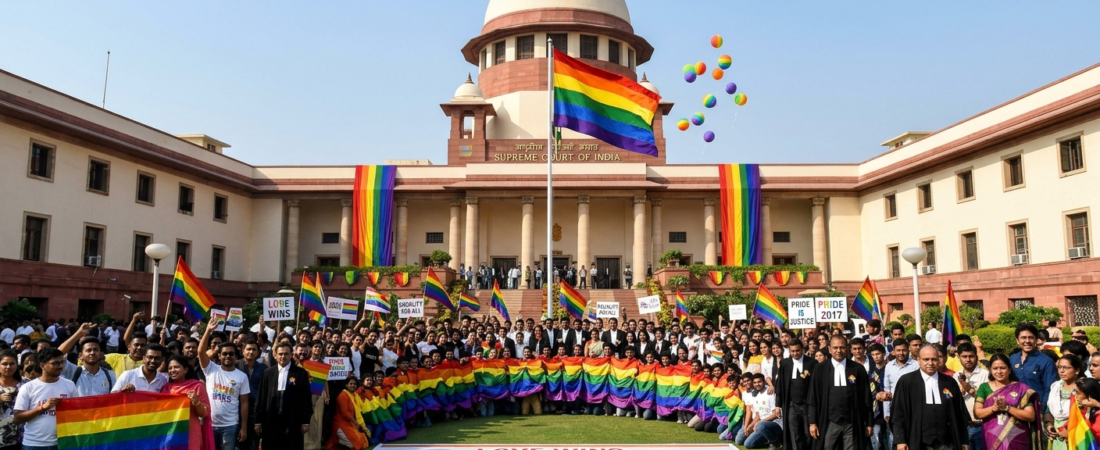
The Monumental Struggle for Equality: Navtej Singh Johar Unmasked
In 2018, a historic verdict redefined individual liberty and civil rights across the nation. The Supreme Court of India unanimously delivered a monumental judgment in Navtej Singh Johar & Ors. v. Union of India, striking down the criminalization of consensual same-sex adult relationships.
In our analysis of Indian jurisprudence, few rulings have carried such deep emotional and legal weight. This decision fundamentally restored basic human dignity, autonomy, and equality to millions of LGBTQ+ citizens who had long lived under the shadow of a colonial-era law.
Written by Kapil Balhara | Technically Reviewed for Accuracy | Last Updated: October 2026
What is Navtej Singh Johar v. Union of India Case?
Navtej Singh Johar v. Union of India is a landmark 2018 Supreme Court of India ruling where a five-judge Constitution Bench unanimously struck down Section 377 IPC to the extent that it criminalized consensual sexual acts between adults in private.
Navtej Singh Johar v Union of India Supreme Court Section 377 IPC Decriminalization
Furthermore, this ruling overruled the controversial 2013 decision in Suresh Kumar Koushal v. Naz Foundation, which had re-criminalized consensual same-sex conduct. Consequently, the verdict established sexual orientation as an inherent facet of human dignity and personal identity protected by the Constitution.
Historical Context of Section 377 IPC
To fully understand the significance of this ruling, one must examine the long legal fight surrounding Section 377 of the Indian Penal Code, 1860. Introduced during British colonial rule, the statute penalized “carnal intercourse against the order of nature”.
Naz Foundation v. Govt. of NCT of Delhi (2009): The Delhi High Court took a historic step by reading down Section 377 IPC, declaring that consensual sex between adults in private was protected under Article 21.
Suresh Kumar Koushal v. Naz Foundation (2013): On appeal, the Supreme Court overturned the Delhi High Court’s ruling, reinstating the penal provision by arguing that the LGBTQ+ community represented a “minuscule fraction” of the population.
NALSA and Puttaswamy Judgments (2014 & 2017): Subsequent judgments firmly recognized transgender rights and established the Right to Privacy as a fundamental right, paving the way to revisit Section 377.
However, in our review of these judicial developments, the petition filed by dancer Navtej Singh Johar, journalist Sunil Mehra, chef Ritu Dalmia, and others brought human stories directly to the court, demonstrating the continuous fear caused by the criminal provision.
Key Takeaway: The petition demonstrated that rights guaranteed under Part III of the Constitution cannot depend on majoritarian perceptions or the size of a minority group.
Key Legal Principles Established in the Verdict
The five-judge Constitution Bench—comprising Chief Justice Dipak Misra, Justice A.M. Khanwilkar, Justice R.F. Nariman, Justice D.Y. Chandrachud, and Justice Indu Malhotra—delivered four concurring judgments. The decision firmly embedded several key constitutional concepts into Indian law.
Core Legal Concepts from the Judgment
Concept
Explanation
Impact on Jurisprudence
Constitutional Morality
State actions must be guided by constitutional principles, not popular majoritarian morality.
Protects minority rights against social prejudice.
Transformative Constitutionalism
The Constitution is an organic document meant to evolve and eliminate systemic inequalities.
Promotes social progress and egalitarian values.
Doctrine of Non-Retrogression
Rights once recognized cannot be taken back or reversed by the state.
Ensures progressive realization of fundamental rights.
Additionally, the Court held that sexual orientation is biological, natural, and inherent to an individual’s identity. Thus, forcing individuals to conceal their identity inflicts psychological harm and violates basic civil rights.
Constitutional Morality vs Social Morality in Navtej Singh Johar case
Constitutional Analysis: Articles 14, 15, 19, and 21
The Court evaluated Section 377 IPC across multiple fundamental rights guaranteed under Part III of the Constitution.
[Article 14: Equality & Non-Arbitrariness] ──> [Article 15: Non-Discrimination on Sex] ──> [Article 19: Freedom of Expression] ──> [Article 21: Right to Life, Dignity & Privacy]
Article 14 (Equality Before Law): The Court declared Section 377 manifestly arbitrary because it failed to distinguish between consensual and non-consensual sexual acts among adults.
Article 15 (Prohibition of Discrimination): The Bench interpreted the term “sex” in Article 15 to include “sexual orientation,” prohibiting state discrimination on this ground.
Article 19(1)(a) (Freedom of Expression): Freedom of expression includes the right to express one’s identity and romantic preferences without state interference.
Article 21 (Right to Life & Liberty): Personal autonomy, bodily integrity, privacy, and the right to choose a life partner lie at the absolute core of Article 21.
Moreover, this rigorous testing demonstrated that criminalizing private, consensual activity among adults fails to meet any reasonable restriction standard.
Key Takeaway: State intrusion into private, consensual adult relationships violates the basic guarantee of personal liberty and human dignity.
Impact on LGBTQ+ Rights and Future Jurisprudence
The ruling in Navtej Singh Johar v. Union of India served as a turning point for civil liberties across the country.
In our analysis of post-2018 legal frameworks, the impact of this judgment continues to reverberate:
Partial Retention of Section 377: Section 377 IPC remains active strictly for non-consensual sexual acts, sexual offenses against minors, and bestiality.
Mental Healthcare Framework: The judgment aligned with statutory protections like the Mental Healthcare Act 2017, affirming that sexual orientation is not a mental disorder.
Foundation for Broader Civil Rights: By establishing equal citizenship, the ruling laid the legal foundation for discussions around non-discrimination policies in employment, housing, and relationship recognition.
Impact of Section 377 IPC Decriminalization on LGBTQ+ Rights in India
Ultimately, the verdict affirmed that constitutional protections belong to every citizen regardless of sexual orientation.
The Supreme Court unanimously struck down Section 377 IPC to the extent that it criminalized consensual sexual acts between adults in private.
FAQ 2: Is Section 377 IPC completely removed from Indian law?
No, Section 377 IPC remains in force for non-consensual sexual acts, offenses against minors (alongside POCSO), and bestiality.
FAQ 3: Which fundamental rights were declared violated by Section 377 IPC?
The Court held that Section 377 violated Articles 14 (Equality), 15 (Non-discrimination), 19 (Freedom of Expression), and 21 (Right to Life, Personal Liberty, Privacy, and Dignity).
Take Control of Your Legal Rights Today
Understanding constitutional guarantees and civil liberties is vital for advocating justice. Explore our comprehensive legal research guides and stay informed on evolving rights in India.