Table of Contents
- Understanding Joseph Shine v. Union of India
- The Legal Framework: Section 497 IPC and Section 198(2) CrPC
- Constitutional Arguments Against Section 497
- Key Opinions from the Five-Judge Constitution Bench
- Comparative Analysis: Pre-2018 Precedents vs. 2018 Judgment
- Frequently Asked Questions
Understanding Joseph Shine v. Union of India
In our legal analysis, the landmark verdict of Joseph Shine v. Union of India (2018) stands as a monumental shift towards constitutional morality. The Supreme Court of India unanimously struck down Section 497 of the Indian Penal Code (IPC) alongside Section 198(2) of the Code of Criminal Procedure (CrPC). Consequently, this decision effectively decriminalized adultery across the nation.
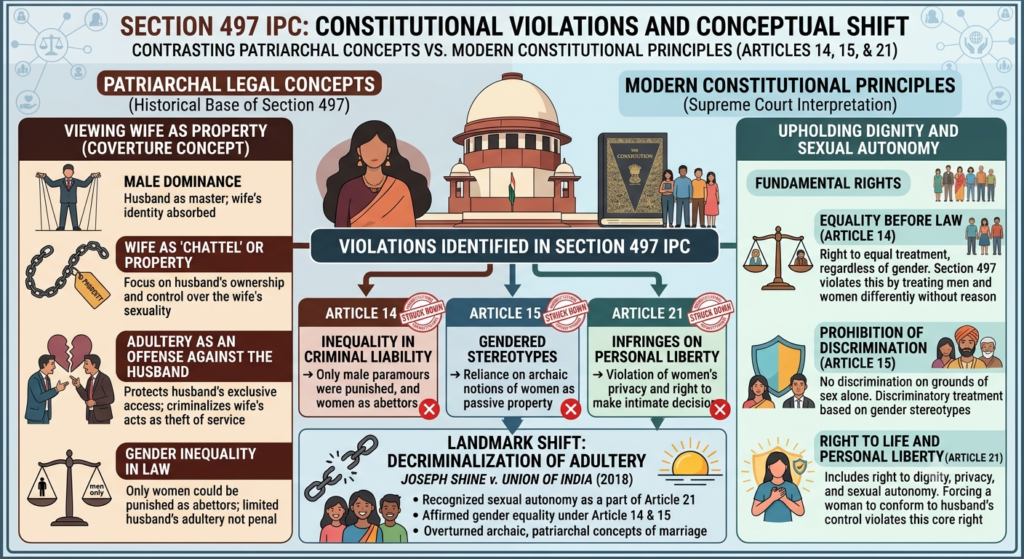
Joseph Shine v. Union of India is a landmark 2018 Supreme Court judgment that struck down Section 497 of the IPC and Section 198(2) of the CrPC as unconstitutional. The ruling decriminalized adultery, establishing that treating women as chattel or property of their husbands violates fundamental rights to equality, autonomy, and dignity.
Written by Kapil Balhara | Technically Reviewed for Accuracy | Last Updated: October 2026
The Legal Framework: Section 497 IPC and Section 198(2) CrPC
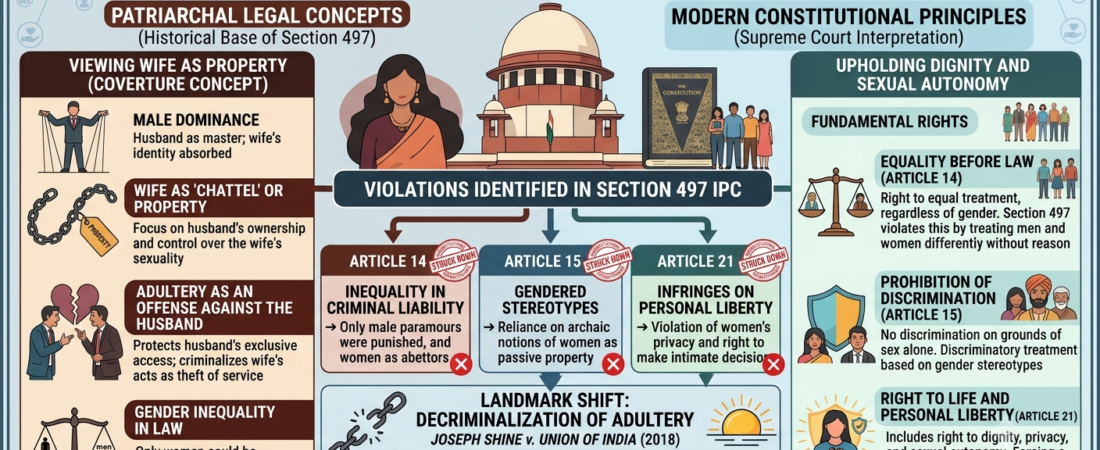
To fully comprehend the verdict, we must first examine the archaic statutes that governed marital infidelity for over a century. Section 497 of the IPC penalised any man who had sexual intercourse with a married woman without her husband’s consent or connivance.
Simultaneously, Section 198(2) of the CrPC dictated procedural compliance. Under this rule, only the adulterous woman’s husband was recognised as an “aggrieved person” capable of filing a formal complaint.
- Key Elements of the Decriminalized Law:
- Exemption of the Wife: The married woman involved was completely immune from punishment as an abettor.
- Spousal Consent Exemption: If the husband consented or connived, no crime was committed.
- Asymmetric Right to Sue: A married woman could not prosecute her unfaithful husband or his partner.
- Unmarried Women Excluded: A married man having relations with an unmarried woman was outside the scope of Section 497.
Furthermore, these combined provisions reduced a wife to a mere passive object. Additionally, the legal architecture rested on the outdated Victorian concept of coverture.
Constitutional Arguments Against Section 497
Article 14: Violation of Equality and Manifest Arbitrariness
Our evaluation shows that Section 497 suffered from manifest arbitrariness. As highlighted in Shayara Bano, any law that acts capriciously or lacks an adequately determining principle violates Article 14.
Key Takeaway: Section 497 created irrational classifications by penalising only third-party males while denying women equal standing as aggrieved parties or autonomous individuals.
Article 15: Gender Discrimination and Entrenched Stereotypes
Although Article 15(3) allows special provisions for women, the Supreme Court ruled that protective discrimination cannot justify paternalistic oppression. Section 497 was grounded in deeply entrenched gender stereotypes.
Moreover, the statute presumed that men are always the active seducers, whereas women are passive victims lacking sexual agency. Consequently, this paternalism reinforced patriarchy rather than empowering women.
Article 21: Encroachment on Dignity, Privacy, and Sexual Autonomy
Drawing strength from K.S. Puttaswamy, the Bench affirmed that individual dignity and privacy are inviolable fundamental rights. Marriage does not submerge a woman’s individual identity into her husband’s.
- Bodily Autonomy: Every adult holds sovereignty over their physical self.
- Personal Choice: Sexual privacy includes the freedom to make intimate personal decisions.
- Individual Dignity: Treating a spouse as chattel or property violates the core promise of Article 21.
Key Opinions from the Five-Judge Constitution Bench
The unanimous judgment contained distinct, powerful concurring opinions from the five-judge bench:
- Chief Justice Dipak Misra (and Justice A.M. Khanwilkar): Stated that a husband is not the master of the wife. They held that treating adultery as a crime intrudes directly into the extreme privacy of the matrimonial sphere.
- Justice R.F. Nariman: Highlighted that Section 497 was a relic of the Victorian era based on the doctrine of coverture. He observed that the law punished the invasion of a husband’s proprietary interest rather than adultery per se.
- Justice Dr. D.Y. Chandrachud: Noted that the provision was a “codified rule of patriarchy”. He emphasized that marriage does not result in the ceding of individual sexual autonomy.
- Justice Indu Malhotra: Recognized that while adultery remains a moral wrong and a valid civil ground for divorce, civil remedies are sufficient and state imposition of criminal sanctions is unconstitutional.
Comparative Analysis: Pre-2018 Precedents vs. 2018 Judgment
Our analysis reveals a dramatic shift in India’s constitutional jurisprudence over the decades:
| Legal Parameter | Earlier Rulings (Yusuf Abdul Aziz, Sowmithri Vishnu, V. Revathi) | Joseph Shine v. Union of India (2018) |
|---|---|---|
| Status of Women | View of women as passive victims needing legal protection. | Autonomous individuals possessing full sexual agency and dignity. |
| Article 15(3) Usage | Used to save Section 497 as a beneficial affirmative action. | Rejected; protective discrimination cannot justify paternalistic oppression. |
| Marital Sanctity | Criminal law necessary to preserve matrimonial stability. | Criminalizing adultery invades privacy and does not save broken marriages. |
| Legal Outcome | Section 497 IPC held constitutionally valid. | Section 497 IPC and Section 198(2) CrPC struck down as unconstitutional. |
Key Takeaway: Transformative constitutionalism replaced archaic Victorian morals with a modern framework centered on individual liberty, gender equality, and dignity.
Frequently Asked Questions
Q1. Is adultery still a crime in India after the Joseph Shine judgment?
No, adultery is no longer a criminal offense in India. The Supreme Court struck down Section 497 of the IPC, meaning no person can be jailed or fined by the state for committing adultery.
Q2. Can adultery still be used as a ground for divorce?
Yes, while adultery is decriminalized, it remains a valid civil ground for divorce and judicial separation under various personal laws in India, such as the Hindu Marriage Act.
Q3. Why was Section 198(2) of the CrPC also struck down?
Section 198(2) of the CrPC provided the procedure for prosecuting adultery, allowing only the husband to file a complaint. Once the substantive offense in Section 497 IPC was declared unconstitutional, the procedural section naturally became unconstitutional to that extent.
Q4. What were the key Supreme Court cases overruled by Joseph Shine v. Union of India?
The judgment explicitly overruled three major prior decisions: Sowmithri Vishnu v. Union of India (1985), V. Revathi v. Union of India (1988), and Yusuf Abdul Aziz v. State of Bombay (1954) to the extent that they upheld the validity of Section 497.
Conclusion
Ultimately, the judgment in Joseph Shine v. Union of India represents a crucial victory for gender equality, individual autonomy, and constitutional morality in India. By dismantling an archaic Victorian law, the Supreme Court affirmed that marriage is a partnership of equals and that the state cannot intrude into private consensual relationships. For tailored legal consultation or deeper research on family law reforms, consult qualified legal professionals or explore updated statutory databases today.