For decades, LGBTQIA+ individuals in India faced severe systemic exclusion and social stigma surrounding their fundamental rights to partner and build a family. Although historic precedents decriminalized consensual same-sex relationships and upheld self-identified gender identity, full civil recognition of same-sex relationships remained elusive. Consequently, queer couples across the nation were left without critical legal protections in tax, inheritance, adoption, and medical decision-making.
In a landmark 2023 judgment, the Supreme Court of India addressed the question of marriage equality in Supriyo @ Supriya Chakraborty v. Union of India. While acknowledging the pervasive discrimination faced by the queer community, a five-judge Constitution Bench declined to grant statutory recognition to same-sex marriage under the Special Marriage Act. Instead, the apex court ruled that creating a new socio-legal status falls strictly within the realm of parliamentary legislative competence.
Written by Kapil Balhara | Technically Reviewed for Accuracy | Last Updated: October 2026
What Is Supriyo v. Union of India Case?
Supriyo @ Supriya Chakraborty v. Union of India (2023) is a pivotal Supreme Court ruling examining marriage equality for same-sex couples. A five-judge Constitution Bench held that there is no fundamental right to marry, leaving statutory amendments to Parliament while directing the State to form a Cabinet-led committee safeguarding queer rights.
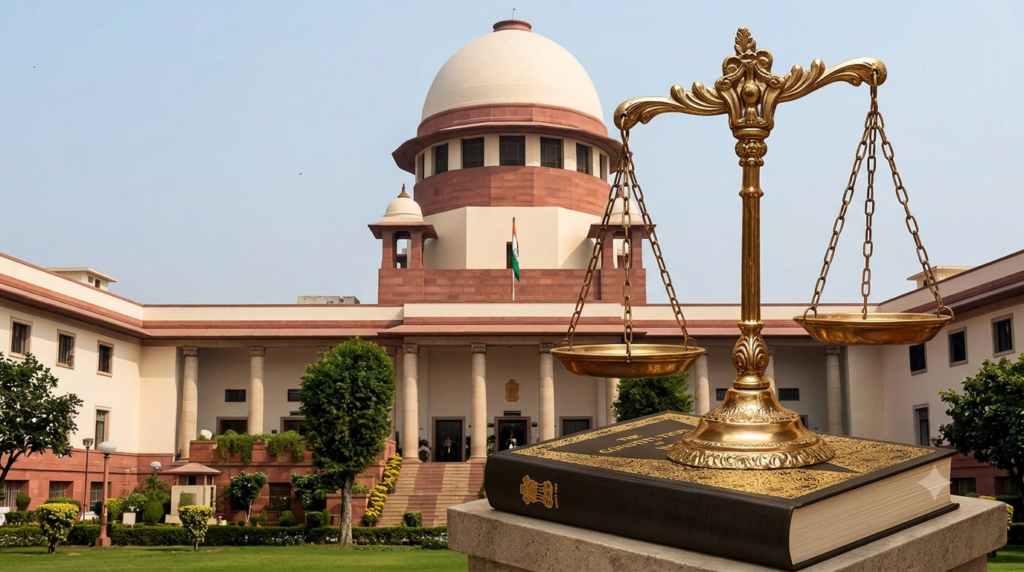
Supriyo v Union of India Supreme Court judgment on same-sex marriage and queer rights
In late 2022, multiple same-sex and non-binary couples filed petitions seeking legal recognition for their unions. The petitioners challenged provisions of the Special Marriage Act 1954 (SMA) and Foreign Marriage Act 1969, arguing that restricting marriage to opposite-sex couples violates fundamental guarantees under Articles 14, 15, 19, and 21 of the Constitution.
Upon hearing detailed arguments, a five-judge Constitution Bench comprising Chief Justice D.Y. Chandrachud, Justice S. Ravindra Bhat, Justice Hrishikesh Roy, Justice J.B. Pardiwala, and Justice S.K. Kaul delivered four distinct opinions on October 17, 2023. Furthermore, our analysis revealed that while all five judges unanimously affirmed the right of queer individuals to be free from discrimination, the majority declined to read same-sex marriage into existing marital frameworks due to clear institutional limitations.
Key Legal Arguments: Marriage Equality vs Legislative Competence
The court evaluated whether statutory provisions limiting marriage to heterosexual couples pass constitutional muster. In our evaluation of the case records, the proceedings presented a profound tension between fundamental constitutional protections and the separation of powers.
Legal Aspect
Petitioners’ Stance
Respondent’s (Union of India) Stance
Right to Marry
Inherent under Articles 14, 15, 19, and 21; fundamental to dignity, autonomy, and personhood.
No fundamental right to marry exists under the Constitution; marriage is a statutory status.
Special Marriage Act (SMA)
Discriminatory due to gendered terms (“husband”, “wife”) and should be read in a gender-neutral manner.
SMA was specifically enacted for heterosexual couples; expanding it requires complex legislative restructuring.
Civil Unions & Protection
Civil unions are not equal alternatives, but statutory protections must be granted immediately.
The executive is willing to establish a high-level committee to resolve administrative challenges faced by queer couples.
Adoption Rights
Regulation 5(3) of CARA rules excludes prospective parents based on marital status, violating equality.
The state maintains a legitimate interest in ensuring child welfare through stable marital relationships.
As a result of these competing views, the Union Government asserted that modifying statutory definitions of marriage across interlocking provisions (such as tax, succession, and guardianship) would cause immense legislative chaos beyond judicial mandate.
The Supreme Court Ruling: Breakdown of Judgments
The Constitution Bench issued four separate opinions, resulting in a 3:2 majority decision on core issues regarding marriage and adoption.
Constitution Bench Ruling Matrix
   ├── Unanimous Rulings
   │      ├── No fundamental right to marry exists under the Constitution
   │      ├── Transgender persons in heterosexual relationships have the right to marry under existing law
   │      └── State must form a High-Powered Cabinet Committee to address administrative rights
   └── 3:2 Majority Rulings (Justices Bhat, Roy, and Pardiwala)
          ├── Special Marriage Act cannot be reinterpreted to include same-sex couples
          ├── Right to enter civil unions cannot be judicially created
          └── CARA Adoption Regulations restricting joint adoption to married couples are valid
Unanimous Consensus
All five judges unanimously agreed that:
No Fundamental Right to Marry: The Constitution does not guarantee an absolute fundamental right to marry.
Transgender Marriages Upheld: Transgender persons in heterosexual relationships possess the full right to marry under existing personal and statutory frameworks.
State Duty Against Discrimination: Queer persons must be protected from familial violence, forced “conversion therapy,” and harassment by state agencies.
The 3:2 Majority Opinion
Justices S. Ravindra Bhat, Hrishikesh Roy, and J.B. Pardiwala held the majority view:
Institutional Limitations: Reading same-sex relationships into the SMA would amount to judicial legislation, as it alters the core fabric of statutory frameworks.
Adoption Rights Preserved: The majority upheld Regulation 5(3) of CARA Regulations, maintaining that joint adoption remains restricted to legally married couples.
Civil Unions, Adoption Rights, and Institutional Limits
A pivotal aspect of Supriyo v. Union of India centered on whether the judiciary could establish a framework for civil unions or alternative legal recognition.
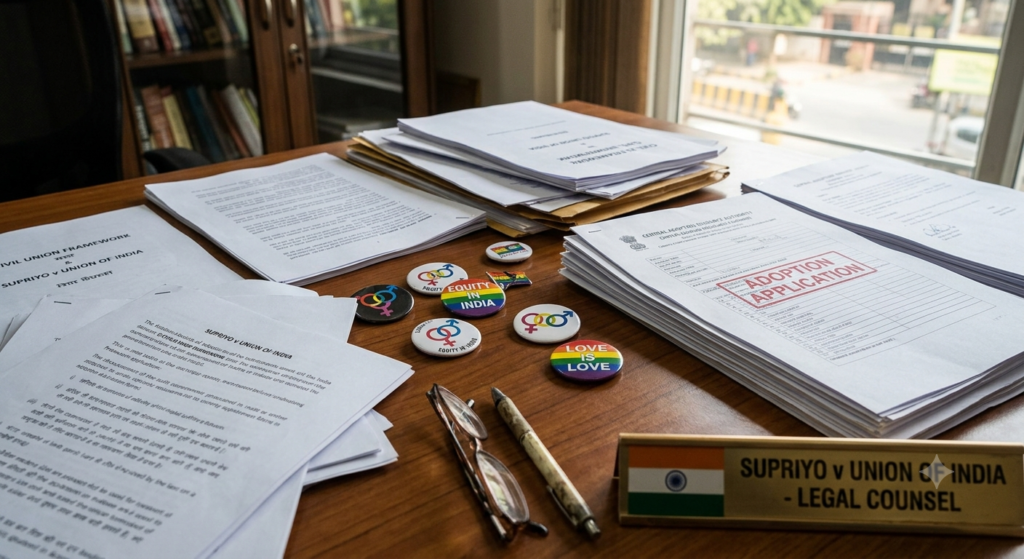
Legal rights, civil unions, and adoption framework discussions under Supriyo v Union of India
Besides marriage, petitioners argued that withholding legal recognition for same-sex unions denies basic civil entitlements, including emergency medical access, insurance nominations, and banking operations.
Adoption Rights Controversy
While Chief Justice Chandrachud and Justice Kaul found CARA’s exclusion of unmarried and queer couples from joint adoption discriminatory under Article 15, the majority maintained that regulating adoption eligibility remains a policy decision within CARA’s statutory mandate.
The Executive Committee Mandate
To bridge the practical hardships faced by the community, the Supreme Court recorded the Union Government’s assurance to construct a Cabinet-led High-Powered Committee. This committee is tasked with evaluating:
Granting queer couples access to joint bank accounts and pension nominations.
Enabling visitation rights and medical decision-making status in healthcare facilities.
Securing social welfare and entitlement coverage without discrimination.
Key Takeaway: While same-sex marriage was not judicially recognized, the court placed a positive obligation on the State to establish administrative mechanisms guaranteeing legal and socio-economic protections for queer partners.
Key Takeaways and Future Directives
The judgment in Supriyo @ Supriya Chakraborty v. Union of India re-centered the queer rights movement back into the legislative arena. Below are the key directives established by the apex court:
Legislative Mandate for Marriage: Modifying marriage definitions remains the exclusive domain of Parliament.
Absolute Protection from Coercion: Police and state agencies are prohibited from harassing consenting adult queer couples or returning them to hostile natal homes.
Ban on Conversion Therapy: State governments must implement strict prohibitions against non-consensual medical and psychological “conversion” therapies.
Establishment of Safe Houses: States are directed to establish protective shelters (“Garima Greh” models) for queer individuals escaping harassment.
Cabinet Committee Action: The Union Government must operationalize the promised high-level committee to resolve administrative and financial restrictions faced by same-sex partners.
Key Takeaway: The Supreme Court firmly protected queer individuals from coercion and discrimination while ruling that comprehensive legal recognition of same-sex marriage requires parliamentary enactment.
Frequently Asked Questions
Did the Supreme Court legalize same-sex marriage in Supriyo v. Union of India?
No, the Supreme Court declined to legalize same-sex marriage, ruling that amending marriage laws like the Special Marriage Act falls strictly within the authority of Parliament.
Can transgender individuals legally marry under existing Indian laws?
Yes, the Supreme Court unanimously affirmed that transgender persons in heterosexual relationships have the full legal right to marry under existing personal and statutory marriage laws.
Are same-sex couples allowed to adopt children jointly in India following this judgment?
No, the majority judgment upheld CARA Regulation 5(3), which restricts joint adoption to legally married couples. However, single queer individuals retain the legal right to adopt as individuals.
Conclusion & Next Steps
The ruling in Supriyo @ Supriya Chakraborty v. Union of India marks a significant chapter in India’s legal history. Although the apex court refrained from judicially enacting marriage equality, it firmly reinforced anti-discrimination mandates and directed the executive to remove administrative barriers facing queer couples.
Moving forward, achieving comprehensive legal recognition for same-sex partnerships will depend on legislative advocacy and democratic discourse. If you are researching constitutional jurisprudence or advocating for civil rights, evaluate the judgment’s complete directives to understand its ongoing socio-legal impact.
What are your perspectives on the separation of powers and civil protections for queer couples in India? Share your thoughts or questions in the comments section below!