
Table of Contents
- Understanding Satender Kumar Antil vs CBI Case
- Offense Categorization Matrix & Bail Conditions
- Section 41 & 41A CrPC Compliance Mandatory Rules
- Role of Section 170 and 167(2) in Preventing Unnecessary Arrests
- Frequently Asked Questions
The Indian criminal justice system has long suffered from over-congested prisons and routine pre-trial detentions. The landmark judgment Satender Kumar Antil vs CBI delivered by the Supreme Court of India addresses this issue directly. This ruling reinforces personal liberty under Article 21 of the Constitution and sets binding guidelines for procedural arrests.
Written by Kapil Balhara / Placitum Advocates | Technically Reviewed for Accuracy | Last Updated: August 2026
Understanding Satender Kumar Antil vs CBI Case
What is the core takeaway of Satender Kumar Antil vs CBI? This landmark Supreme Court judgment establishes comprehensive guidelines to reform India’s bail jurisprudence, curb unnecessary arrests, strictly enforce Section 41A CrPC notices, and ensure undertrial prisoners are not routinely remanded when cooperating with investigating authorities.
In our legal practice, we routinely observe trial courts issuing non-bailable warrants or demanding arrest as a precondition to taking charge-sheets on record. The Supreme Court specifically addressed this misconception by evaluating Section 170 CrPC. The apex court held that the word “custody” under Section 170 does not necessitate physical arrest before filing a charge-sheet.
Key Takeaway: Bail is the rule, and jail is the exception. Arrest is a draconian measure that must be used sparingly, not as a matter of routine administrative procedure.
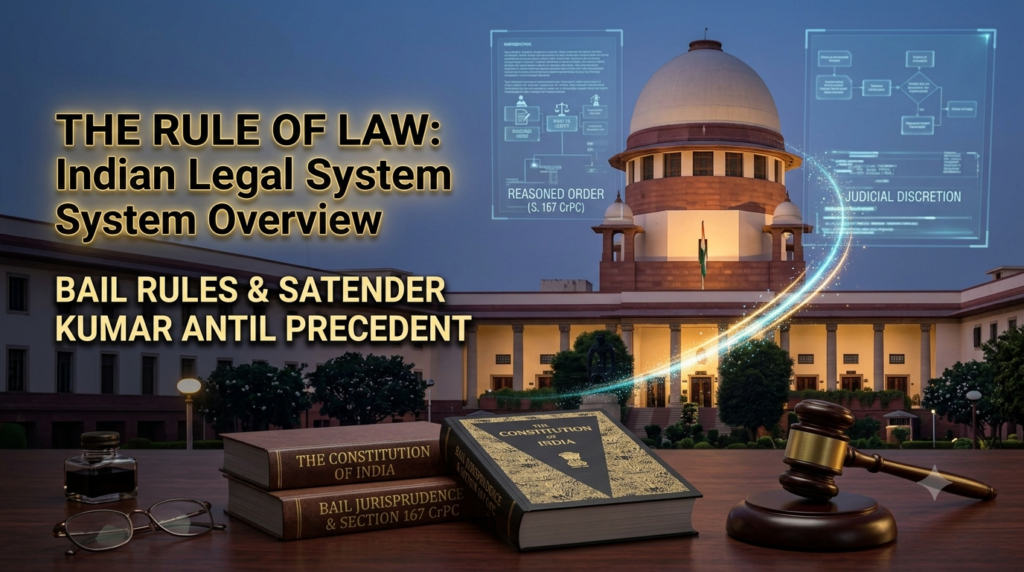
Furthermore, the Supreme Court highlighted international human rights standards and the fundamental principle of presumption of innocence. Over two-thirds of inmates in Indian prisons are undertrial prisoners, many of whom are incarcerated simply because they cannot afford bail sureties.
Offense Categorization Matrix & Bail Conditions
To streamline bail applications across trial courts and High Courts, the Supreme Court accepted a four-tier classification system for criminal offenses.
| Category | Description of Offenses | Core Bail Guidelines |
|---|---|---|
| Category A | Offenses punishable with imprisonment of 7 years or less. | Issue ordinary summons first. No physical custody required on appearance if cooperative. |
| Category B | Offenses punishable with death, life imprisonment, or > 7 years. | Bail applications decided on merits upon appearance pursuant to court process. |
| Category C | Offenses under Special Acts (NDPS, PMLA, UAPA, Companies Act). | Decided on merits subject to statutory twin conditions under special enactments. |
| Category D | Economic offenses not covered by Special Acts. | Decided on merits considering seriousness of charge and severity of punishment. |
Specifically, for Category A offenses where the accused was not arrested during investigation and fully cooperated, courts must issue summons or bailable warrants rather than non-bailable warrants.
If you require assistance with complex bail proceedings, schedule a consult through our legal service page.
Section 41 & 41A CrPC Compliance Mandatory Rules
The Supreme Court reiterated that compliance with Section 41 and 41A of the Code of Criminal Procedure is non-negotiable. Police officers cannot make arbitrary arrests for offenses carrying sentences of up to 7 years.
- Mandatory Reason to Believe: The investigating officer must formally document the specific reasons necessitating arrest under Section 41(1)(b)(ii).
- Service of Notice: A formal notice of appearance under Section 41A must be served within two weeks of case registration.
- Magisterial Scrutiny: Judicial Magistrates must review compliance before authorizing detention. Defaulting officers face departmental proceedings and contempt of court.
Key Takeaway: Non-compliance with Section 41 and 41A CrPC directly entitles the accused to grant of bail.
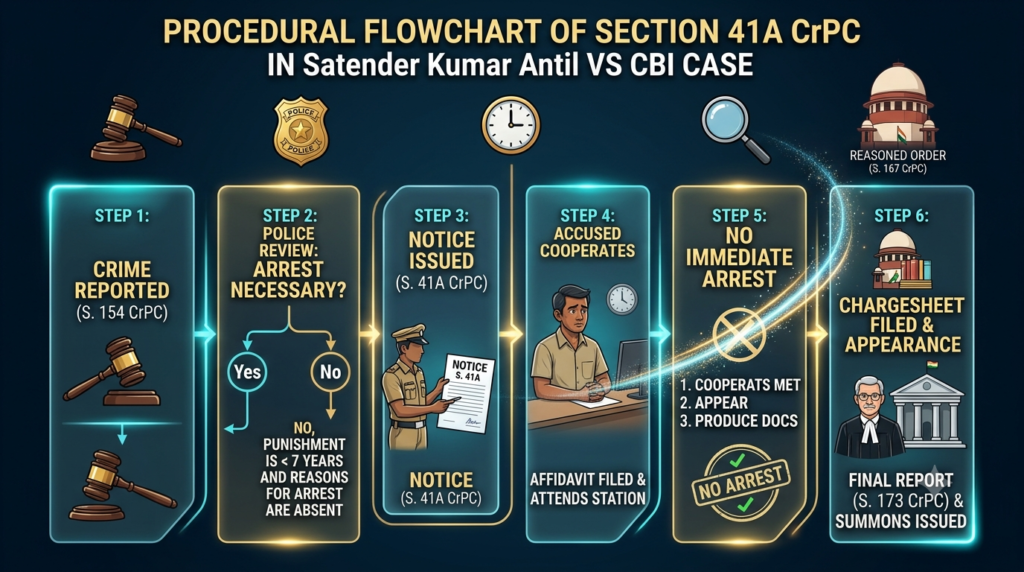
However, if an accused fails to comply with the notice terms or refuses to cooperate, the investigating agency retains the power to effect arrest upon recording valid reasons.
Role of Section 170 and 167(2) in Preventing Unnecessary Arrests
Another crucial dimension of this ruling is the interpretation of Section 170 CrPC alongside default bail under Section 167(2) CrPC.
- Section 170 CrPC Clarification: Investigating officers do not need to produce the accused in physical custody when submitting a final charge-sheet.
- Section 167(2) Indefeasible Right: Default bail is an absolute constitutional right flowing from Article 21 if the investigation is not completed within 60 or 90 days.
- Section 88 Bond Acceptance: Courts should accept personal bonds for appearance rather than forcing custodial remands.
For instance, when an individual has participated throughout the investigation without being arrested, filing a charge-sheet does not automatically warrant incarceration. The trial court should utilize Section 88 CrPC to secure attendance.
Link to Download Satender Kumar Antil vs CBI Judgement
As a result, trial courts are instructed to decide bail applications within one week in ordinary circumstances. High Courts are requested to decide bail matters within one month.
Frequently Asked Questions
Does Satender Kumar Antil vs CBI apply to economic offenses?
Yes, economic offenses not covered by special statutes fall under Category D. Bail is decided on merits by evaluating the gravity of the charge alongside the severity of potential punishment.
Is Section 45 of the PMLA included in Category C guidelines?
The Supreme Court clarified that Section 45 PMLA was inadvertently listed in Category C in the initial order, and the intent of the judgment is to expand bail accessibility rather than restrict it.
What happens if a police officer violates Section 41A CrPC guidelines?
Police officers who make arrests without complying with Section 41A CrPC or filing required checklists are liable for departmental action and contempt proceedings before the relevant High Court. Judicial Magistrates authorizing such illegal detentions also face High Court administrative action.