Written by Kapil Balhara | Technically Reviewed for Accuracy | Last Updated: August 2026
Introduction
Detaining an accused indefinitely strikes at the core of personal liberty. Consequently, criminal law mandates strict timelines for police investigations. When investigating agencies fail to complete their inquiry within prescribed deadlines, statutory rights protect the accused. The landmark Supreme Court decision in Bikramjit Singh vs State of Punjab re-established these foundational protections under Indian criminal jurisprudence.
This exhaustive legal analysis breaks down the intersection of Section 167 of the Code of Criminal Procedure (CrPC), the Unlawful Activities (Prevention) Act (UAPA), and the National Investigation Agency (NIA) Act. Moreover, our evaluation clarifies why default bail acts as a fundamental right rooted in constitutional liberty.
Table of Contents
- Understanding Bikramjit Singh vs State of Punjab
- Factual Matrix of the Case
- Statutory Conflict: CrPC, UAPA, and the NIA Act
- Judicial Breakdown: Jurisdictional Error vs Indefeasible Right
- Legal Principles & Precedents Table
- Key Takeaways for Legal Practitioners
- Frequently Asked Questions
Understanding Bikramjit Singh vs State of Punjab
Bikramjit Singh vs State of Punjab is a landmark 2020 Supreme Court ruling establishing that only a designated Special Court—not an Ilaqa Magistrate—holds jurisdiction to extend UAPA remand beyond 90 days up to 180 days. Failure to seek extension from the correct judicial authority grants the accused an indefeasible constitutional right to default bail under Section 167(2) CrPC.
Historically, investigating agencies often exploited procedural gaps to delay charge-sheets. Therefore, understanding this judgment helps legal associates and researchers enforce statutory bail mechanisms effectively.
Factual Matrix of the Case
The case stems from a grenade attack on November 18, 2018, at the Nirankari Bhawan in Rajasansi, Amritsar. The explosion tragically killed three people and injured twenty-two others. Consequently, the Punjab State Police registered an FIR invoking IPC provisions along with the Arms Act, Explosive Substances Act, and Section 13 of UAPA.
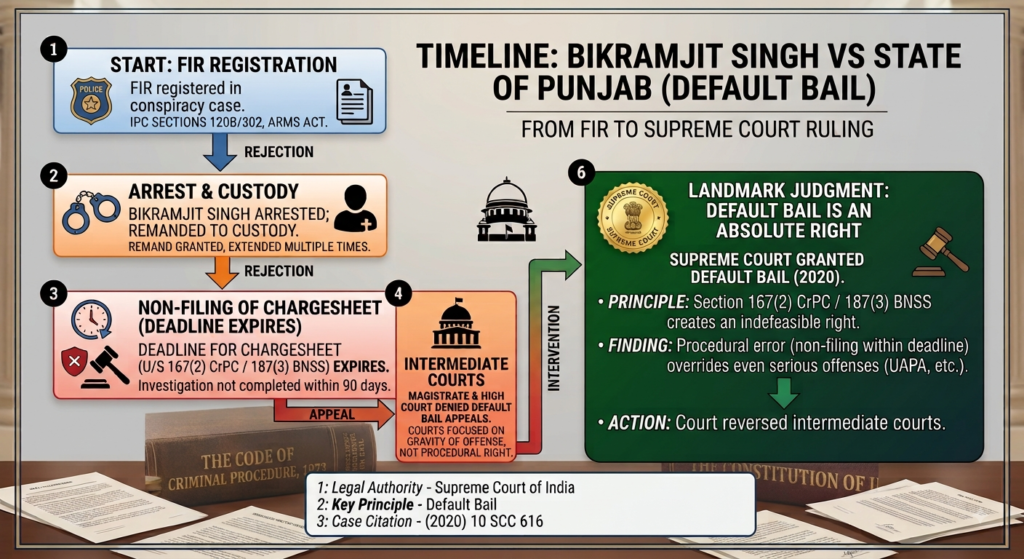
The police apprehended Bikramjit Singh on November 22, 2018. Subsequently, he was remanded to judicial custody. The statutory 90-day investigation deadline expired on February 21, 2019.
Prior to this expiry, on February 13, 2019, the Sub-Divisional Judicial Magistrate (Ilaqa Magistrate) extended the investigation window to 180 days. However, on February 25, 2019, the Magistrate rejected the accused’s default bail application based on that prior extension.
The accused challenged the extension order before the Special Court (Additional Sessions Judge). On March 25, 2019, the Special Court set aside the Magistrate’s extension order for lack of jurisdiction.
The very next day, March 26, 2019, the prosecution filed its charge-sheet. Despite the invalidation of the extension order, the Special Court and later the Punjab and Haryana High Court denied default bail. They erroneously ruled that filing the charge-sheet extinguished the right to statutory bail. The matter ultimately reached the Supreme Court of India.
Key Takeaway: An application for default bail filed upon the expiry of the statutory period creates an enforceable right that cannot be destroyed by subsequent charge-sheets.
Statutory Conflict: CrPC, UAPA, and the NIA Act
To comprehend the Supreme Court’s decision, we must examine three distinct statutory frameworks:
1. Section 167(2) CrPC
Under Section 167 of the Code of Criminal Procedure, an investigating officer must complete investigation within 60 or 90 days depending on the offence. If the police fail to submit a charge-sheet within this timeframe, the accused earns an absolute right to statutory bail.
2. Section 43-D(2) UAPA
UAPA modifies Section 167 CrPC. It permits extension of detention from 90 days up to 180 days. However, such extension requires a specific report by the Public Prosecutor indicating investigation progress and reasons for continued detention. Crucially, only “the Court” possesses authority to grant this extension.
3. Sections 13 and 22 of the NIA Act
Section 2(1)(d) of UAPA defines “Court” as a criminal court having jurisdiction, including Special Courts under the NIA Act. Under Section 22 of the NIA Act, State Governments designate Courts of Session as Special Courts to try scheduled offences.
In our analysis, the State Police argued that because local police conducted the investigation under Section 10 of the NIA Act, the Ilaqa Magistrate retained jurisdiction. However, the Supreme Court rejected this contention. The Court clarified that all scheduled offences under UAPA—regardless of whether investigated by national agencies or state police—are triable exclusively by Special Courts.
Judicial Breakdown: Jurisdictional Error vs Indefeasible Right
Justice R.F. Nariman, delivering the judgment, dissected two critical questions of law:
Question 1: Who has the jurisdiction to extend investigation time under UAPA?
The Supreme Court held that an Ilaqa Magistrate lacks authority to grant extensions under Section 43-D(2)(b) UAPA. That power rests exclusively with the Special Court constituted under the NIA Act, or in its absence, the Court of Session. Consequently, the Magistrate’s extension order dated February 13, 2019, was void ab initio.
Question 2: Does filing a charge-sheet defeat a pending default bail right?
The prosecution argued that because a charge-sheet was submitted on March 26, 2019, default bail could no longer be claimed. Rebutting this, the Supreme Court relied on foundational precedents like Uday Mohanlal Acharya v. State of Maharashtra and Sanjay Dutt v. State.
The Court declared that when an accused applies for default bail after the statutory period expires, the right “avails” immediately. Subsequent filing of a police report cannot defeat this accrued right. Furthermore, procedural delays by courts in deciding bail applications cannot prejudice the applicant.
Key Takeaway: Default bail under Section 167(2) CrPC is not merely a statutory provision; it is an intrinsic component of Article 21’s fundamental right to personal liberty.
Legal Principles & Precedents Table
The following comparison illustrates how the Supreme Court reconciled earlier precedents in Bikramjit Singh vs State of Punjab:
| Case Name | Core Ruling / Precedent Established | Relevance to Bikramjit Singh Case |
|---|---|---|
| Hitendra Vishnu Thakur (1994) | Default bail is an indefeasible right arising from prosecution failure. | Established initial framework for statutory bail under special laws. |
| Sanjay Dutt v. State (1994) | Right must be “availed of” prior to charge-sheet submission. | Clarified when default bail rights trigger legally. |
| Uday Mohanlal Acharya (2001) | Applying for bail equals “availing” the right; charge-sheets cannot defeat it. | Formed primary authority used to protect Bikramjit Singh’s liberty. |
| Rakesh Kumar Paul (2017) | Even oral applications suffice for default bail; technicalities must yield to liberty. | Reaffirmed broad, constitutional interpretation of Article 21. |
Key Takeaways for Legal Practitioners
When handling UAPA matters or complex criminal litigation, lawyers and legal associates should keep a structured checklist in mind:
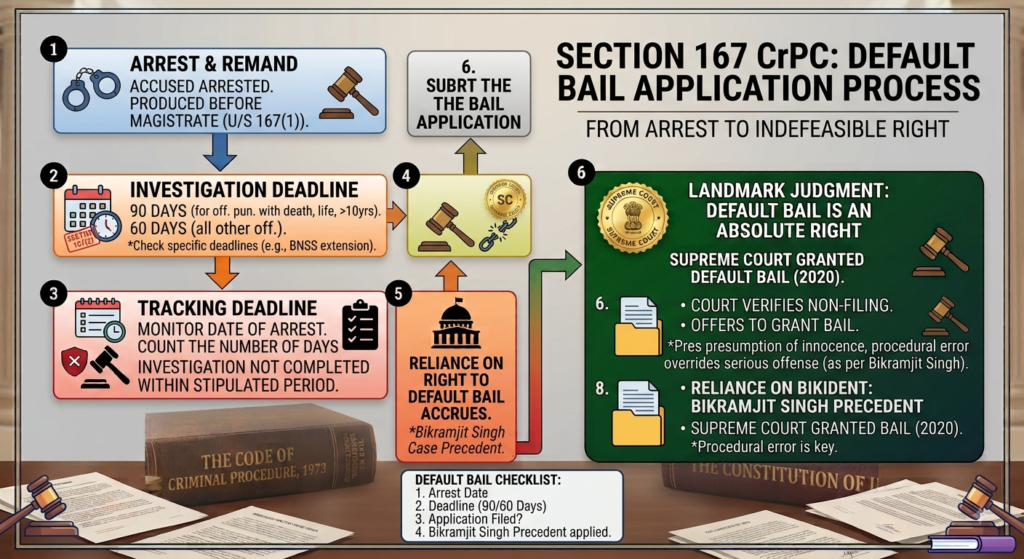
- Calculate Deadlines Accurately: Track the exact date of arrest and determine whether 60, 90, or 180 days apply.
- Verify Judicial Competence: Ensure any extension under Section 43-D(2) UAPA originates from a designated Special Court or Sessions Judge.
- File Promptly: Submit a default bail application immediately upon expiry of the statutory period.
- Record Willingness to Furnish Bail: Explicitly state in your application that the accused is ready and willing to furnish bail bonds.
Link to Download Bikramjit Singh vs State of Punjab Judgement
Frequently Asked Questions
Q1. What is the main outcome of Bikramjit Singh vs State of Punjab?
The Supreme Court ruled that only Special Courts under the NIA Act hold jurisdiction to extend UAPA investigation limits to 180 days. Additionally, it affirmed that filing a charge-sheet after a default bail application is submitted cannot extinguish the right to bail.
Q2. Can an Ilaqa Magistrate extend investigation time under UAPA?
No. The Supreme Court explicitly held that Ilaqa Magistrates lack jurisdiction to grant extensions under Section 43-D(2) UAPA. Only Special Courts or Courts of Session hold this power.
Q3. Is default bail a fundamental right in India?
Yes. The Supreme Court reiterated that statutory bail under Section 167(2) CrPC forms an integral part of the fundamental right to personal liberty under Article 21 of the Constitution of India.
Q4. What happens if the police file a charge-sheet while a default bail application is pending?
The right to default bail remains intact. As long as the accused filed for default bail before the charge-sheet was presented, subsequent filings by prosecution cannot defeat the accrued right.
Conclusion
The decision in Bikramjit Singh vs State of Punjab reinforces constitutional safeguards against arbitrary detention. By invalidating orders passed without jurisdiction, the Supreme Court upheld the rule of law and secured fundamental liberty.
If you require expert assistance with criminal appeals, UAPA litigation, or statutory bail applications, contact Placitum Advocates today for professional advice.