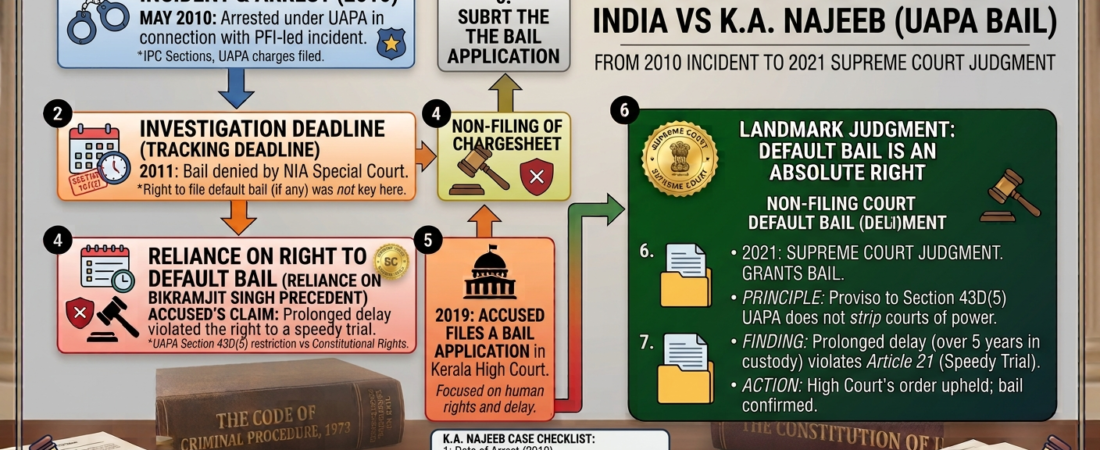
Written by Kapil Balhara | Technically Reviewed for Accuracy | Last Updated: August 2026
Introduction
Protracted incarceration without a trial threatens personal liberty. Consequently, statutory provisions barring bail under special legislation create serious constitutional friction. The Unlawful Activities (Prevention) Act (UAPA) imposes severe restrictions on securing bail. However, the landmark Supreme Court decision in Union of India vs K.A. Najeeb rebalanced the scale between statutory restrictions and constitutional guarantees.
This comprehensive legal analysis explores how the Supreme Court reconciled Section 43-D(5) of the UAPA with Article 21 of the Constitution. Additionally, our assessment outlines how trial delays allow Constitutional Courts to enlarge undertrials on bail despite stringent statutory bars.
Table of Contents
- Understanding Union of India vs K.A. Najeeb
- Factual Background of the Case
- Statutory Conflict: UAPA Section 43-D(5) vs Article 21
- Judicial Breakdown: Supreme Court Analysis
- Comparative Analysis of Special Bail Provisions
- Key Takeaways for Legal Practitioners
- Frequently Asked Questions
Understanding Union of India vs K.A. Najeeb
Union of India vs K.A. Najeeb is a landmark 2021 Supreme Court judgment holding that statutory restrictions on bail under Section 43-D(5) of the UAPA do not oust the jurisdiction of Constitutional Courts to grant bail when an undertrial’s fundamental right to a speedy trial under Article 21 is violated.
Historically, investigating agencies relied heavily on UAPA provisions to retain custody for extended periods. Therefore, understanding this ruling helps legal associates and researchers enforce constitutional remedies effectively.
Factual Background of the Case
The case arose from a violent incident on July 4, 2010, in Thodupuzha, Kerala. Members of the Popular Front of India (PFI) intercepted Professor T.J. Joseph as he returned home with his family. The attackers forcefully chopped off his right palm due to an alleged objectionable question set in a college examination paper. Furthermore, the perpetrators threw country-made bombs at bystanders to instill panic.
An FIR was registered under various provisions of the Indian Penal Code, Explosive Substances Act, and UAPA. The respondent, K.A. Najeeb, was named as a key co-conspirator who arranged vehicles, SIM cards, and post-attack shelter. However, Najeeb absconded, forcing the trial court to split his trial from the other co-accused. Most co-accused were tried and convicted in 2015, receiving sentences ranging between two to eight years.
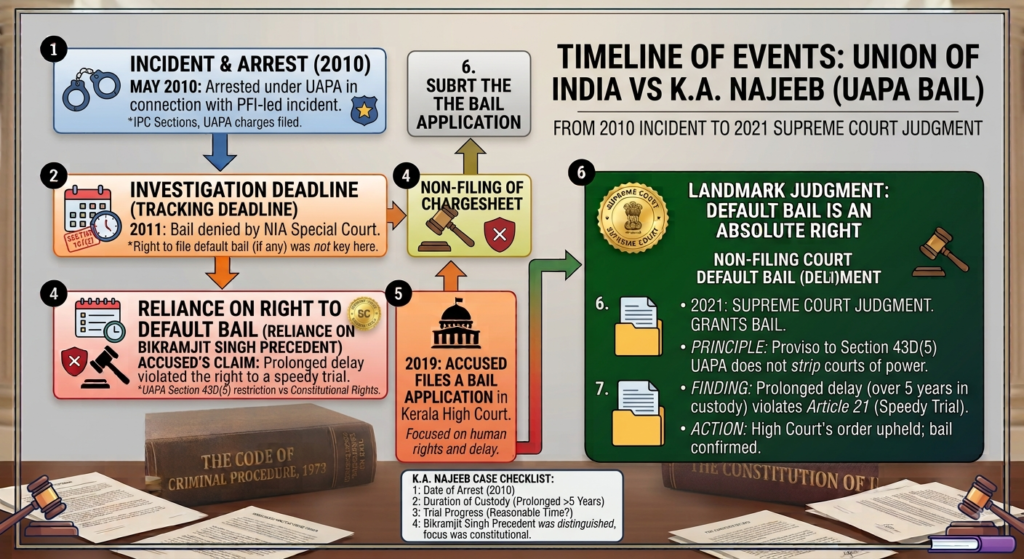
Najeeb was arrested on April 10, 2015. Between 2015 and 2019, he approached courts six times seeking bail, claiming parity with co-accused and pointing to his limited role. The courts repeatedly rejected his bail applications under Section 43-D(5) of UAPA, finding a prima facie case against him.
In May 2019, Najeeb approached the High Court of Kerala again. The High Court noted that Najeeb had spent four years in custody while the trial had not even commenced. Consequently, the High Court granted him bail. The Union of India through the National Investigation Agency (NIA) appealed this decision to the Supreme Court.
By the time the Supreme Court decided the appeal, Najeeb had completed over five years and five months in judicial custody. Meanwhile, the prosecution planned to examine 276 witnesses.
Key Takeaway: Extended pre-trial detention without prospective commencement of trial creates a valid ground for Constitutional Courts to grant bail under Article 21, even in special statutes.
Statutory Conflict: UAPA Section 43-D(5) vs Article 21
To understand the legal significance of the case, we must evaluate the statutory conflict:
Section 43-D(5) of UAPA
Under Section 43-D(5) of the UAPA, no person accused of an offence under Chapters IV and VI shall be released on bail if the court finds reasonable grounds for believing that the accusation is prima facie true. This creates an extraordinarily high threshold for securing bail during initial trial stages.
Article 21 of the Indian Constitution
Article 21 guarantees the fundamental right to life and personal liberty. Supreme Court jurisprudence has repeatedly affirmed that access to justice and a speedy trial are inherent components of Article 21.
In our analysis, the NIA contended that NIA v. Zahoor Ahmad Shah Watali mandated a strict bar against bail whenever a prima facie case exists. However, the Supreme Court distinguished Watali by noting that Watali dealt with the High Court conducting an improper mini-trial rather than addressing constitutional remedies for prolonged incarceration.
Judicial Breakdown: Supreme Court Analysis
Justice Surya Kant, writing for the Bench, clarified the interplay between statutory limits and constitutional powers:
1. Preeminence of Constitutional Rights
The Supreme Court held that statutory restrictions like Section 43-D(5) of UAPA do not oust the power of Constitutional Courts to enforce Part III rights. While trial courts must strictly follow statutory bans, High Courts and the Supreme Court can grant bail to cure Article 21 violations.
2. Assessment of Custody Duration vs Maximum Sentence
The Court highlighted that thirteen co-accused who completed their trial received maximum sentences of eight years. Najeeb had already spent over five and a half years in jail—more than two-thirds of the likely sentence. Therefore, forcing further custody while waiting for 276 witnesses to be examined was unjustifiable.
3. Distinction Between UAPA and NDPS Act
The Court pointed out that Section 43-D(5) of UAPA is less stringent than Section 37 of the NDPS Act. Unlike the NDPS Act, UAPA does not require the court to record satisfaction that the accused is “not guilty”. Instead, UAPA merely provides an additional statutory ground to deny bail alongside traditional factors like flight risk and witness tampering.
Key Takeaway: Statutory provisions barring bail melt down when an undertrial spends substantial time in jail without a timely trial prospects.
Comparative Analysis of Special Bail Provisions
The following comparison table demonstrates how statutory bail provisions interact with constitutional remedies across different special enactments:
| Legislation | Statutory Bail Provision | Key Conditions for Bail | Impact of Article 21 Override |
|---|---|---|---|
| UAPA, 1967 | Section 43-D(5) | Refused if accusation is prima facie true. | Bypassed when trial is indefinitely delayed and custody is prolonged. |
| NDPS Act, 1985 | Section 37 | Court must be satisfied accused is not guilty and unlikely to re-offend. | Subject to constitutional relaxation during gross pre-trial delays. |
| TADA, 1987 (Repealed) | Section 20(8) | Stringent dual conditions similar to NDPS. | Precedent established that prolonged delay justifies Article 21 relief. |
| PMLA, 2002 | Section 45 | Dual conditions requiring proof of non-guilt at bail stage. | High Courts regularly invoke Najeeb principles for extended detentions. |
Key Takeaways for Legal Practitioners
When preparing bail petitions under special criminal statutes, practitioners should follow a structured approach based on the Najeeb framework:
- Calculate Proportional Incarceration: Determine the ratio between time already served in custody and the maximum expected sentence.
- Document Trial Progression: Record the total number of proposed prosecution witnesses versus those examined to demonstrate trial delay.
- Plead Article 21 Explicitly: Invoke constitutional remedies alongside statutory bail grounds in High Court petitions.
- Offer Imposable Strict Conditions: Propose clear undertakings, such as weekly police station visits and surrender of passports, to mitigate flight or re-offence concerns.
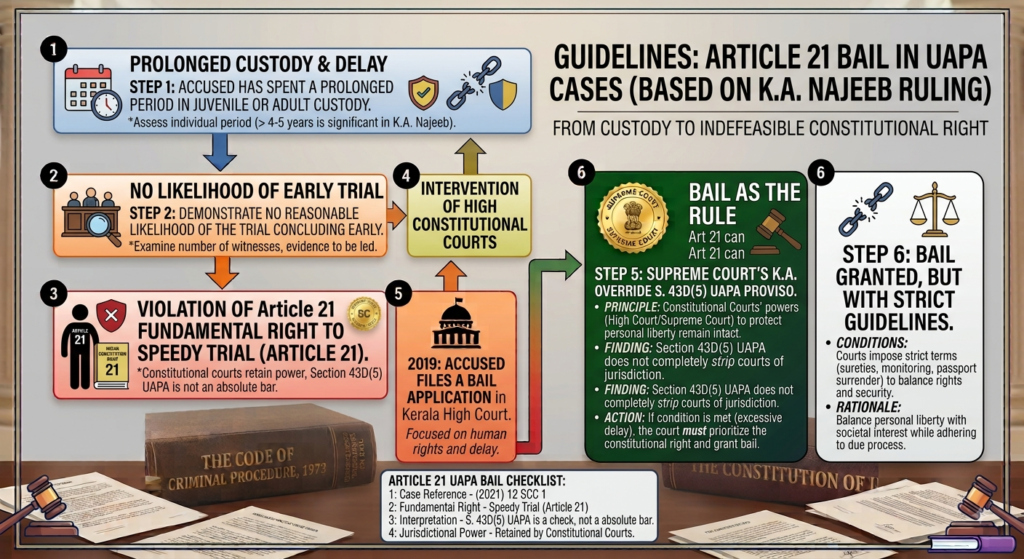
In accordance with the Supreme Court’s instructions, Najeeb was released on bail subject to strict conditions, including marking weekly attendance at the local police station and refraining from activities that inflame communal sentiments.
Link to Download Union of India vs K.A. Najeeb Judgement
Frequently Asked Questions
Q1. What is the main legal principle established in Union of India vs K.A. Najeeb?
The Supreme Court established that statutory restrictions against bail under Section 43-D(5) of UAPA do not prevent Constitutional Courts from granting bail when an undertrial’s right to a speedy trial under Article 21 is infringed.
Q2. Does the decision in K.A. Najeeb override the Watali judgment?
No, the Supreme Court distinguished Zahoor Ahmad Shah Watali. While Watali restricts courts from conducting mini-trials on evidence strength during initial bail, Najeeb applies when prolonged pre-trial incarceration violates Article 21 guarantees.
Q3. How does Section 43-D(5) of UAPA differ from Section 37 of the NDPS Act?
Section 43-D(5) of UAPA requires the court to deny bail if charges are prima facie true. In contrast, Section 37 of the NDPS Act requires affirmative satisfaction that the accused is not guilty and will not commit offences while on bail, making NDPS comparatively more stringent.
Q4. Can trial courts grant bail under the KA Najeeb precedent?
Generally, statutory trial courts remain bound by the explicit restrictions of Section 43-D(5) UAPA. The exercise of constitutional powers under Article 21 to override statutory bars is primarily exercised by High Courts and the Supreme Court.
Conclusion
The ruling in Union of India vs K.A. Najeeb serves as a vital safeguard against endless pre-trial custody under severe penal statutes. By establishing that statutory bars must yield to fundamental constitutional liberties, the Supreme Court ensured that prosecution delays cannot become an instrument of indefinite detention.
If you require strategic counsel on UAPA matters, bail applications, or criminal writs, contact Placitum Advocates to consult our legal team.