Written by Kapil Balhara | Technically Reviewed for Accuracy | Last Updated: August 2026
Introduction
Excessive monetary demands routinely price poor citizens out of their fundamental freedom. Consequently, pre-trial detention often transforms into an indirect form of punishment for the impoverished. When courts mandate local property owners as sureties, migratory workers and indigent defendants face systemic exclusion. The groundbreaking Supreme Court judgment in Moti Ram vs State of M.P reshaped Indian bail jurisprudence by dismantling these financial and territorial barriers.
This authoritative legal post examines how Justice V.R. Krishna Iyer redefined bail under the Code of Criminal Procedure (CrPC). Furthermore, our evaluation illustrates how Article 14 and Article 21 protect an Indigent Accused from arbitrary Surety Requirement practices, securing Equal Justice across India.
Table of Contents
- Understanding Moti Ram vs State of M.P Case
- Factual Matrix and Magisterial Intransigence
- Legal Interpretation: Does Bail Include Personal Bonds?
- Abolishing Territorial and Financial Discrimination
- Comparative Evaluation of Pre-Trial Release Options
- Key Takeaways for Legal Practitioners
- Frequently Asked Questions
Understanding Moti Ram vs State of M.P Case
Moti Ram vs State of M.P is a landmark 1978 Supreme Court decision establishing that the term “bail” encompasses release on an accused’s personal bond without monetary sureties. The ruling prohibited unreasonably high bail amounts and declared rejecting sureties based on geographical origin unconstitutional.
Historically, subordinate courts routinely insisted on wealthy local sureties, causing prolonged Pre-Trial Detention for poor individuals. Therefore, analyzing this ruling enables legal researchers and advocates to challenge excessive bail conditions effectively.
Factual Matrix and Magisterial Intransigence
The petitioner, Moti Ram, was a poor mason accused of an offence under Indian penal law. The Supreme Court initially granted him bail “to the satisfaction of the Chief Judicial Magistrate”. However, the presiding magistrate interpreted this directive rigidly by demanding a surety bond for Rs. 10,000.
Being an indigent laborer, Moti Ram could not arrange such a substantial financial sum. Furthermore, when he produced his own brother as a surety, the magistrate rejected the surety bond. The magistrate reasoned that the brother and his property were situated in a different district.
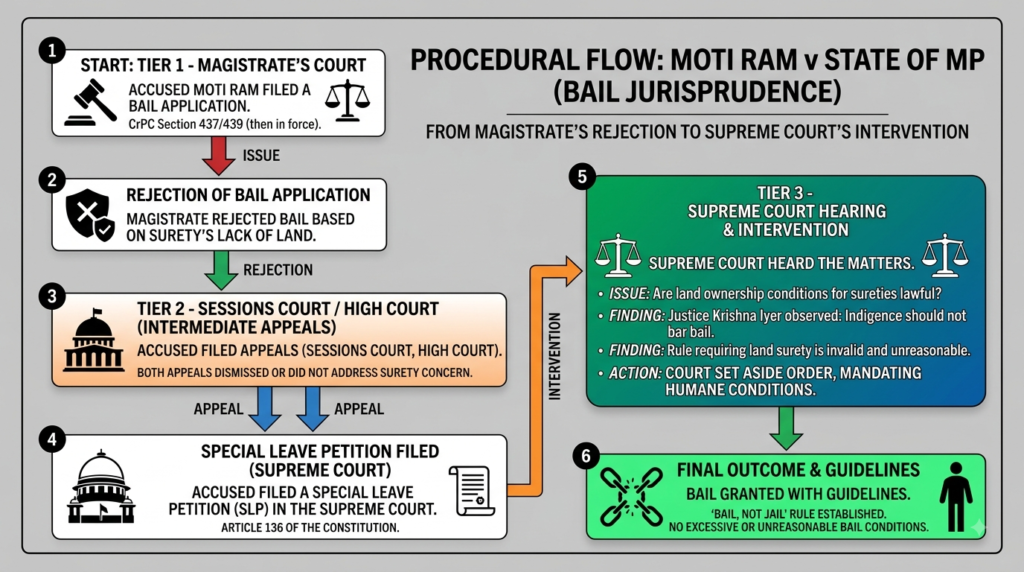
Frustrated by this judicial obstruction, the prisoner approached the Supreme Court again to modify the order. He prayed for release on a personal bond or a reduced surety amount of Rs. 2,000. In response, the Supreme Court evaluated the wider systemic impact of excessive Bail Bonds on disadvantaged socio-economic groups.
The Court recognized that treating a mason and a millionaire alike under uniform financial demands creates severe inequality. Consequently, Justice Krishna Iyer delivered a sweeping judgment on fundamental human rights.
Key Takeaway: Setting excessive bail or rejecting non-local sureties converts judicial release into a double denial of freedom for poor litigants.
Legal Interpretation: Does Bail Include Personal Bonds?
The Supreme Court examined Chapter XXXIII of the Code of Criminal Procedure, 1973, pointing out its ambiguous terminology. The Bench systematically analyzed whether courts possess statutory authority to release accused persons without monetary sureties:
1. Linguistic Analysis of CrPC Provisions
- Section 436: Mentions release on bail while its proviso explicitly permits release on an “own bond without sureties” for bailable offences.
- Section 437: Covers non-bailable cases and emphasizes an undertaking to appear rather than sole reliance on sureties.
- Section 441: Uses “bail” generically to encompass both the personal bond of the accused and surety undertakings.
- Section 389(1): Explicitly empowers appellate courts to release convicted persons on their “own bond”.
In our analysis, the Court resolved these semantic ambiguities through a constitutional lens. Applying Mahatma Gandhi’s talisman, the Bench held that the word “bail” genericly covers release on an individual’s personal bond without sureties.
Abolishing Territorial and Financial Discrimination
Justice Krishna Iyer criticized the magistrate’s insistence on local sureties, labeling it “geographic allergy”. The judgment highlighted that India maintains a unified legal structure rather than isolated judicial districts.
Constitutional Violations under Article 14
Demanding that sureties own assets within the specific court district creates severe discrimination against migrant workers, linguistic minorities, and travelers. In fact, Article 14 guarantees equality before the law to every citizen across the entire territory of India.
Furthermore, our evaluation revealed that relying strictly on monetary security creates an unjust system. Drawing insights from the Vera Foundation’s Manhattan Bail Project and the American Bail Reform Act of 1966, the Bench advocated for non-monetary release factors like family ties and community roots.
Key Takeaway: The best guarantee of appearance in court is the reach of the law, not a financial price tag.
Comparative Evaluation of Pre-Trial Release Options
The table below contrasts traditional bail practices with the reformative framework established in Moti Ram vs State of M.P:
| Parameter | Pre-Moti Ram Practice | Post-Moti Ram Standard |
|---|---|---|
| Primary Requirement | Mandatory heavy financial surety bonds. | Release on personal recognizance/bond. |
| Geographical Limits | Sureties restricted to the local court district. | Sureties accepted from anywhere in India. |
| Evaluation Standard | Monetary capacity of the surety. | Community roots, employment, and family ties. |
| Treatment of Indigents | Imprisonment due to financial incapacity. | Protection under Article 14 ensuring Fair Trial access. |
Key Takeaways for Legal Practitioners
When advocating for impoverished clients or challenging unreasonable bail terms, trial lawyers should execute these strategic steps:
- Invoke Personal Recognizance: File applications requesting release on a personal bond under Section 436/437 by citing Moti Ram.
- Challenge Excessive Sums: Object to high financial demands that price indigent clients out of their personal liberty.
- Submit Non-Local Sureties: Present out-of-district sureties alongside proof of identity and community roots.
- Detail Social Roots: Document the accused’s family structure, employment length, and residential stability to prove low flight risk.
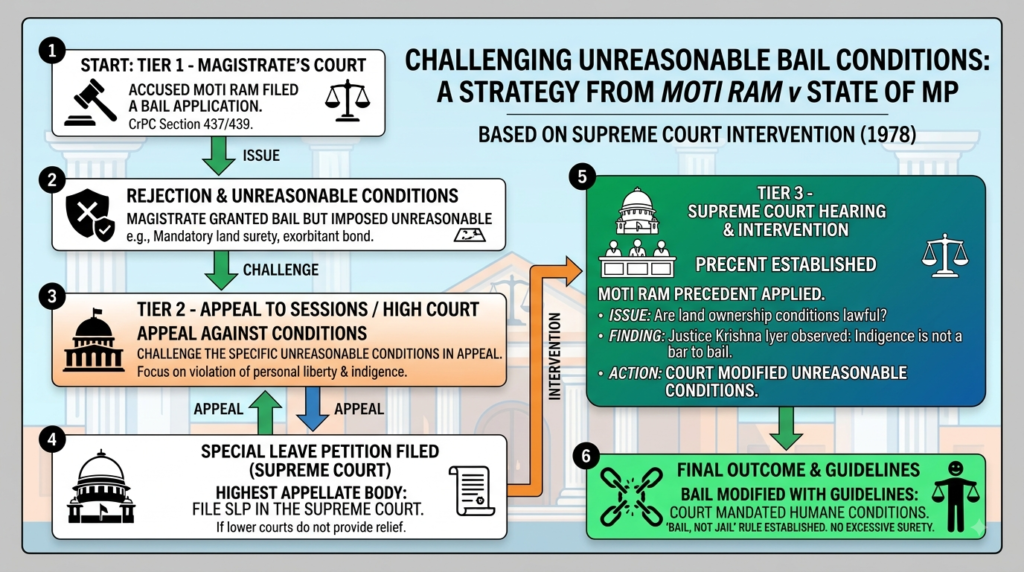
Ultimately, the Supreme Court allowed the petition and directed the magistrate to release Moti Ram on his personal bond in the sum of Rs. 1,000 without requiring any sureties.
Frequently Asked Questions
Q1. What is the main legal ratio of Moti Ram vs State of M.P?
The Supreme Court ruled that the legal term “bail” includes release on an accused person’s personal bond without sureties. It prohibited demanding excessive monetary bonds and banned rejecting sureties based on geographical location.
Q2. Can a magistrate reject a surety simply because their property is in another district?
No. The Supreme Court held that rejecting a surety due to territorial location violates Article 14, as Indian legal jurisdiction is unified across all states and districts.
Q3. How does Moti Ram protect an indigent accused person?
The judgment prevents courts from imposing heavy financial demands that poor individuals cannot meet. It directs magistrates to evaluate community ties rather than relying exclusively on monetary security.
Q4. Did Moti Ram influence subsequent bail legislation in India?
Yes. The judgment highlighted flaws in the CrPC, paving the way for amendments that introduced specific provisions for releasing indigent undertrials on personal bonds without sureties.
Conclusion
The ruling in Moti Ram vs State of M.P remains a vital safeguard against poverty-based incarceration. By establishing that financial demands must not impede personal liberty, the Supreme Court ensured that equal justice protects every citizen regardless of wealth.
If you require expert representation for bail applications, challenging onerous surety terms, or criminal litigation, contact Placitum Advocates to consult our legal team.