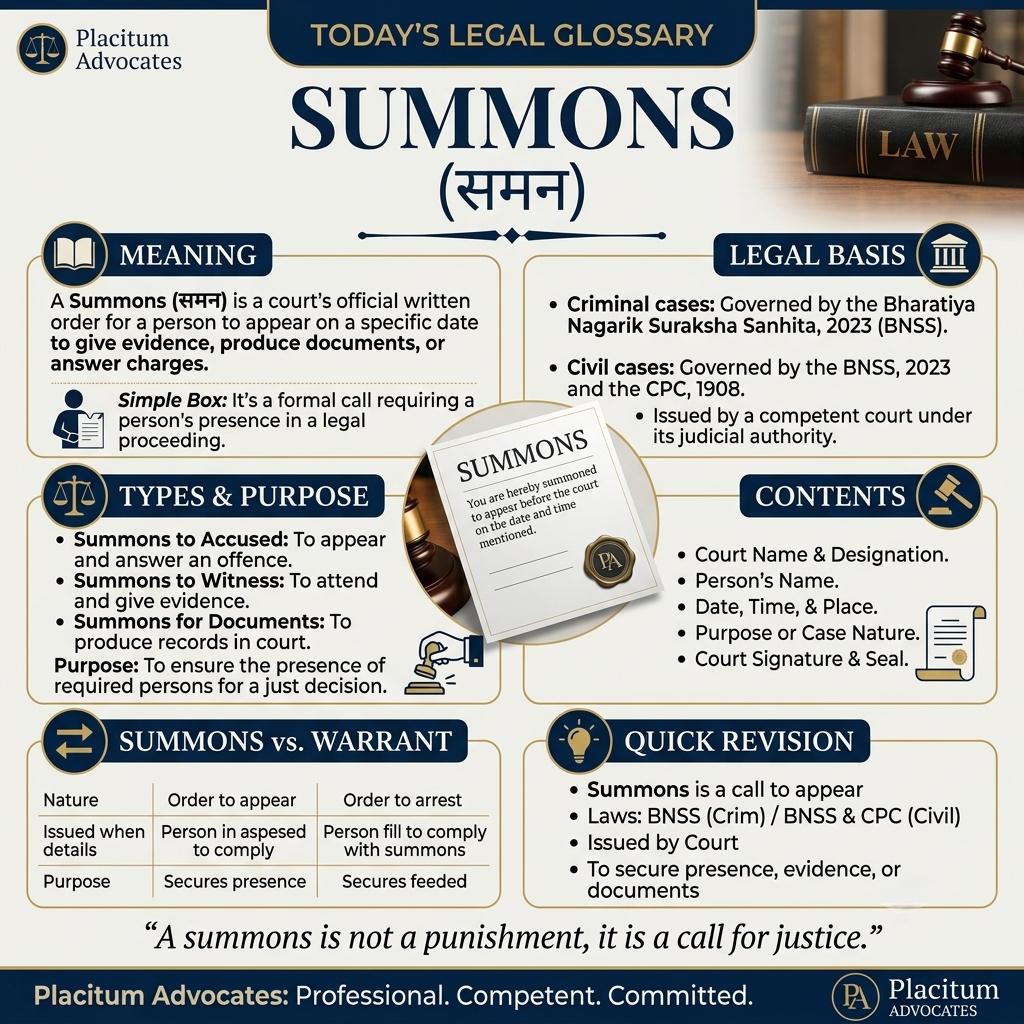
Received an official letter with “Summons” or “समन” (Saman) written on it? We know this can be stressful. This simple guide from Placitum Advocates will explain everything you need to know about a court summons, in easy, non-legal language.
Do not panic. A summons is a very common legal document. The goal is simple: to make sure the right people are in court so justice can be served.
What is a Court Summons? In Simple Words
Think of a court summons as an official “formal invitation” from a court. However, it’s not an invitation you should ignore.
In legal terms, a summons is a court’s written order. It directs a specific person to appear in court on a specific date and time. It is not an arrest. It is a demand for your presence.
What is Inside an Official Summons Letter?
An official summons will always clearly state what is expected of you. By reading it, you will know exactly:
- 🏛️ Which Court: The name of the specific court sending the letter.
- 👤 Your Name: It must have your correct name.
- 📅 When to Be There: The exact date and time you must appear.
- 📍 Where to Go: The precise location of the court.
- ⚖️ The Reason: Why the court needs you (the type of summons).
- ✅ Court Seal: It must have the court’s official signature and seal to be valid.
Why Did I Receive a Court Summons? The Main Reasons
There are three primary types of court summons. Understanding your specific type is the first step.
1. Summons to an Accused
You receive this if you have been accused of a crime or offence. It is an order to come to court to answer to those charges. Getting this does not mean you are guilty. It means you must explain your side.
2. Summons to a Witness
The court has identified you as a person who might have information about a case. This summons directs you to come to court to provide your evidence. It is a civil duty.
3. Summons for Documents
Sometimes the court only needs a specific paper, record, or digital file from you. This summons orders you to bring those documents to the court on the specified date.
Important: Summons vs. Warrant – A Big Difference
People often confuse these two, but they are very different legal tools. We cannot stress this difference enough.
| What it is | A Summons | A Warrant |
|---|---|---|
| Simple Meaning | An official order to appear. | An official order to arrest. |
| When it is issued | When the court expects you to comply. | When you have ignored a previous summons or other court orders. |
| The Result | You must show up in court yourself. | The police are ordered to bring you. This involves force. |
The bottom line is: A summons is your chance to cooperate. A warrant is the result of non-cooperation.
Key Legal Facts in Simple Language
Here are the crucial facts, but made extremely simple to understand:
- The Laws: Summons in both criminal and civil cases are now governed by a new law in India called the Bharatiya Nagarik Suraksha Sanhita, 2023 (BNSS). (Previously, the Code of Criminal Procedure was the law).
- A “Quick Revision” on Rules:
- Ignoring a summons is a bad idea. It can lead to the court issuing a Warrant for your arrest.
- Always read the details. Date, time, and location are the most important fields.
Final Thoughts from Placitum Advocates
At Placitum Advocates, we believe a summons is not a punishment. It is a call for justice, and your participation is crucial for a fair legal process.
If you have received a summons, the best action is to seek legal advice immediately. Do not hide it. We are here to help you navigate the system, understand your rights, and ensure you are prepared.