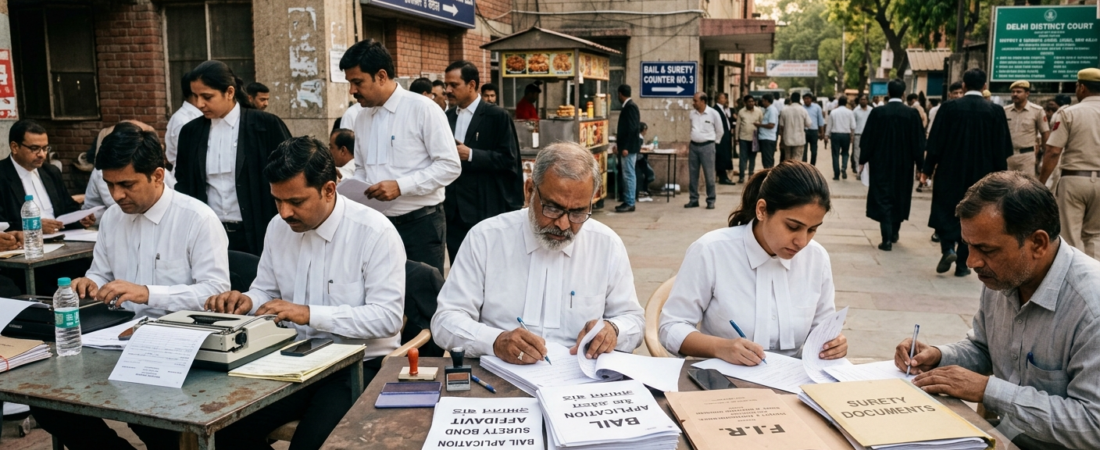
Written by Kapil Balhara | Technically Reviewed for Accuracy | Last Updated: August 2026
Securing a favorable bail order from the Delhi High Court is a massive legal victory, but it is only half the battle. An accused individual cannot walk out of Tihar, Mandoli, or Rohini Jail until the judicial directives regarding a bail bond and local sureties are formally satisfied and accepted by the trial court.
For families of an arrested individual, navigating the transition from a High Court bail order to the actual execution of a bond at the Magistrate or District Sessions level can feel overwhelming. This comprehensive guide breaks down the precise bail bond amount and surety process in the Delhi High Court, statutory provisions under the Bharatiya Nagarik Suraksha Sanhita, 2023 (BNSS) and the Code of Criminal Procedure, 1973 (CrPC), document requirements, online order downloads, and landmark Supreme Court rulings.
Table of Contents
- What Is a Bail Bond and How Does It Work in India?
- Statutory Provisions Governing Bail Bonds: BNSS Rules vs. CrPC
- Comparing Legal Remedies: Personal Bond, Surety Bond, and Cash Options
- Step-by-Step Procedure: From High Court Order to Jail Release
- Landmark Supreme Court Judgments Safeguarding Liberty
- Common Pitfalls That Delay Prison Release and Actionable Solutions
- Frequently Asked Questions
What Is a Bail Bond and How Does It Work in India?
A bail bond is a solemn legal undertaking executed by an accused person—typically supported by one or more guarantors—promising full compliance with court directives and mandatory attendance at every trial hearing.
A bail bond is a formal legal contract executed under Section 485 BNSS (formerly Section 441 CrPC) between the judiciary, an accused individual, and their surety. The designated monetary sum is not an immediate fee, but a financial penalty forfeited to the State if the accused absconds.
Consequently, when the Delhi High Court grants relief, physical release requires executing this bond before the trial court. In our criminal defense practice, we frequently observe families facing unexpected delays because they misunderstand how trial courts verify financial guarantors.
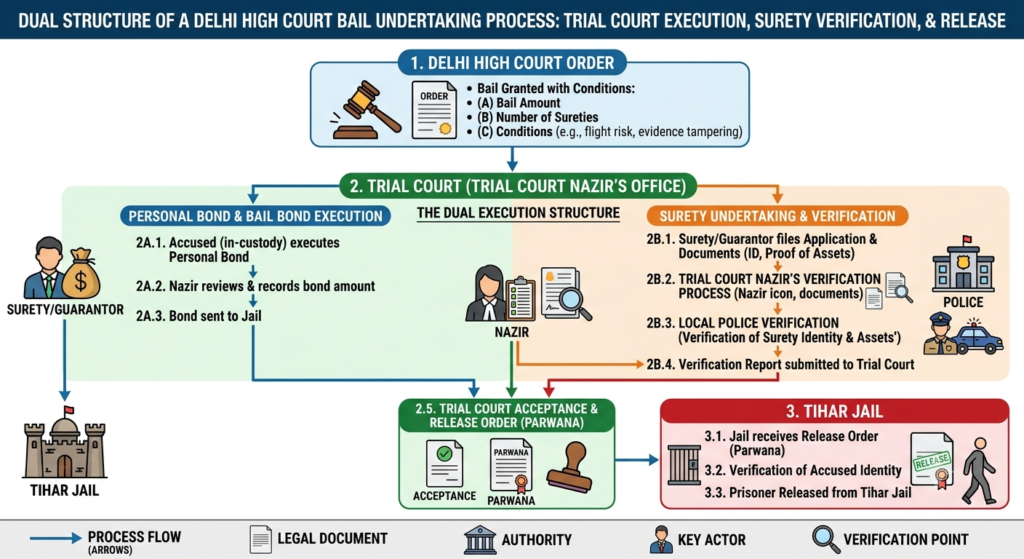
The Dual Structure of a Bail Undertaking
When the Delhi High Court grants bail, the official order typically contains specific conditions. For example, the judge may order that the applicant be released upon furnishing a personal bond in the sum of ₹50,000 with one local surety of the like amount to the satisfaction of the trial court. This directive creates two distinct legal obligations:
- Personal Bond (Executed by the Accused): The accused person submits a direct, written commitment promising to attend all trial court proceedings and strictly adhere to all bail conditions.
- Surety Bond (Executed by the Guarantor): A third party acts as a guarantor, pledging verifiable financial assets equal to the bond sum to guarantee the appearance of the accused.
Statutory Provisions Governing Bail Bonds: BNSS Rules vs. CrPC
Following recent criminal law updates in India, statutory bail rules have transitioned from the historic CrPC framework to the modern Bharatiya Nagarik Suraksha Sanhita, 2023 (BNSS). Therefore, current court filings must cite updated sections alongside legacy provisions where applicable.
Statutory Transition Mapping:
* Amount of Bond and Reduction: Section 440 CrPC ➔ Section 484 BNSS
* Bond of Accused and Sureties: Section 441 CrPC ➔ Section 485 BNSS
* Declaration by Sureties: Section 441A CrPC ➔ Section 486 BNSS
* Deposit Instead of Recognizance (Cash Bail): Section 445 CrPC ➔ Section 490 BNSS
* Forfeiture of Bond Proceedings: Section 446 CrPC ➔ Section 491 BNSS
* Indigent Person / Personal Bond Release: Section 436 CrPC Proviso ➔ Section 478 BNSS
Statutory Mandate Against Excessive Bail
Under Section 484 BNSS (formerly Section 440 CrPC), the law explicitly mandates that the bail bond amount shall not be excessive. The monetary threshold must strictly correlate with the gravity of the alleged offence, the financial capacity of the accused, and the degree of flight risk.
Key Takeaway: Furthermore, judicial officers must never use exorbitant bond amounts or unreasonable surety conditions as an indirect, punitive tool to prolong pre-trial detention.
Comparing Legal Remedies: Personal Bond, Surety Bond, and Cash Options
Understanding the mechanisms available to satisfy judicial conditions is essential for expediting prison release. In addition, selecting the proper asset backing prevents unnecessary rejections during court scrutiny.
| Parameter | Personal Bond | Surety Bond | Cash Bail Option | Fixed Deposit (FD) as Surety |
|---|---|---|---|---|
| Who Executes It? | The Accused person | A Third-Party Guarantor | Accused or Family | Surety / Guarantor |
| Asset Backing | Self-declaration & ID | Solvent Property / Income proof | Direct Cash Deposit with Court | Bank FDR Lien-Marked to Court |
| Primary Requirement | Signature & Undertaking | Solvency verification | Court permission required | Original FD receipt + Bank Letter |
| When Applied? | Standard in all bail matters | Mandated in non-bailable cases | Exceptional / Indigent cases | Highly preferred in Delhi Courts |
Using a Fixed Deposit as a Surety Bond in Delhi Courts
In Delhi District Courts (such as Saket, Tis Hazari, Patiala House, Rohini, Dwarka, or Karkardooma), offering a Fixed Deposit Receipt (FDR) issued by a nationalized or scheduled bank represents one of the fastest methods to secure court approval.
- Monetary Value: The FDR amount must equal or exceed the specific bond sum ordered by the High Court.
- Lien Marking: The bank must officially mark a lien on the FDR in favor of the designated trial court judge (for example, “In the name of CMM / Sessions Judge, Saket Courts, Delhi”).
- Court Submission: The original FDR is submitted directly to the court’s Nazir (financial clerk) alongside an official verification letter from the issuing bank branch.
Is Cash Bail Allowed in Delhi Courts?
While cash bail is legally recognized under Section 490 BNSS (formerly Section 445 CrPC), Delhi trial courts treat cash deposits as an exceptional remedy rather than a routine choice. Judges generally prefer a solvent local surety with permanent residential ties to ensure attendance.
However, if an accused person is impoverished or lacks local acquaintances, the defense advocate can file a formal petition seeking permission to deposit cash bail or secure release on a personal bond under Section 478 BNSS.
Step-by-Step Procedure: From High Court Order to Jail Release
Once the Delhi High Court pronounces an order granting bail, defense counsel and family members must execute a precise operational workflow to secure physical release from custody.
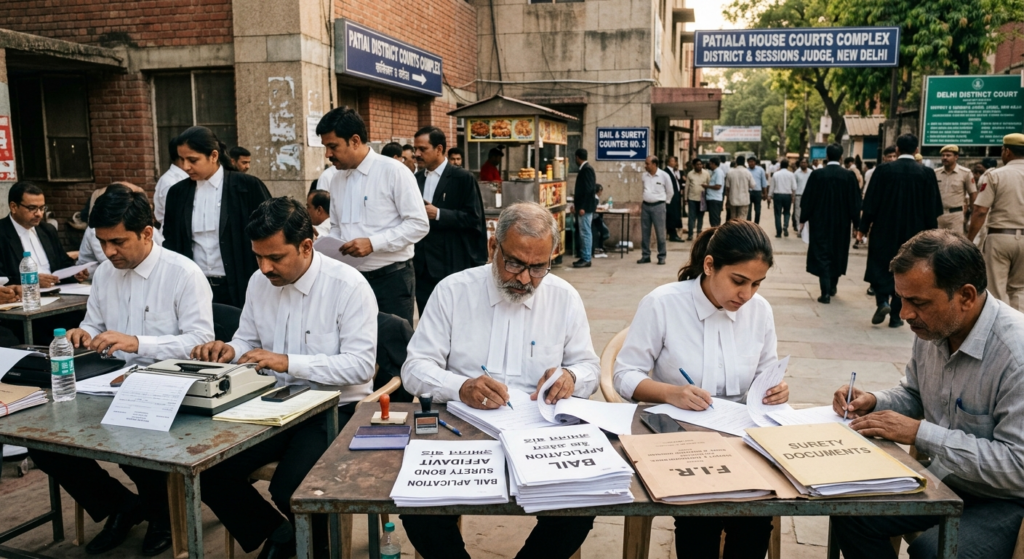
Step 1: Downloading the Delhi High Court Bail Order Online
You do not need to wait for physical certified copies to begin administrative preparations.
- Visit the Official Delhi High Court Portal or access the eCourts High Court Services application.
- Navigate to Order Information System and select Case Wise Search.
- Choose the appropriate Case Type, such as
BAIL APPLN.orCRL.M.(BAIL). - Enter the specific Case Number and Registration Year.
- Download the certified PDF order bearing the official digital signature and neutral citation of the Delhi High Court.
Step 2: Compiling Required Documents for the Surety
The individual acting as a guarantor must assemble a complete financial and identity dossier:
- Government Photo ID and Address Proof: Aadhaar Card, Voter ID, or Passport. Note that a local Delhi/NCR address is mandatory when the court order specifies a “local surety.”
- Proof of Solvency and Financial Capacity:
- Original Property Ownership Deeds, Khatoni records, or unencumbered vehicle Registration Certificates (RC).
- Original Bank Fixed Deposit Receipt (FDR) lien-marked to the trial court.
- Recent Income Tax Returns (ITR) or salary certificates accompanied by Form 16.
- Passport-Sized Photographs: 3 to 4 recent passport photos of the guarantor.
- Affidavit of Surety: A sworn affidavit under Section 486 BNSS (formerly Section 441A CrPC) declaring that the guarantor has not stood as a surety in multiple unrelated active cases, complete with itemized asset disclosures.
Step 3: Submitting Bail Bonds in the Trial Court
First, the formal bail bond forms (Personal Bond and Surety Bond) are filled out, signed by the guarantor, and executed by the accused inside prison (attested by the Jail Superintendent). Subsequently, the defense advocate files the bond application before the jurisdictional trial court or designated Duty Magistrate during weekends. The judge then examines the guarantor in open court to verify their financial solvency and personal relationship with the accused.
Step 4: Verification and Release Warrant (Robkar) Issue
In standard matters where the guarantor submits an original FDR or clean vehicle RC alongside verified local identity documents, the court accepts the bond immediately. However, in sensitive cases, the magistrate may forward property or identity papers to the local police station for physical verification, which takes 24 to 48 hours.
Once accepted, the court issues an official Release Order (Robkar). In Delhi, this document is transmitted electronically through the secure FASTER (Fast and Secured Transmission of Electronic Records) judicial network directly to Tihar, Mandoli, or Rohini Jail, securing release that evening.
Landmark Supreme Court Judgments Safeguarding Liberty
Binding precedents established by the Supreme Court of India govern how trial courts handle bail bonds and surety verifications.
Precedents Guarding Against Oduous Conditions
- Hussainara Khatoon v. Home Secretary, State of Bihar (1979): The Supreme Court established that demanding heavy financial sureties from impoverished litigants violates Article 21 of the Constitution. Courts must release indigent individuals on personal bonds when flight risk remains negligible.
- Moti Ram v. State of M.P. (1978): Justice V.R. Krishna Iyer held that courts must not interpret “surety” in an overly restrictive manner by demanding local guarantors with extensive landed properties, as this unfairly penalizes migrant workers and poor citizens.
- Satender Kumar Antil v. CBI (2022): The Apex Court clarified that setting impossible bail conditions or exorbitant bond amounts defeats the purpose of granting bail. Trial judges were instructed to adopt a flexible, practical approach during surety evaluation.
- In Re Policy Strategy for Grant of Bail (2023): The Supreme Court directed that if an accused remains in prison for seven days after receiving bail due to an inability to furnish financial bonds or local sureties, trial courts must suo motu consider relaxing or modifying those conditions.
Common Pitfalls That Delay Prison Release and Actionable Solutions
In our trial experience, minor administrative errors routinely stall prison release orders by several days.
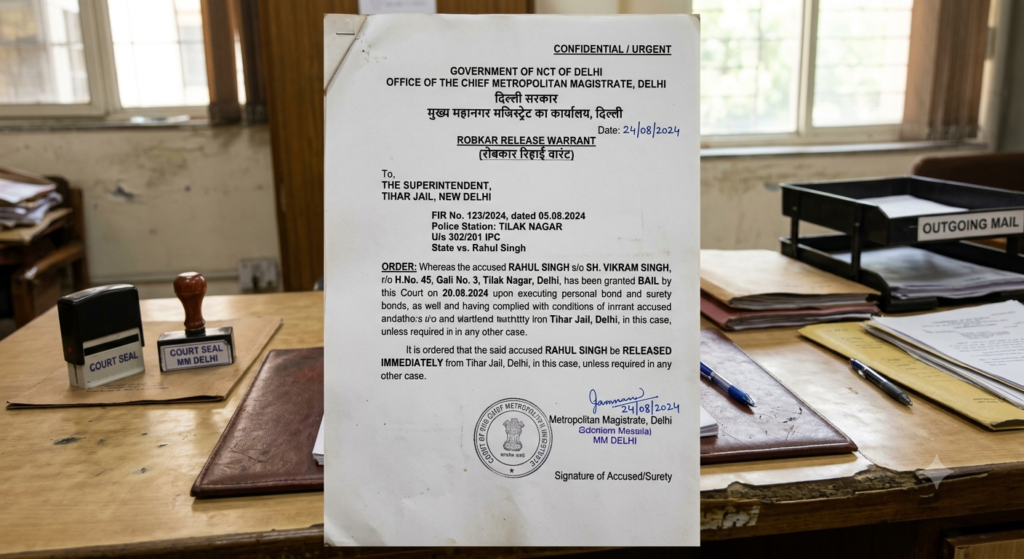
Operational Errors to Avoid
- Discrepancies in Name and Address: Ensure the guarantor’s full name on their identity card matches their property papers, vehicle RC, or bank FDR down to the exact spelling.
- Ignoring Local Surety Directives: If the High Court order mandates a “local Delhi surety,” presenting a guarantor residing outside the National Capital Region (NCR) leads to immediate rejection by the trial magistrate.
- Encumbered Property Documents: Offering property that is mortgaged to a financial institution or jointly owned with uncooperative relatives creates severe verification delays.
- Missing the Daily Jail Intake Cutoff: Defense teams must ensure the trial court transmits the electronic Robkar before the daily 5:00 PM prison processing cutoff at Tihar Jail.
Strategic Action Plan for Families
- Download the High Court Order Promptly: Access the official online portal immediately after the judge pronounces bail.
- Select an Eligible Guarantor: Identify a close relative or friend residing in Delhi/NCR who holds verifiable financial assets or an active bank Fixed Deposit.
- Organize the Document File: Assemble original identity cards, tax documents, bank receipts, property records, and photographs into a organized dossier.
- Coordinate Early Court Presentation: Ensure your defense lawyer submits the bail bond application during the morning court session to guarantee same-day release.
Frequently Asked Questions
What is the standard bail bond amount set by the Delhi High Court?
Bail bond amounts generally range between ₹10,000 and ₹100,000 in routine matters. However, in complex economic offences or high-value cases, courts may set higher bond thresholds based on the financial scale of the alleged crime.
What happens if a surety decides to withdraw from the bond later?
Under Section 489 BNSS (formerly Section 444 CrPC), a guarantor can file a formal application requesting discharge from their bond. The trial court will then issue a warrant against the accused, requiring them to furnish a replacement surety or face judicial detention.
Can a family member residing outside Delhi act as a surety?
If the High Court order simply calls for “one surety,” a relative from another state can serve as guarantor. Conversely, if the order explicitly demands a “local surety,” the guarantor must possess verified residential proof within Delhi/NCR.
What are the legal consequences of violating a bail bond condition?
If an accused person fails to attend court or breaches imposed restrictions, the magistrate initiates bond forfeiture proceedings under Section 491 BNSS (formerly Section 446 CrPC). The court issues non-bailable warrants against the accused and directs the guarantor to pay the pledged penalty amount or face civil recovery steps.
Mandatory Disclaimer
This article is published solely for general informational and legal educational purposes and does not constitute formal legal advice. Accessing, reading, or acting upon this material does not create an advocate-client relationship. Litigants, accused persons, or family members facing criminal proceedings should consult a qualified criminal defense advocate registered with the Bar Council of Delhi for professional guidance tailored to their specific case facts.