Written by Kapil Balhara | Technically Reviewed for Accuracy | Last Updated: August 2026
Table of Contents
- Legal Counsel During Police Interrogation
- What an Advocate Can and Cannot Do During Inquiry
- Step-by-Step Guide to Attending Interrogation with Counsel
- Common Litigant Mistakes and Landmark Judicial Precedents
- Frequently Asked Questions
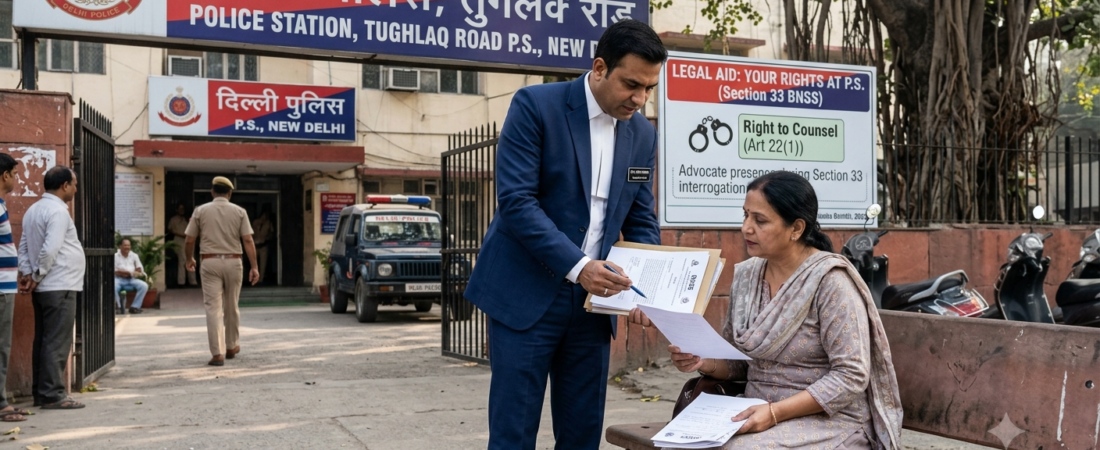
Facing police station questioning creates immense fear and anxiety for any citizen. However, Indian statutory law explicitly guarantees your fundamental right to consult a legal defense practitioner during an ongoing inquiry.
In our legal practice, we frequently observe individuals facing police inquiries without proper legal counsel. This guide provides an exhaustive analysis of your rights, statutory provisions, and practical steps to ensure full protection during an interrogation.
Citizens often wonder if they can bring an advocate along when summoned for a official investigation. Understanding your fundamental safeguards ensures you remain protected against illegal coercion or forced statements.
During police station questioning, an individual possesses a statutory right under Section 33 of the Bharatiya Nagarik Suraksha Sanhita, 2023 (BNSS) to meet and be accompanied by an advocate. The lawyer may remain within visible distance during interrogation to prevent procedural abuse, though they cannot directly answer questions for the client.
Historically, this safeguard existed under Section 41D of the Code of Criminal Procedure (CrPC). The legislature codified this core protection into Section 33 of BNSS.
Statutory & Constitutional Foundations
- Article 22(1) of the Constitution of India: Guarantees every person the fundamental right to consult and be defended by a legal practitioner of their choice upon arrest or detention.
- Section 33 BNSS (Formerly Section 41D CrPC): Expressly dictates that when an individual undergoes interrogation, they are entitled to meet an advocate during questioning.
- Article 20(3) Constitutional Safeguard: Protects citizens against self-incrimination, ensuring no person is compelled to give testimony against themselves.
When our legal team evaluated procedural inquiries, having an advocate present significantly reduced instances of verbal harassment and custodial overreach.
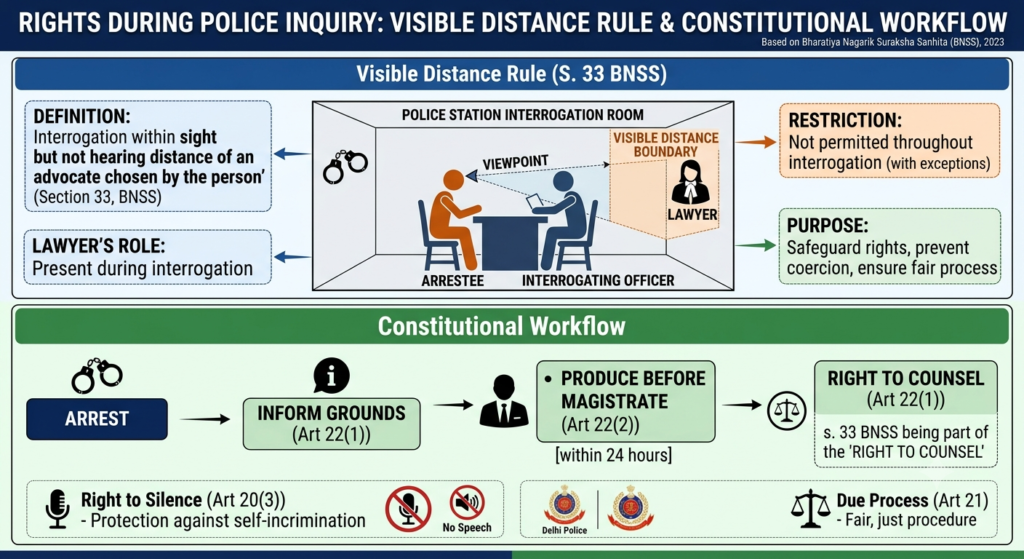
While an advocate provides vital moral and legal support, understanding their exact legal limits prevents operational friction with the Investigating Officer (IO).
| Scope of Action | Permitted Role of Advocate | Prohibited Action |
|---|---|---|
| Physical Presence | Sitting within visible distance (e.g., across a glass pane or nearby hall). | Sitting beside the client to answer questions directly on their behalf. |
| Legal Advice | Briefing the client prior to entry and reviewing submitted documents. | Constantly interrupting the IO or coaching the client during active questioning. |
| Procedural Safety | Intervening immediately if physical coercion or verbal abuse occurs. | Obstructing the police officer from conducting a lawful statutory inquiry. |
| Documentation | Inspecting Section 35(3) BNSS notices and checking Daily Diary entries. | Demanding to dictate station logbooks or altering official investigation files. |
Key Takeaway: An advocate acts as an active observer to prevent illegalities, but the interviewee must personally provide factual answers to the IO.
Successfully navigating police station questioning requires a disciplined, structured approach. Follow these four mandatory steps to preserve your legal remedies.
- Pre-Interrogation Strategy Session: Meet your lawyer prior to entering the station. Your counsel will examine the notice issued under Section 35(3) BNSS, assemble relevant evidentiary documents, and draft a formal written representation.
- Formal Entrance & Vakalatnama Submission: Upon arriving at the station, your advocate introduces themselves to the IO. Counsel submits a Vakalatnama or Memo of Appearance and formally requests permission to observe the proceeding under Section 33 BNSS.
- Establishing “Visible Distance” Positioning: If the officer objects, your lawyer will cite established High Court guidelines. Counsel will position themselves within visual sight to ensure safety while preserving interrogation confidentiality.
- Recording Official Attendance & Departure: Before departing, ensure your advocate verifies that the station Daily Diary (DD) entry reflects your precise entry and exit times. Obtain a signed, stamped copy of your notice marked “Attended and Complied.”
Avoiding tactical errors during an inquiry protects your long-term legal defense. In our legal evaluations, unrepresented individuals frequently fall into avoidable procedural traps.
Common Pitfalls Litigants Must Avoid
- Attending Alone Out of Fear: Entering a station without prior legal advice often leads to signing coerced statements or blank papers.
- Expecting the Lawyer to Answer Questions: Assuming an advocate will speak for you causes the IO to record non-cooperation.
- Failing to Secure DD Entry Proof: Departing without an official stamped notice or DD Entry receipt leaves you vulnerable to false claims of non-compliance.
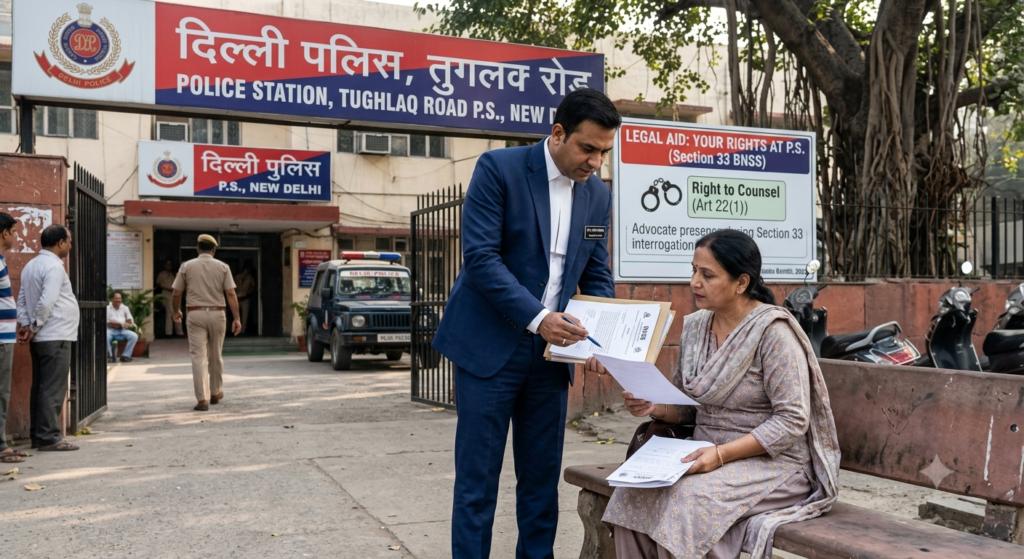
Landmark Supreme Court and High Court Rulings
- Nandini Satpathy v. P.L. Dani (1978) : The Supreme Court recognized that the right to consult an advocate attaches during police interrogation to prevent forced self-incrimination.
- D.K. Basu v. State of West Bengal (1997) : The Supreme Court established binding custodial guidelines, confirming that an arrestee or interrogatee may meet their attorney during questioning.
- Senior Advocates & State Guidelines (Delhi High Court) : The High Court clarified that while advocates cannot dictate questioning, police officers cannot exclude lawyers from remaining within visual range during questioning under Section 41D CrPC (now Section 33 BNSS).
Key Takeaway: Judicial precedents establish that visible-distance lawyer presence is a mandatory procedural safeguard, not a discretionary favor by police officers.
If you face intimidation, unlawful detention, or coercion during an inquiry, take immediate legal countermeasures. Applying for Anticipatory Bail under Section 482 BNSS provides comprehensive statutory protection against arbitrary custody.
Can the police refuse to allow my lawyer inside the station?
No, the police cannot completely ban your lawyer. Under Section 33 BNSS, you have a statutory right to meet your advocate during interrogation. While the IO can prevent the lawyer from sitting right next to you, counsel is legally entitled to remain within visible distance.
Will bringing a lawyer make me look guilty to the police?
No. Bringing an advocate is a constitutional right aimed at protecting procedural fairness. Police officers respect individuals who arrive prepared and aware of their legal rights.
What should I do if the IO threatens to arrest me during questioning?
If the IO threatens arrest despite your full compliance with a Section 35(3) BNSS notice, your advocate can immediately intervene. Counsel can present binding Supreme Court rulings like Arnesh Kumar and move an urgent Anticipatory Bail application under Section 482 BNSS before the jurisdictional court.
Need Urgent Station Representation?
Facing police questioning requires fast, decisive, and knowledgeable legal support. Contact our senior criminal defense attorneys today to secure expert station representation and safeguard your constitutional liberty.
Disclaimer: This article is for informational purposes only and does not constitute formal legal advice. Reading this content does not create an attorney-client relationship. If you are facing police station questioning, consult a qualified criminal advocate immediately for case-specific guidance.