Written by Kapil Balhara | Technically Reviewed for Legal Accuracy | Last Updated: August 2026
Indian procedural law strictly prohibits police officers from summoning women, senior citizens above 65 years of age, children under 15, and mentally or physically disabled individuals to a police station for questioning. Under Section 179 of the Bharatiya Nagarik Suraksha Sanhita, 2023 (BNSS) [formerly Section 160 of the Code of Criminal Procedure, 1973 (CrPC)], police officers are legally mandated to conduct any necessary inquiry or interrogation exclusively at the person’s residence.
This comprehensive guide details the statutory exemptions for vulnerable demographics, step-by-step procedures to counter illegal police notices, and legal remedies available in Delhi to enforce your fundamental rights.
Table of Contents
- Home Interrogation Rules in Delhi
- The Core Legal Framework: BNSS 2023 vs. CrPC 1973
- Statutory Exemptions and Police Duties Matrix
- Step-by-Step Practical Process: How to Respond to an Illegal Police Notice
- Common Pitfalls & Key Precedents
- Actionable Next Steps for Protection
- Frequently Asked Questions
Home Interrogation Rules in Delhi
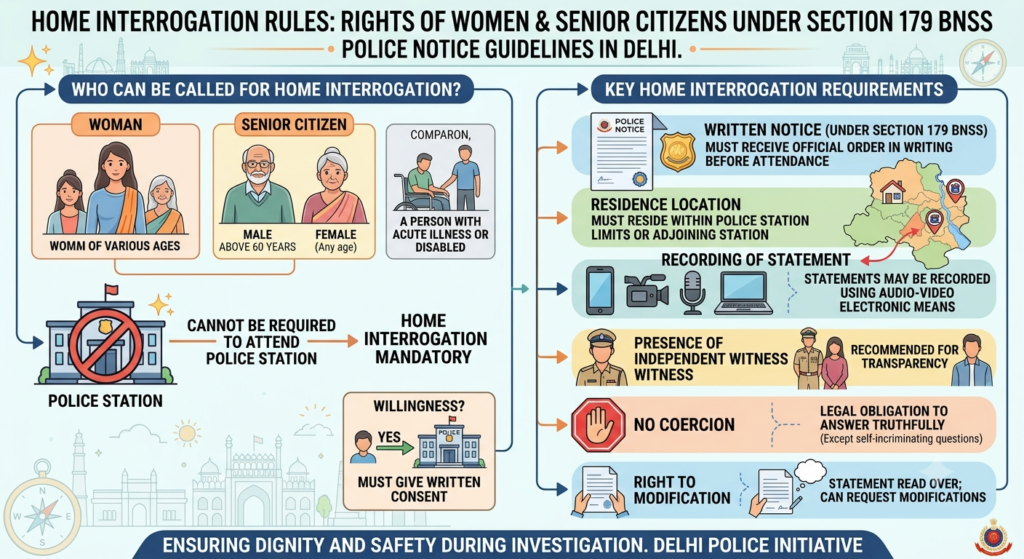
Under Section 179 BNSS (formerly Section 160 CrPC), police officers cannot compel women of any age, senior citizens over 65, or children under 15 to visit a police station. Investigating officers must record their statements at their residence. Violating this mandatory proviso constitutes illegal police overreach and warrants administrative action.
Key Takeaway: You do not have to obey a police notice that demands a woman or senior citizen appear at a station. The law mandates home interrogation, and issuing a formal written reply protects you from illegal coercion.
The Core Legal Framework: BNSS 2023 vs. CrPC 1973
The code of criminal procedure balances police investigative powers with human dignity and individual safeguards. When an investigating officer (IO) requires the attendance of a witness or an accused, specific statutory boundaries apply.
Statutory Exemption Provisions
- Section 179(1) BNSS [formerly Section 160(1) CrPC]: Establishes the general power of an investigating officer to issue a written order requiring the attendance of any person who appears to be acquainted with the facts of a case.
- The Mandatory Proviso: The proviso to Section 179(1) BNSS explicitly lays down mandatory statutory exemptions. It dictates that no male person under 15 years of age, no male person above 65 years of age, no woman of any age, and no person with a mental or physical disability shall be required to attend any place other than the place in which such person resides.
- BNSS Expanded Scope: Modern statutory frameworks reinforce these protections. Consequently, even under preliminary inquiries, officers cannot bypass home interrogation mandates.
Legal Duties of Investigating Officers
- Home Interrogation Mandate: If a woman or senior citizen’s statement is necessary for an investigation, police officers must visit their residence.
- Female Officer Presence: When recording the statement of a female, standard protocol mandates that a woman police officer or female constable should be present.
- Witness Expense Cover: Under Section 179(2) BNSS [Section 160(2) CrPC], the police department must pay reasonable expenses incurred by any person for attending an inquiry outside their residence where legally permissible.
Statutory Exemptions and Police Duties Matrix
Our analysis revealed that knowing statutory exemptions helps families challenge illegal police overreach effectively.
| Demographic / Category | Statutory Requirement | Permissible Location of Questioning | Can Police Force Station Attendance? |
|---|---|---|---|
| Women (Any Age) | Protected under Section 179 BNSS Proviso | Residence / Current place of stay only | No — Absolute Statutory Prohibition |
| Senior Citizens (65+ Years) | Protected under Section 179 BNSS Proviso | Residence / Current place of stay only | No — Absolute Statutory Prohibition |
| Children (Under 15 Years) | Protected under Section 179 BNSS Proviso | Residence / Place of residence only | No — Absolute Statutory Prohibition |
| Disabled / Sick Persons | Protected under Section 179 BNSS Proviso | Residence / Place of treatment | No — Absolute Statutory Prohibition |
Step-by-Step Practical Process: How to Respond to an Illegal Police Notice
If an investigating officer in Delhi issues a notice directing a female or senior citizen to appear physically at a police station, follow these structured steps to assert your statutory protection.
- Verify the Notice Details: Examine the notice served by the police. Check whether it is issued under Section 179 BNSS (or 160 CrPC) or Section 35(3) BNSS (or 41A CrPC). Identify the police station, investigating officer’s name, and the capacity in which the person is being called.
- Issue a Formal Written Legal Response: Do not send the protected individual to the police station. Instead, engage a defense advocate to draft an immediate written reply to the notice. Explicitly cite the proviso to Section 179(1) BNSS / Section 160(1) CrPC. State clearly that the individual is a woman, senior citizen above 65, or person with health conditions. Confirm full willingness to cooperate with the investigation and invite the IO to visit the residence at a mutually convenient time.
- Serve the Reply via Official Channels: Send the written response to the investigating officer and the Station House Officer (SHO) via official police email, Speed Post with Acknowledgment Due, or hand delivery by a legal representative to obtain a stamped receiving copy.
- File a Representation to Senior Police Officers: If the IO ignores the written reply and continues to threaten the family, submit a formal complaint to the Deputy Commissioner of Police (DCP) or the Joint Commissioner of Police of the relevant Delhi district. Detail the illegal demands and request urgent administrative intervention.
- Seek Judicial Protection Before the High Court: If police harassment persists, your advocate can file a Writ Petition under Article 226 of the Constitution before the Delhi High Court. The court routinely grants protective orders directing police to adhere strictly to statutory provisions and conduct questioning exclusively at the person’s residence under video recording if necessary.
Key Takeaway: Never communicate verbally over the phone. Serving a written reply via registered post or official email builds indisputable proof of your willingness to cooperate at home.
Common Pitfalls & Key Precedents
Frequent Mistakes Litigants Make
- Complying Out of Panic: Sending a female relative or elderly family member to the police station out of fear validates illegal police behavior and exposes them to intimidation.
- Failing to Create a Written Record: Relying on verbal phone calls with the IO rather than issuing a formal written legal reply leaves you without proof of compliance.
- Confusing Witness Summons with Accused Notices: While Section 179 BNSS covers witnesses and individuals acquainted with facts, police sometimes attempt to misuse Section 35(3) BNSS (41A CrPC) to bypass home interrogation protections. Courts have held that protective statutory umbrella principles apply strictly to safeguard vulnerable groups from custodial harassment.
Landmark Judicial Precedents & Guidelines
Nandini Satpathy v. P.L. Dani (1978)
The Supreme Court held that forcing a woman to appear at a police station in violation of Section 160(1) CrPC is a clear breach of statutory mandate. The Court emphasized that women cannot be summoned to police stations for examination, and any evidence obtained through such coercive presence is tainted.
Delhi High Court Directives
The Delhi High Court has consistently penalized police officers who violate Section 160 CrPC / 179 BNSS. Furthermore, the Court has clarified that calling women or elderly individuals to the police station under the guise of “informal inquiries” or “preliminary verification” is strictly illegal and renders the IO liable for departmental disciplinary action.
Departmental Action Against Errant Police Officers
A citizen subjected to illegal summons can file a formal complaint before the Police Complaints Authority (PCA), Delhi, or move a petition for prosecution against the IO under administrative rules for deliberate non-compliance with statutory mandates.
Actionable Next Steps for Protection
- Do not send protected individuals (females, elderly above 65, minors, or disabled persons) to any police station upon receiving a notice.
- Preserve the written notice and make copies of all medical or age-proof identity documents, such as birth certificates or senior citizen cards.
- Draft and serve an immediate legal reply citing Section 179 BNSS / 160 CrPC, offering complete cooperation at your residence.
- Escalate to senior police hierarchy (DCP/Joint CP Delhi) or approach the Delhi High Court if the police persist with coercive threats.
Frequently Asked Questions
Can police force a woman to come to the police station as an accused under Section 35(3) BNSS / 41A CrPC?
No, procedural safeguards and constitutional protections under Article 21 shield women from custodial intimidation during questioning. Police officers must record statements of female accused or witnesses at their residence, accompanied by female officers.
What should I do if the Investigating Officer threatens arrest for non-compliance?
If an IO threatens arrest because a woman or senior citizen refuses to visit the station, immediately submit a written representation to the district DCP and file an application for interim protection or anticipatory bail in court.
Are senior citizens above 60 protected, or is the limit strictly 65 years?
Section 179 BNSS explicitly grants statutory exemption to male senior citizens above 65 years of age. However, elderly individuals under 65 suffering from severe medical illnesses or physical disabilities are also protected under the sick and infirm category of the same proviso.
Assert Your Legal Safeguards Today
Navigating illegal police notices requires swift action, detailed documentation, and decisive legal representation.
Do not allow unlawful summons to compromise your family’s safety or dignity. Take immediate steps to enforce your statutory rights under the law.
Disclaimer: This article is published solely for educational and informational purposes and does not constitute formal legal advice. Reading this content or communicating through this platform does not create an attorney-client relationship. If you or your family members have received an illegal police notice in Delhi, consult a qualified criminal defense advocate immediately for case-specific guidance.