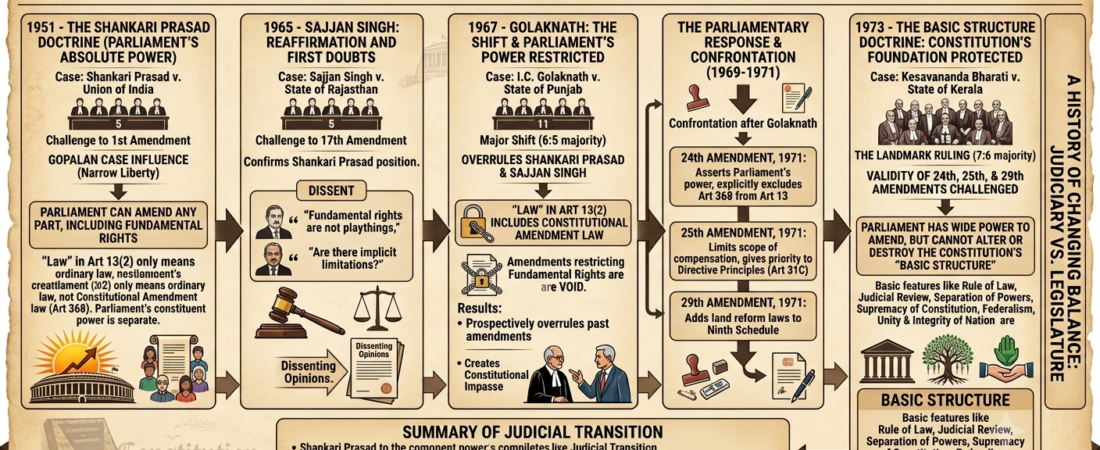
Landowners across India faced immediate property loss when the government introduced radical land reform acts after independence. This aggressive reform agenda forced the Supreme Court to rule on Shankari Prasad v. Union of India (1951), establishing the early boundaries of parliamentary power over fundamental rights.
Written by Kapil Balhara | Technically Reviewed for Accuracy | Last Updated: October 2026
Table of Contents
- Executive Summary & Case Overview
- Factual Matrix: Why the Agrarian Crisis Reached the Court
- Core Legal Issues Before the Supreme Court
- Deep-Dive Analysis of the Constitutional Ruling
- Evolution of Parliamentary Power: From Shankari Prasad to Kesavananda
- Framework for Analyzing Constitutional Amendment Challenges
- Frequently Asked Questions
Executive Summary & Case Overview
The unanimous judgment in Sri Shankari Prasad Singh Deo v. Union of India marked the initial battle between judicial review and legislative power in independent India.
Key Takeaway: Shankari Prasad v. Union of India (1951) was a landmark Supreme Court case that validated the First Constitutional Amendment. The court held that constitutional amendments under Article 368 are constituent laws, meaning they are exempt from the judicial review restrictions of Article 13(2).
| Case Parameter | Legal Attribute |
|---|---|
| Full Case Name | Sri Shankari Prasad Singh Deo v. Union of India |
| Citation | 1951 AIR 458, 1952 SCR 89 |
| Judicial Bench | Harilal Kania C.J., M. Patanjali Sastri, B.K. Mukherjea, S.R. Das, and N. Chandrasekhara Aiyar JJ. |
| Key Legislation | The Constitution (First Amendment) Act, 1951 |
| Core Provisions | Article 13(2), Article 31A, Article 31B, Ninth Schedule, Article 368 |
Factual Matrix: Why the Agrarian Crisis Reached the Court
Following independence, several state legislatures passed aggressive land reform acts to abolish the zamindari system. Consequently, affected landlords challenged these provincial agrarian laws in various High Courts.
For instance, the Patna High Court declared the Bihar Land Reforms Act, 1950 unconstitutional for violating equal protection rights. In contrast, the Allahabad and Nagpur High Courts upheld similar land reform laws in their respective jurisdictions.
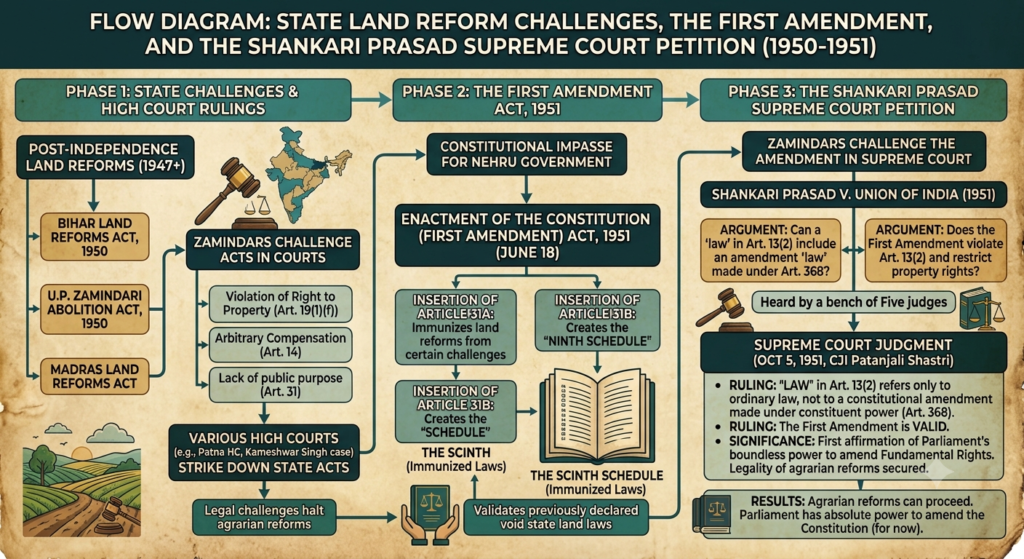
To stop endless litigation and protect land redistribution, Parliament enacted the First Constitutional Amendment Act in 1951. Specifically, this amendment introduced Article 31A and Article 31B alongside the Ninth Schedule to shield agrarian laws from judicial review.
Thereupon, landlord Shankari Prasad and other property owners filed writ petitions under Article 32 directly before the Supreme Court. They argued that Parliament used constituent power to abridge fundamental rights illegally.
Core Legal Issues Before the Supreme Court
Our analysis of the case file shows three primary questions that required urgent constitutional interpretation:
- Scope of Article 13(2): Does the word “law” inside Article 13(2) include a Constitutional Amendment passed under Article 368?
- Limits of Power: Can Parliament amend Part III guarantees through its constitutional amending power under Article 368?
- Validity of the Ninth Schedule: Are Article 31A and Article 31B constitutionally valid when they prevent courts from enforcing fundamental rights?
Deep-Dive Analysis of the Constitutional Ruling
The five-judge bench issued a unanimous decision delivered by Justice M. Patanjali Sastri. Specifically, the court rejected all challenges against the First Constitutional Amendment.
Harmonizing Article 13(2) and Article 368
The petitioners contended that Article 13(2) explicitly forbids the State from enacting any law that takes away fundamental rights. Therefore, they argued that any amendment restricting property rights must be declared void.
However, the Supreme Court drew a sharp distinction between ordinary legislative power and constituent power. The court ruled that “law” under Article 13(2) refers only to ordinary rules made under legislative powers.
Key Takeaway: The court ruled that constitutional amendments made under Article 368 represent constituent power, so they fall outside the statutory definition of “law” mentioned in Article 13(2).
Validating Articles 31A, 31B, and the Ninth Schedule
In addition, the petitioners challenged Article 31B, claiming it curtailed High Court powers under Article 226. They asserted that Parliament altered judicial review without obtaining required state legislative ratifications.
Nevertheless, the court dismissed this argument. The bench observed that Articles 31A and 31B were designed to protect property legislation directly rather than alter judicial jurisdiction under Article 226.
- Article 31A protected land acquisition laws from fundamental rights challenges under Articles 14, 19, and 31.
- Article 31B created a protective validation mechanism through the Ninth Schedule.
- Laws added to the Ninth Schedule received total immunity from judicial invalidation.
Evolution of Parliamentary Power: From Shankari Prasad to Kesavananda
The legal doctrine introduced in this ruling created a two-decade conflict between Parliament and the judiciary. Understanding this case requires tracking how subsequent benches evaluated Article 368.
Sajjan Singh v. State of Rajasthan (1965)
Fourteen years later, the Supreme Court upheld Shankari Prasad in Sajjan Singh v. State of Rajasthan. Chief Justice P.B. Gajendragadkar reiterated that Article 368 grants Parliament full authority to amend any provision.
However, Justice H.R. Khanna and Justice M. Hidayatullah raised doubts in their separate opinions. They questioned whether fundamental rights could be edited at the absolute discretion of Parliament.
Golaknath v. State of Punjab (1967)
Eventually, a eleven-judge bench formally overruled Shankari Prasad in I.C. Golaknath v. State of Punjab. Chief Justice K. Subba Rao declared that constitutional amendments are “law” under Article 13(2).
Consequently, the court ruled that Parliament could not abridge or take away Part III rights through amendments. This decision applied prospectively to avoid overturning previous land reforms.
Kesavananda Bharati v. State of Kerala (1973)
Finally, a thirteen-judge bench resolved this conflict by creating the Basic Structure Doctrine. The court recognized parliamentary power under Article 368 but prohibited Parliament from altering the core identity of the Constitution.
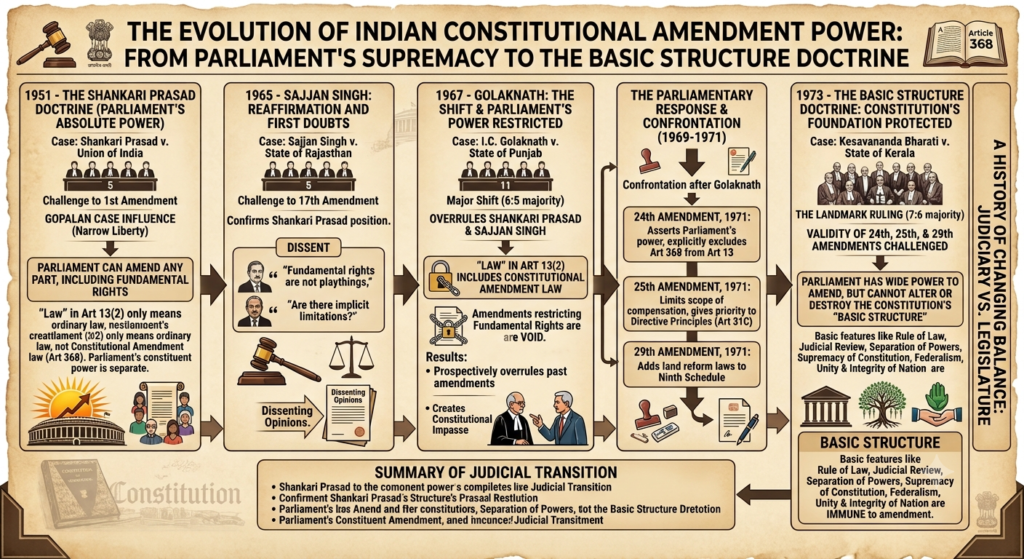
Key Takeaway: While Shankari Prasad gave Parliament unlimited power to amend fundamental rights, modern constitutional law limits Article 368 so Parliament cannot destroy the basic structure.
Are you working on complex constitutional law research? Explore our detailed case digests to build bulletproof legal arguments faster.
Framework for Analyzing Constitutional Amendment Challenges
When evaluating modern challenges to constitutional amendments, legal professionals must follow a systematic test derived from post-Shankari Prasad developments:
Step-by-Step Amendment Evaluation Guide
- Verify Procedural Compliance: Ensure Parliament passed the bill strictly according to procedural requirements in Article 368.
- Identify Impacted Rights: List the specific fundamental rights altered or restricted by the constitutional amendment.
- Apply the Basic Structure Test: Determine whether the amendment damages essential features like judicial review, federalism, or rule of law.
- Inspect Ninth Schedule Date: Check if the challenged statute was added to the Ninth Schedule after April 24, 1973, making it open to basic structure judicial review.
By applying this structured framework, legal researchers can accurately predict how current courts evaluate legislative encroachments.
Frequently Asked Questions
What was the main ruling in Shankari Prasad v. Union of India?
The Supreme Court held that Parliament has full power to amend any part of the Constitution, including Part III fundamental rights, through Article 368.
What is the conflict between Article 13(2) and Article 368?
Article 13(2) states that the State cannot make any law that takes away fundamental rights. Article 368 outlines procedures to amend the Constitution. The conflict centres on whether an amendment is a “law” under Article 13(2).
Did Kesavananda Bharati overrule Shankari Prasad?
Yes, Kesavananda Bharati established that while Parliament can amend fundamental rights, it cannot alter the basic structure of the Constitution, replacing the unlimited power doctrine established in Shankari Prasad.
Conclusion
The legacy of Shankari Prasad v. Union of India shaped the foundation of Indian constitutional jurisprudence. By establishing an early distinction between legislative and constituent power, this case triggered decades of judicial debate that ultimately birthed the Basic Structure Doctrine.
If you are a legal professional or student analyzing constitutional law disputes, bookmark this guide for your case preparations and legal briefs today.