Written by Kapil Balhara | Technically Reviewed for Accuracy | Last Updated: October 2026
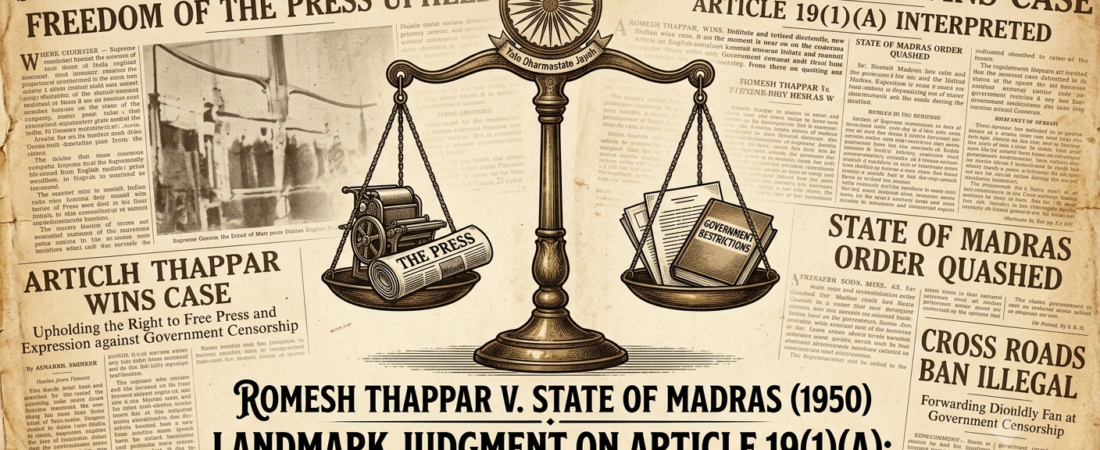
Does the government have the constitutional right to silence independent journalism to maintain local law and order? This critical question reached the Supreme Court of India in 1950 through the landmark case Romesh Thappar v. State of Madras. The Supreme Court declared that press freedom is an essential component of speech and expression under Article 19(1)(a). Consequently, the Court ruled that local public order issues cannot justify banning publication entry or circulation.
In this detailed analysis, we break down the case details, legal arguments, First Amendment impacts, and enduring constitutional legacies.
Table of Contents
- Definition & Summary Block
- Factual Background: The Cross Roads Ban
- Key Legal Issues Raised Before the Court
- Arguments Presented by the Parties
- The Supreme Court Judgment & Analysis
- Comparative Matrix of Key Legal Concepts
- Impact of the Judgment: The First Constitutional Amendment
- Frequently Asked Questions
Definition & Summary Block
Romesh Thappar v. State of Madras (1950 AIR 124) is a foundational Supreme Court judgment that established freedom of circulation as an integral part of the freedom of speech and expression under Article 19(1)(a). The Court invalidated State-imposed press censorship, ruling that broad public order concerns cannot restrict free speech unless they directly threaten State security.
Factual Background: The Cross Roads Ban
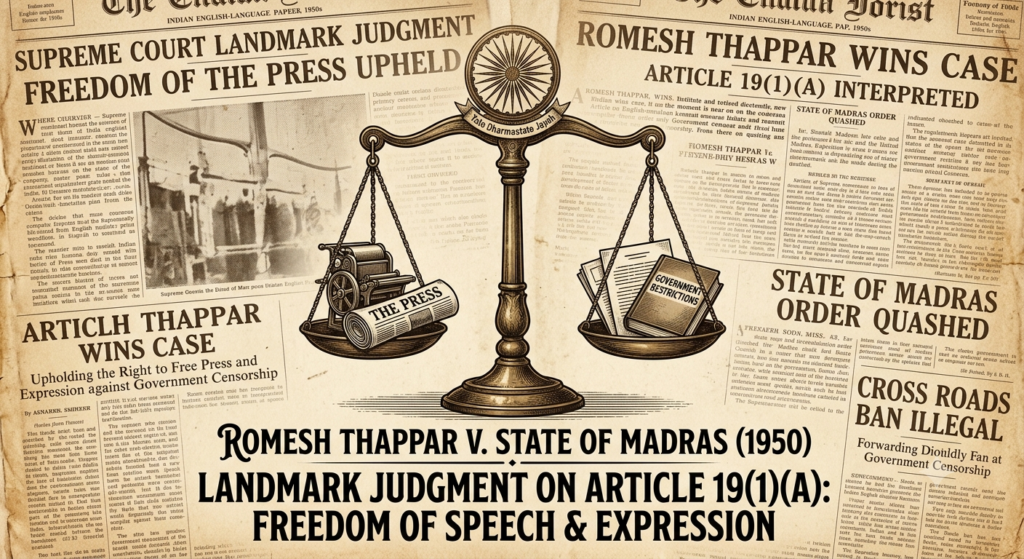
Romesh Thappar was the editor, printer, and publisher of an English weekly journal named Cross Roads, published out of Bombay. The weekly publication frequently critiqued government policies. Therefore, state authorities viewed the weekly journal with considerable concern.
On March 1, 1950, the Government of Madras issued an order under Section 9(1-A) of the Madras Maintenance of Public Order Act, 1949. The notification prohibited the entry, circulation, sale, and distribution of Cross Roads throughout the State. The government claimed this executive order was necessary to secure public safety and maintain public order.
Because of this circulation ban, Romesh Thappar filed a writ petition directly in the Supreme Court under Article 32 of the Constitution. He claimed the State order violated his Fundamental Right under Article 19(1)(a).
Key Takeaway: The executive ban on the circulation of Cross Roads challenged whether public safety laws could restrict independent journalism in post-independence India.
Key Legal Issues Raised Before the Court
The Supreme Court faced three critical constitutional questions:
- Maintainability: Can a petitioner approach the Supreme Court directly under Article 32 without exhausting remedies in the High Court under Article 226?
- Freedom of Circulation: Does freedom of speech and expression under Article 19(1)(a) include the right to circulate publications across state boundaries?
- Validity of Pre-Amendment Restrictions: Did Section 9(1-A) of the Madras Maintenance of Public Order Act fall within the permissible limits set by Article 19(2)?
Arguments Presented by the Parties
Petitioner’s Arguments (Romesh Thappar)
- Counsel C.R. Pattabhi Raman argued that freedom of speech includes freedom of propagation, which requires unrestricted circulation.
- Section 9(1-A) of the Madras Act went beyond the narrow exceptions listed under Article 19(2).
- The law did not target actions that directly undermine State security or aim to overthrow the State.
Respondent’s Arguments (State of Madras)
- Advocate-General of Madras raised a preliminary objection, arguing the petitioner should have approached the Madras High Court first under Article 226.
- The State argued that “public safety” forms an integral part of maintaining the “security of the State”.
- Broad police powers allow the legislature to restrict publication entry to prevent local civil unrest and maintain public order.
The Supreme Court Judgment & Analysis
Direct Access Under Article 32
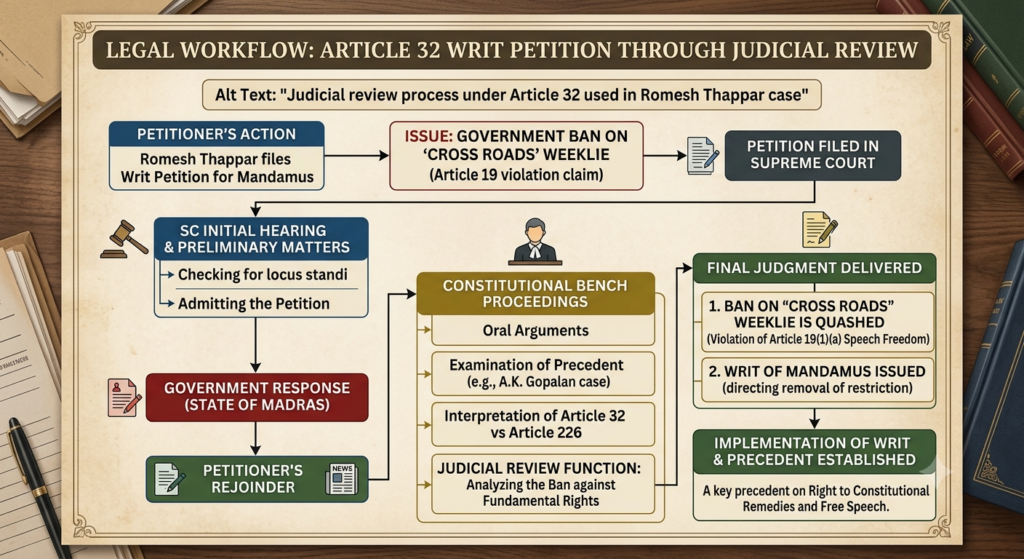
First, the Supreme Court overruled the State’s preliminary objection regarding direct access. Justice M. Patanjali Sastri emphasized that Article 32 is not merely a jurisdictional provision. Instead, Article 32 is itself a guaranteed Fundamental Right.
The Court declared that it acts as the protector and guarantor of fundamental rights. Consequently, the Supreme Court cannot refuse to entertain applications seeking protection against the infringement of these rights.
Scope of Freedom of Speech and Circulation
Next, the majority bench evaluated the core constitutional right. The Court held that freedom of speech and expression guaranteed under Article 19(1)(a) includes the freedom to propagate ideas. Most importantly, that freedom is ensured through free circulation.
Without circulation, the act of publication holds little real value. Therefore, banning publication entry into a state infringes directly upon Article 19(1)(a).
Doctrine of Severability and Public Order
Finally, the Court evaluated the validity of the impugned Madras statute. In the original 1950 Constitution, Article 19(2) allowed restrictions only for specific grounds: libel, slander, defamation, contempt of court, offenses against decency/morality, or matters undermining the security of the State.
The Court drew a clear legal boundary between minor public order disturbances and grave threats to State security:
- Section 9(1-A) authorised restrictions for the broad purpose of “public safety” and “public order”.
- However, Article 19(2) did not contain the phrase “public order” at that time.
- The law was overly broad and lacked severability between constitutional and unconstitutional applications.
Because the statute allowed bans for minor local disruptions, the Court struck down Section 9(1-A) as unconstitutional. Justice Fazl Ali dissented, arguing that public safety and public order naturally link to State security.
Key Takeaway: The Supreme Court established that local public order issues cannot justify state restrictions on press freedom under original constitutional provisions.
Comparative Matrix of Key Legal Concepts
| Legal Concept | Scope Before Romesh Thappar | Scope Post-Romesh Thappar Ruling | Impact on Press Censorship |
|---|---|---|---|
| Article 19(1)(a) | Ambiguous regarding distribution | Includes publication, propagation, and circulation | Invalidates arbitrary entry bans on journals |
| Article 19(2) Grounds | Undermining State security | Excludes general public order from initial grounds | Limits state legislative restrictions strictly |
| Article 32 Relief | Exhaustion of lower remedies suggested | Absolute right to approach Supreme Court directly | Strengthens constitutional remedy enforcement |
| Public Safety vs. State Security | Treated as synonymous terms by states | Separated into distinct legal categories | Prevents broad executive use of safety laws |
Our legal analysis shows how this landmark ruling established strong protections for free expression across India.
Impact of the Judgment: The First Constitutional Amendment
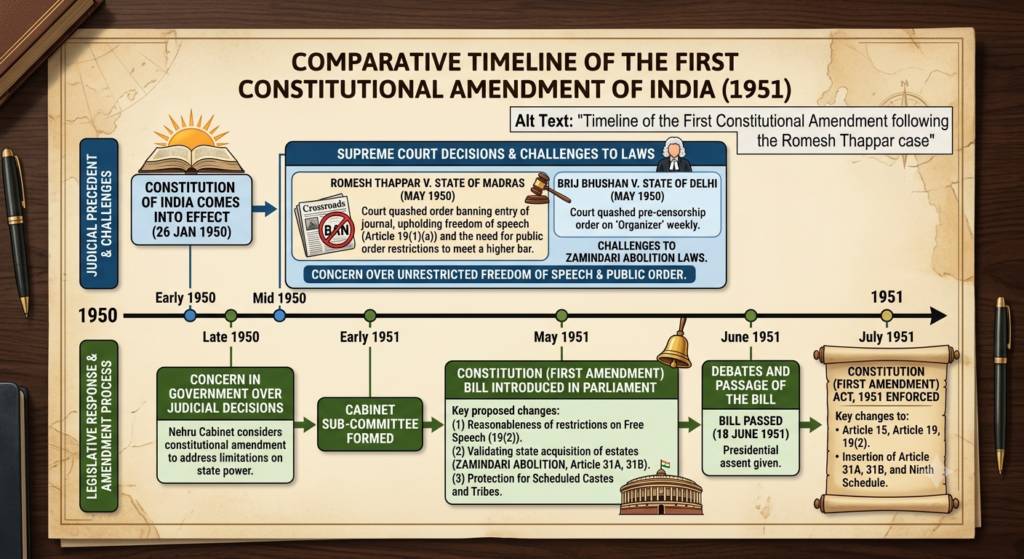
The decision in Romesh Thappar v. State of Madras created immediate operational difficulties for executive governance. Therefore, the government responded by passing the Constitution (First Amendment) Act, 1951.
The First Amendment altered the legal landscape through three key changes:
- It added “Public Order” into Article 19(2) as a valid ground for restricting speech.
- It added “Friendly relations with foreign States” and “Incite to an offence” as valid grounds.
- It required all restrictions imposed under Article 19(2) to be “reasonable”, making them subject to judicial review.
Key Takeaway: Although Parliament introduced “public order” into Article 19(2) via the First Amendment, the judgment permanently established judicial review over the reasonableness of executive restrictions.
Are you evaluating a potential breach of constitutional rights? Reach out to our legal research team today for comprehensive case law analysis and strategic consultation!
Frequently Asked Questions
What was the main ruling in Romesh Thappar v. State of Madras?
The Supreme Court ruled that freedom of speech under Article 19(1)(a) includes the freedom of circulation. Additionally, the Court held that broad public order concerns could not justify banning publications under the original text of Article 19(2).
Why did Romesh Thappar approach the Supreme Court directly?
Romesh Thappar filed a writ petition directly under Article 32 because the Government of Madras banned his weekly journal, Cross Roads. The Supreme Court confirmed that individuals can approach it directly to enforce Fundamental Rights without exhausting lower court remedies first.
How did the government react to the Romesh Thappar judgment?
Parliament passed the Constitution (First Amendment) Act, 1951. This amendment added “public order” and “incitement to an offence” to Article 19(2), while requiring all speech restrictions to meet a test of reasonableness.
What is the significance of the freedom of circulation in Indian law?
The judgment established that publishing content without the right to distribute and circulate it renders free speech meaningless. Freedom of circulation remains a foundational pillar of modern Indian press freedom law.