The tragic shooting of Prem Ahuja by Commander K.M. Nanavati transformed Indian criminal jurisprudence overnight. This historical conflict ultimately led to the abolition of the jury trial system across India.
Written by Kapil Balhara | Technically Reviewed for Accuracy | Last Updated: August 2026
Table of Contents
- What is K.M. Nanavati vs State of Maharashtra?
- Factual Matrix of the Case
- Core Legal Issues and Statutory Framework
- Landmark Supreme Court Judgment and Legal Principles
- Comparative Legal Analysis
- Frequently Asked Questions
What is K.M. Nanavati vs State of Maharashtra?
Definition/Summary Block: K.M. Nanavati vs State of Maharashtra (1962 AIR 605) is a landmark Supreme Court case that abolished jury trials in India. It established crucial legal standards regarding murder under Section 300 IPC, the defence of grave and sudden provocation, and the burden of proof under Section 105 of the Evidence Act.
Factual Matrix of the Case
Commander K.M. Nanavati was a second-in-command officer in the Indian Navy married to Sylvia. Due to his long assignments at sea, Sylvia developed an illicit relationship with Prem Bhagwandas Ahuja, a businessman based in Bombay.
On April 27, 1959, Sylvia confessed her infidelity to Nanavati. Enraged by this confession, Nanavati dropped his family at a cinema hall, went to his naval ship, and procured a semi-automatic revolver with six rounds under false pretences.
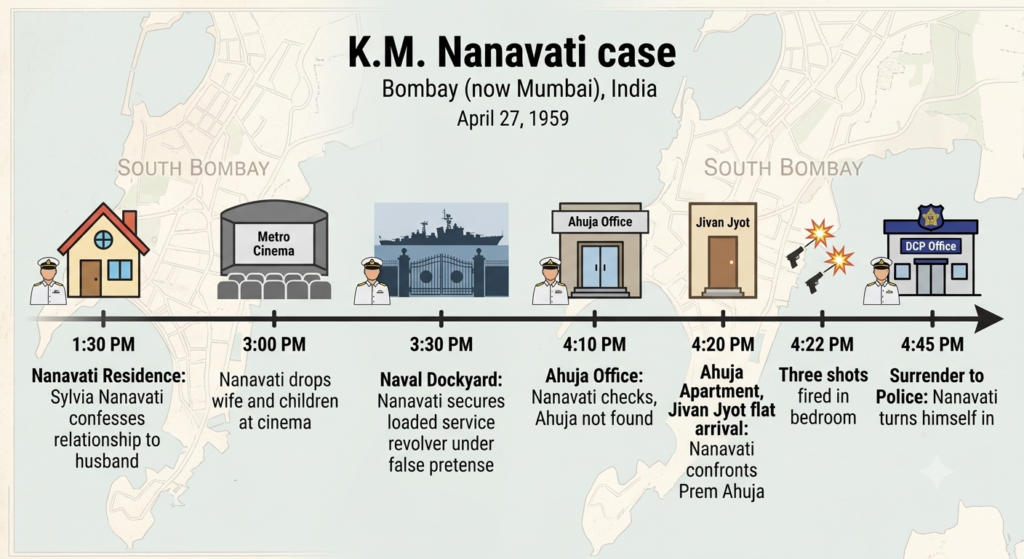
He then drove directly to Ahuja’s residence at Jivan Jyot. Upon entering the bedroom, an altercation ensued between the two men. Nanavati fired three shots, resulting in the immediate death of Ahuja. He then surrendered to the police.
Core Legal Issues and Statutory Framework
The primary legal dispute centered on whether the offense committed fell under murder or culpable homicide.
The Plea of Grave and Sudden Provocation
The defence argued that the shooting occurred due to grave and sudden provocation. They claimed two shots went off accidentally during a physical struggle.
Furthermore, the defence invoked Exception 1 to Section 300 IPC. However, the prosecution maintained that sufficient time had elapsed between the confession and the shooting, allowing a critical cooling off period.
Key Takeaway: The presence of a cooling off period negates the plea of sudden provocation because it allows time for premeditation and calculation.
Burden of Proof and Statutory Presumptions
Under Section 105 of the Indian Evidence Act, when an accused pleads a General Exception under the IPC, the court presumes the absence of such circumstances.
Presumption of Innocence (Prosecution Burden) ──> Rebuttal of Exceptions (Section 105, Accused Burden)
As a result, the burden of proving that the incident was accidental rests entirely on the accused.
Landmark Supreme Court Judgment and Legal Principles
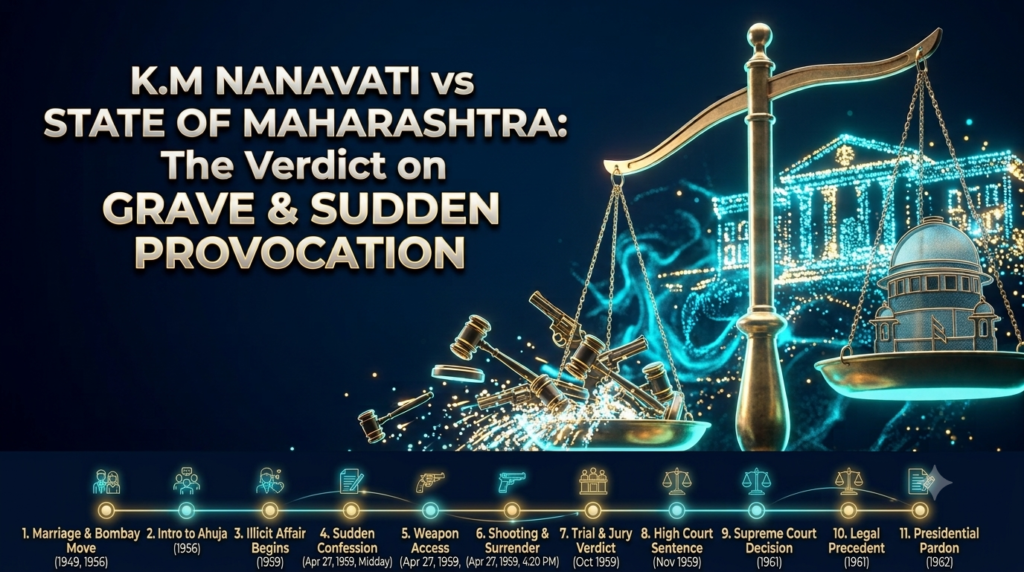
The Sessions Court jury returned a 8:1 verdict of “not guilty”. Disagreeing with this outcome, Sessions Judge Referred the matter to the High Court under Section 307 CrPC.
The Bombay High Court overturned the jury’s verdict and convicted Nanavati under Section 302 IPC. On appeal, the Supreme Court upheld the conviction.
Link to Download K.M. Nanavati vs State of Maharashtra Judgement
The Apex Court laid down four critical rules regarding provocation:
- Words and gestures can cause grave provocation under Indian conditions.
- The test of provocation relies on whether a reasonable person of the same class would lose self-control.
- The fatal act must trace directly to the passion arising from the provocation.
- The provocation must not offer scope for premeditation or calculation.
Comparative Legal Analysis
Our analysis reveals distinct differences in how key legal aspects were evaluated across the trial stages:
| Legal Parameter | Sessions Court Jury View | High Court & Supreme Court View |
|---|---|---|
| Primary Verdict | Not Guilty (8:1 Majority) | Guilty under Section 302 IPC |
| Provocation Test | Treated as sudden provocation | Rejected due to cooling off period |
| Burden of Proof | Misdirected on Section 105 Evidence Act | Strictly applied Section 105 against accused |
| Jury System Effect | Influenced by media coverage | Led directly to abolition of jury trials |
Specifically, this decision permanently transformed Indian criminal procedure.
Key Takeaway: The Supreme Court clarified that jury verdicts can be set aside if misdirections in the charge to the jury lead to a failure of justice.
Frequently Asked Questions
Why did the Nanavati case end jury trials in India?
The case highlighted how lay jurors could be swayed by media campaigns and public emotional bias. Consequently, the Indian government abolished jury trials in subsequent criminal procedure reforms.
What is the significance of the cooling off period under Section 300 IPC?
A cooling off period provides time for passion to subside and premeditation to take over. If a cooling off period exists between the provocation and the act, Exception 1 to Section 300 IPC cannot apply.
Who bears the burden of proof when claiming accident under Section 80 IPC?
Under Section 105 of the Indian Evidence Act, the burden of proving circumstances that bring a case within Section 80 IPC rests on the accused.
Need legal assistance with criminal appeals or constitutional matters? Contact Kapil Balhara at Placitum Advocates to secure expert guidance on your case.