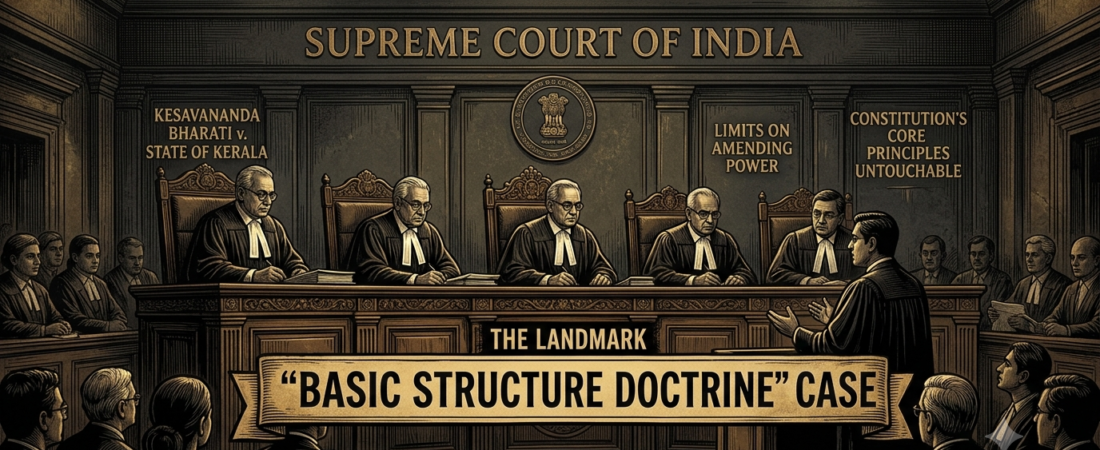
Table of Contents
- Introduction to the Landmark Election Case
- What is Indira Nehru Gandhi v. Raj Narain?
- Key Legal Issues and Constitutional Amendments
- High Court vs. Supreme Court Verdicts
- Impact on the Basic Structure Doctrine
- Frequently Asked Questions
1. Introduction to the Landmark Election Case
In our legal analysis of constitutional law, few cases carry the historical weight of Indira Nehru Gandhi v. Raj Narain. This landmark judgment redefined the limits of executive power, constitutional amendments, and judicial independence in India.
The case originated from an election petition challenging the 1971 Lok Sabha election result from the Rae Bareli constituency. Smt. Indira Nehru Gandhi had won the election by a wide margin. However, her political opponent, Shri Raj Narain, contested the victory in the Allahabad High Court. He alleged that the Prime Minister had committed corrupt practices under election laws.
Written by Kapil Balhara | Technically Reviewed for Accuracy | Last Updated: October 2026
2. What is Indira Nehru Gandhi v. Raj Narain?
Key Takeaway: Understanding the exact legal definition of this historic constitutional battle is essential for grasping Indian constitutional jurisprudence.
Indira Nehru Gandhi v. Raj Narain is a landmark 1975 Supreme Court case (AIR 1975 SC 2299) that invalidated Clause (4) of the 39th Constitutional Amendment. The Court held that stripping judicial review over Prime Ministerial elections violates the basic structure of the Constitution, specifically the principles of free and fair elections and the Rule of Law.
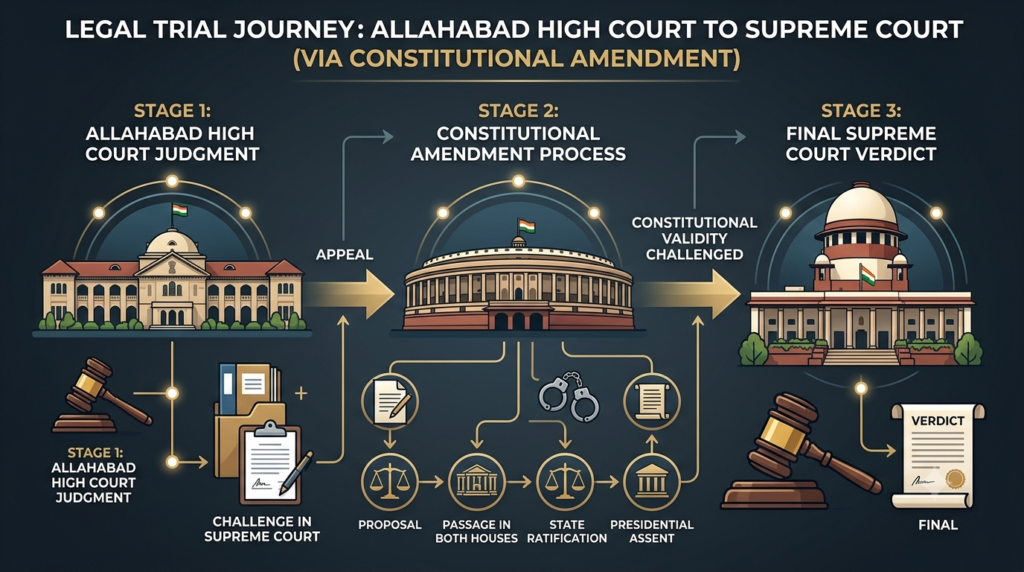
3. Key Legal Issues and Constitutional Amendments
When we evaluated the historical trial records, several core legal issues stood out regarding statutory election provisions and constitutional boundaries:
- Allegations of Corrupt Practices: The election petition alleged misuse of government machinery, including obtaining assistance from gazetted officers and utilizing military aircraft.
- The 39th Constitutional Amendment: During the appeal’s pendency, Parliament passed Article 329A. Clause (4) declared the Prime Minister’s election valid notwithstanding any court judgment.
- Retrospective Statutory Amendments: Parliament enacted the Election Laws (Amendment) Act 40 of 1975 to change definitions of a “candidate” and “official duty” retrospectively.
Key Takeaway: Retrospective changes to ordinary election statutes are constitutionally valid, but altering the basic structure via constitutional amendment is strictly impermissible.
4. High Court vs. Supreme Court Verdicts
The Allahabad High Court found Smt. Indira Gandhi guilty of corrupt practices under Section 123(7) of the Representation of the People Act, 1951. Consequently, the High Court disqualified her from holding public office for six years.
However, the Supreme Court evaluated the matter under altered statutory provisions. The Constitution Bench unanimously upheld the statutory amendments to election laws while striking down Clause (4) of Article 329A.
| Feature / Aspect | Allahabad High Court Verdict (12 June 1975) | Supreme Court Verdict (7 November 1975) |
|---|---|---|
| Status of Resignation (Yashpal Kapur) | Held effective only upon official Gazette publication. | Held effective from the date of actual resignation. |
| Use of State Machinery / Rostrums | Found to be a corrupt practice under Section 123(7). | Validated under official security duty exceptions. |
| 39th Amendment, Clause (4) | Not in existence during trial. | Struck down as unconstitutional (Violates Basic Structure). |
| Election Status | Declared Void; 6-year disqualification imposed. | Declared Valid due to valid statutory changes. |
5. Impact on the Basic Structure Doctrine
In our analysis of the Kesavananda Bharati framework, this case marked the first time the Supreme Court applied the Basic Structure Doctrine to strike down a Constitutional Amendment.
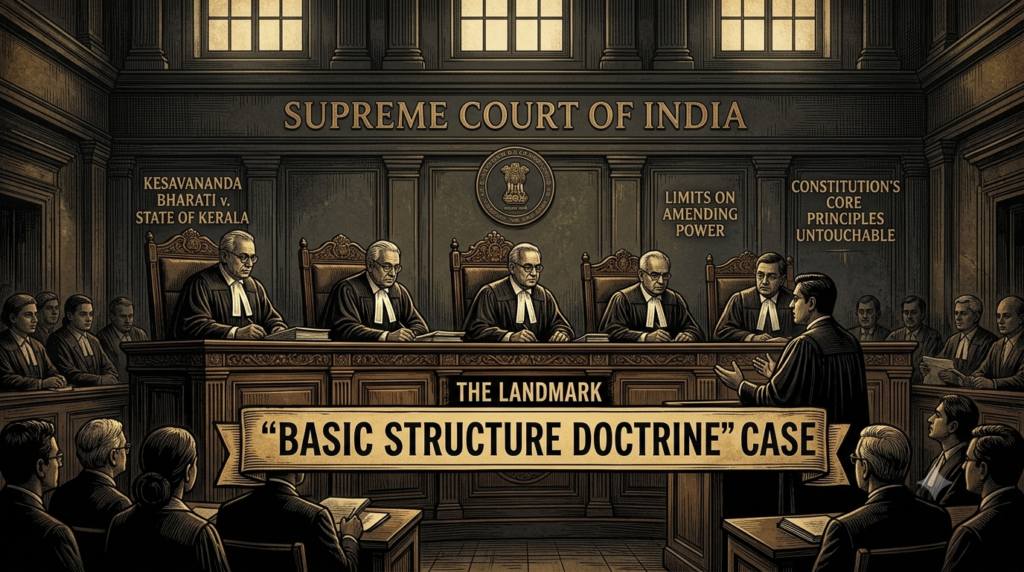
To understand how the Court applied these concepts, follow these key judicial determinations:
- Reaffirmation of Kesavananda Bharati: The Bench confirmed that Parliament’s amending power under Article 368 cannot destroy essential constitutional features.
- Rule of Law and Equality: Khanna, Mathew, and Chandrachud, JJ., held that validating a specific election without applying legal standards violates the Rule of Law and Article 14.
- Free and Fair Elections: The Court ruled that democracy mandates genuine, unimpeded electoral dispute adjudication.
- Separation of Powers: The Bench emphasized that Parliament cannot perform pure judicial functions by passing legislative judgments on private election disputes.
Key Takeaway: The judiciary serves as an essential check against legislative usurpation of judicial functions.
6. Frequently Asked Questions
Q1. Why is Indira Gandhi v. Raj Narain significant in Indian legal history?
It was the first case where the Supreme Court applied the Basic Structure doctrine to strike down a constitutional amendment, specifically Article 329A(4).
Q2. What was Clause (4) of Article 329A?
Clause (4) sought to void the Allahabad High Court judgment, making the Prime Minister’s election immune from judicial review and valid under all circumstances.
Q3. Did the Supreme Court uphold Smt. Indira Gandhi’s election victory?
Yes, the Supreme Court upheld her election because Parliament had retrospectively amended ordinary election laws, which altered the legal basis of the High Court’s findings.
Q4. Was the ‘Cow and Calf’ symbol ruled a religious symbol?
No, the Supreme Court explicitly held that the “Cow and Calf” symbol allotted by the Election Commission was not a religious symbol under Section 123(3) of the Act.
Conclusion
The judgment in Indira Nehru Gandhi v. Raj Narain remains an enduring pillar of Indian constitutional law. It firmly established that while Parliament possesses broad authority to enact and amend ordinary legislation, it cannot erase judicial review or dismantle the democratic framework of the nation. For legal professionals, researchers, and students, this ruling represents the ultimate triumph of the Rule of Law over unchecked political authority.