Table of Contents
- Introduction to the Landmark Case
- Background and Key Legal Issues
- Supreme Court Ruling on Article 14 and Single Domicile
- Institutional Preference vs. Domicile Reservation
- Comparative Analysis of Admission Rules
- Frequently Asked Questions
Introduction to the Landmark Case
In the historic judgment of Pradeep Jain v. Union of India, the Supreme Court evaluated wholesale domicile reservation in professional education. Furthermore, this decision struck down state rules that barred outside candidates from competing for medical seats.
Written by Kapil Balhara | Technically Reviewed for Accuracy | Last Updated: October 2026
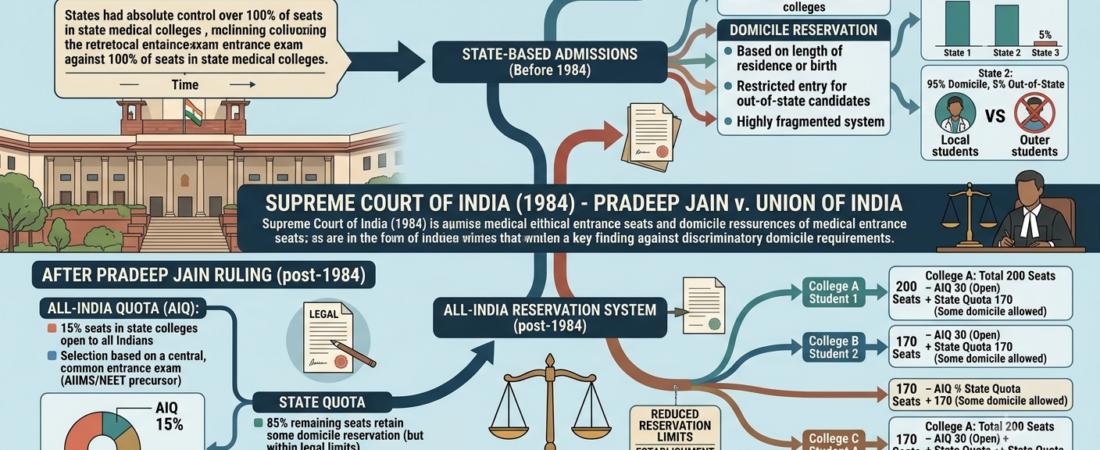
Pradeep Jain v. Union of India (1984) is a landmark Supreme Court case that ruled, wholesale domicile reservation in medical admissions violative of Article 14. The judgment established all-India quotas for MBBS and post-graduate courses. Consequently, it affirmed that India recognizes only one single domicile.
Our legal analysis shows that this decision protected merit in higher education. Specifically, the judgment prevented regional quota rules from destroying academic excellence.
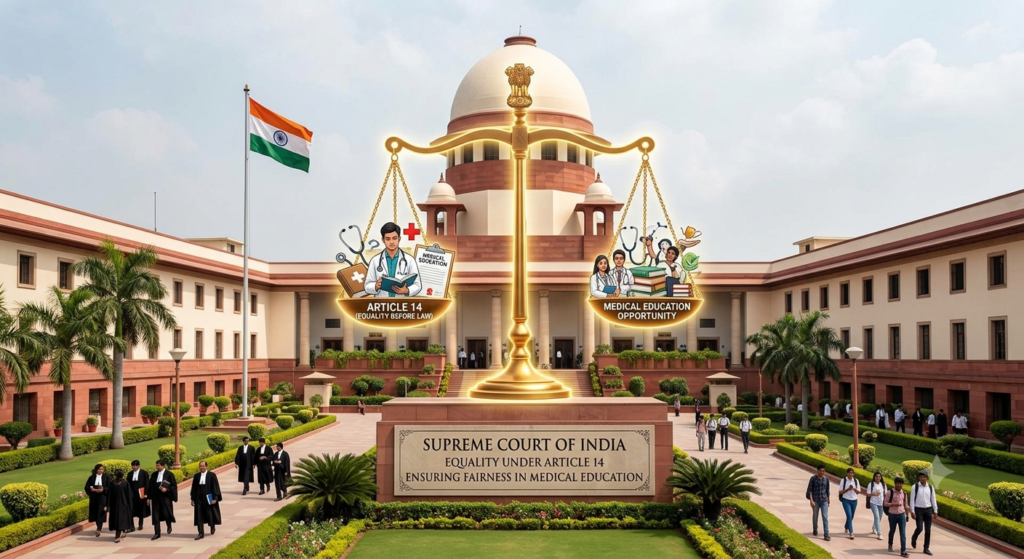
Key Takeaway: The Supreme Court held that India has only one single domicile, meaning no state can treat citizens from other regions as outsiders.
Background and Key Legal Issues
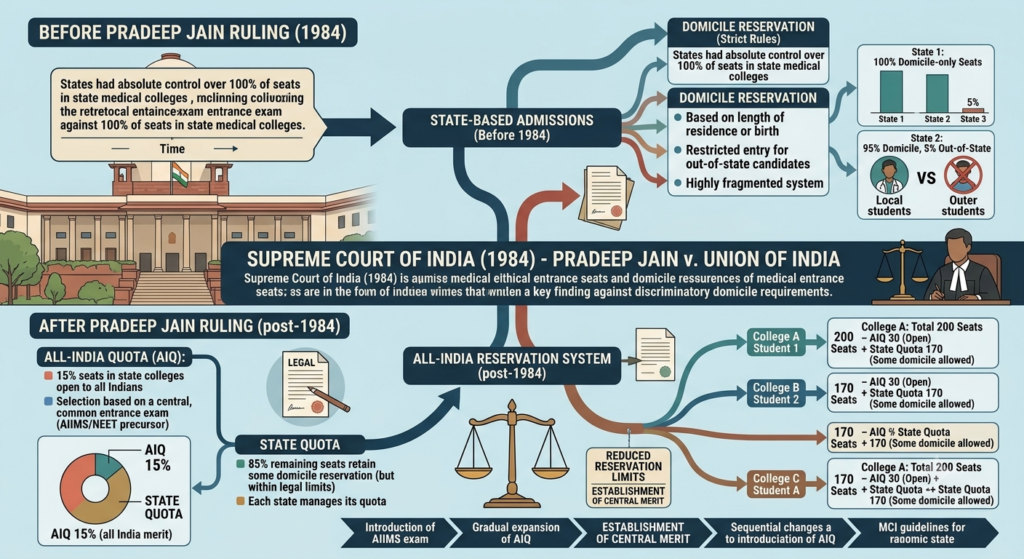
The legal dispute arose when MBBS and MDS aspirants challenged state-wise residence requirements across various universities. For instance, candidates in Delhi, Karnataka, and Uttar Pradesh faced strict local quota rules.
In addition, various state governments enforced rules requiring continuous residence ranging from 3 to 20 years. Consequently, highly meritorious students were denied admission simply because they lacked local residence qualifications.
Moreover, the petitioners argued that wholesale domicile reservation violates Article 14 of the Constitution. Thus, the main legal issue was whether states could give complete preference to local applicants irrespective of merit.
Supreme Court Ruling on Article 14 and Single Domicile
In our evaluation, the judgment delivered by Justice P.N. Bhagwati established a vital precedent in constitutional law. Furthermore, the court clarified that Article 5 of the Constitution recognizes only one domicile, which is the domicile in India.
- Single Domicile Principle: The court observed that India is one unified nation with single citizenship. Therefore, the concept of a separate state domicile is legally unsustainable.
- Article 14 Mandate: The bench held that excluding meritorious candidates solely based on residence creates arbitrary discrimination.
- Creation of All-India Quota: The court mandated that at least 30% of open MBBS seats must be filled purely on all-India merit.
Key Takeaway: Equal opportunity under Article 14 requires that primary selection criteria must prioritize academic merit while limiting regional preferences.
Midway through analyzing this historic precedent, legal researchers can bookmark our constitutional repository for further authoritative case summaries.
Institutional Preference vs. Domicile Reservation
The judgment carefully distinguished between state-wise domicile reservation and institutional preference for advanced studies. Consequently, the bench recognized that institutional continuity holds legitimate academic value.
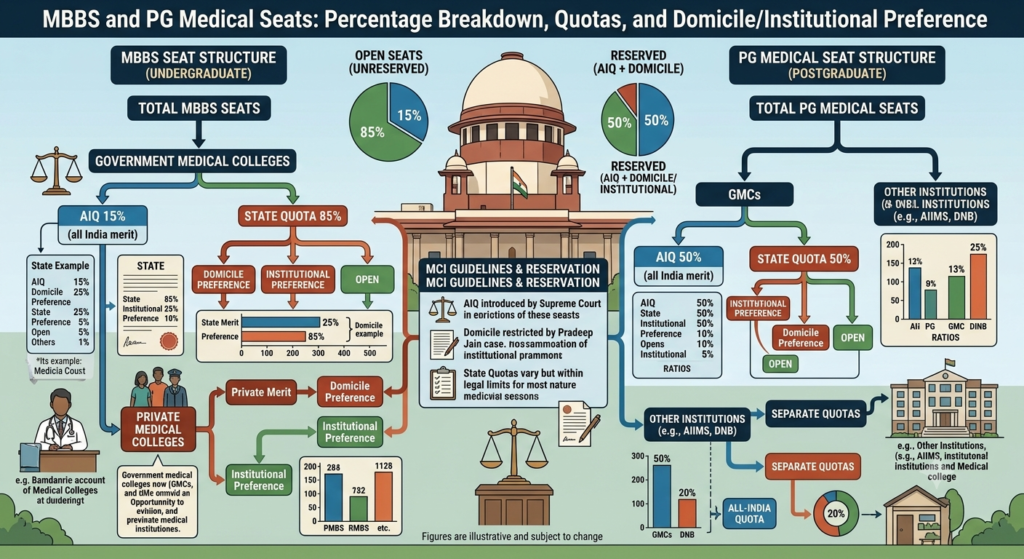
- Undergraduate MBBS/BDS: The court capped total local reservations, including institutional preferences, at an outer limit of 70%.
- Post-Graduate MD/MS: The bench ruled that state residence cannot be a ground for reservation in post-graduate seats. However, institutional preference was permitted up to a maximum of 50%.
- Super Specialities: In disciplines like neurosurgery and cardiology, the court prohibited all reservations, requiring 100% selection on all-India merit.
Additionally, Justice Amarendra Nath Sen concurred with the directions, emphasizing that national interest requires uncompromised excellence in super-specialist training.
Key Takeaway: At higher levels of specialized education, merit must remain the overriding criterion to prevent devaluation of professional expertise.
Comparative Analysis of Admission Rules
To understand the structural reforms introduced by this judgment, we evaluated the constitutional standards applied to different tiers of medical education:
| Education Level | Domicile/Residence Reservation | Institutional Preference | All-India Merit Quota |
|---|---|---|---|
| MBBS / BDS | Permitted up to outer limit of 70% combined. | Included within the 70% local ceiling. | Minimum 30% open to all-India entrance. |
| MD / MS / MDS | Completely prohibited based on residence. | Permitted up to a maximum limit of 50%. | Minimum 50% open to all-India merit. |
| Super Specialities | Completely prohibited. | Completely prohibited. | 100% open based strictly on national merit. |
Frequently Asked Questions
Q1. What was the central ratio decidendi of Pradeep Jain v. Union of India?
The core ratio decidendi is that wholesale reservation based on residence or domicile violates Article 14. Therefore, states must reserve an all-India quota in professional medical admissions to preserve competitive merit.
Q2. Does the Indian Constitution allow states to have separate domiciles?
No, Article 5 of the Constitution establishes a single Indian domicile. Consequently, states cannot create independent state-level domiciles to restrict constitutional freedoms.
Q3. Why are reservations prohibited in super-specialty medical courses?
The court held that super-specialty fields demand exceptional skill and capability. Thus, compromising merit in vital specialities like cardiology or neurosurgery creates grave national risks.
Conclusion
Ultimately, Pradeep Jain v. Union of India remains a cornerstone of constitutional jurisprudence regarding educational admissions. By striking down oppressive local quotas, the Supreme Court successfully safeguarded equal opportunity while upholding national integrity.