Table of Contents
- Introduction to the Landmark Case
- Background and Key Legal Issues
- Supreme Court Ruling on Article 72 and Judicial Review
- Oral Hearing Rights and Executive Guidelines
- Comparative Analysis of Executive and Judicial Powers
- Frequently Asked Questions
Introduction to the Landmark Case
In the historic judgment of Kehar Singh v. Union of India, the Supreme Court evaluated the constitutional scope of presidential mercy under Article 72. Furthermore, this decision clarified how executive clemency operates independently alongside judicial verdicts.
Written by Kapil Balhara | Technically Reviewed for Accuracy | Last Updated: October 2026
Our legal analysis shows that this decision protected executive discretion under constitutional checks. Specifically, the judgment prevented state authorities from improperly restricting mercy petition reviews.
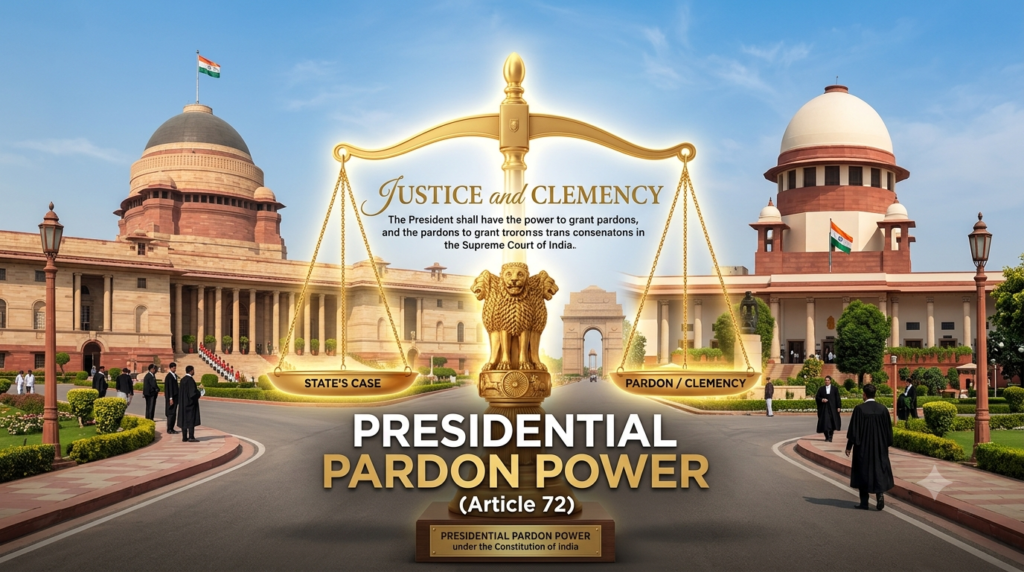
Key Takeaway: The Supreme Court ruled that the President acts on a distinct constitutional plane when granting pardons, without altering or superseding the judicial record.
Background and Key Legal Issues
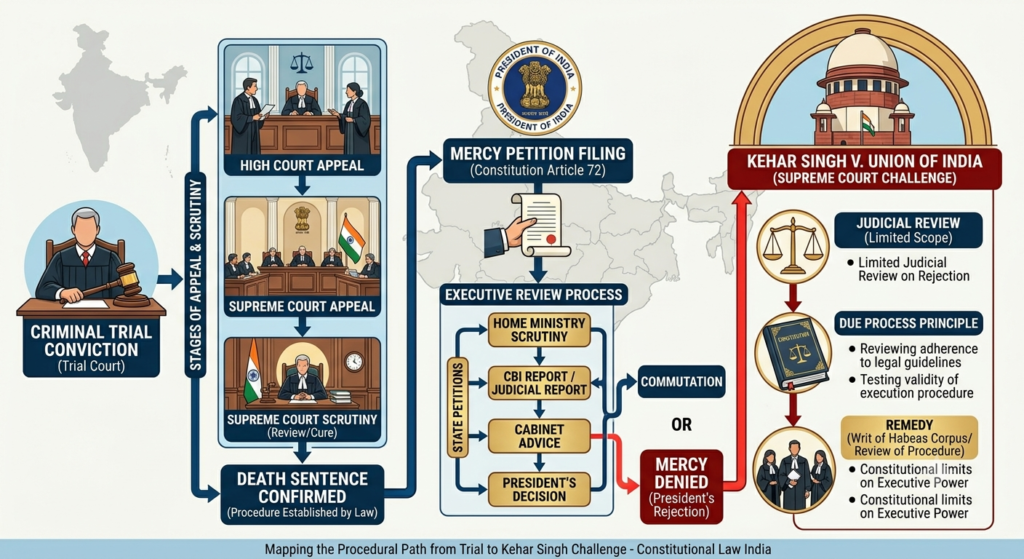
The controversy arose following the trial for the assassination of former Prime Minister Indira Gandhi. Subsequently, Kehar Singh received a death sentence under Section 120-B read with Section 302 of the Indian Penal Code.
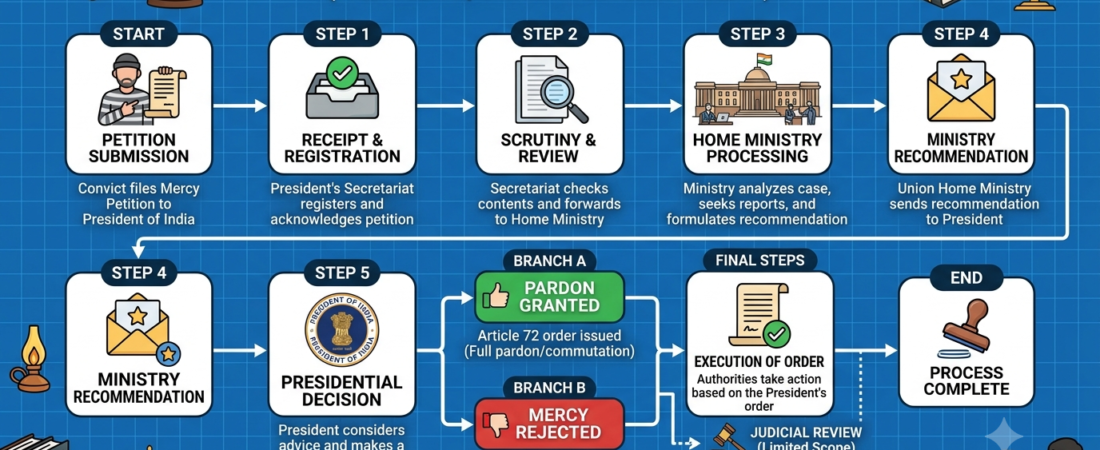
After the Supreme Court dismissed his appeals and review petitions, Kehar Singh’s son submitted a mercy petition under Article 72. For instance, the petition urged that the trial evidence contained errors and requested an oral hearing before the President.
However, the President’s secretariat rejected the request, stating the President could not re-examine evidence decided by the highest court. Consequently, counsel challenged this decision through writ petitions under Article 32.
Supreme Court Ruling on Article 72 and Judicial Review
In our evaluation, the Constitution Bench led by Chief Justice R.S. Pathak delivered an authoritative decision. Furthermore, the court held that the President possesses the full authority to examine trial evidence on merits.
- Independent Scrutiny Power: The President can evaluate criminal evidence and reach conclusions different from the court.
- Distinct Constitutional Plane: Presidential clemency does not erase or modify the judicial judgment itself; rather, it remits or eliminates the sentence.
- Bound by Executive Advice: Under Article 74(1), the President exercises mercy powers upon the advice of the Central Government.
Key Takeaway: The President is not precluded from entering into the merits of a case decided finally by the Supreme Court.
Midway through reviewing these constitutional principles, legal scholars can bookmark our analysis repository to explore complementary statutory reviews.
Oral Hearing Rights and Executive Guidelines
The Supreme Court thoroughly analyzed whether a condemned prisoner can insist on a personal hearing before the President. Consequently, the bench rejected the claim for a mandatory oral argument.
- Executive Nature: Mercy proceedings remain executive in character, leaving presentation methods to the President’s discretion.
- No Rigid Guidelines Needed: The court declined to prescribe rigid rules for Article 72, noting that situations vary vastly across cases.
- Judicial Review Scope: While the court can examine whether executive self-denial occurred, it cannot review mercy decisions on pure merits.
Additionally, because the President acted under an erroneous view of Article 72 power, the court directed a fresh consideration of the mercy petition.
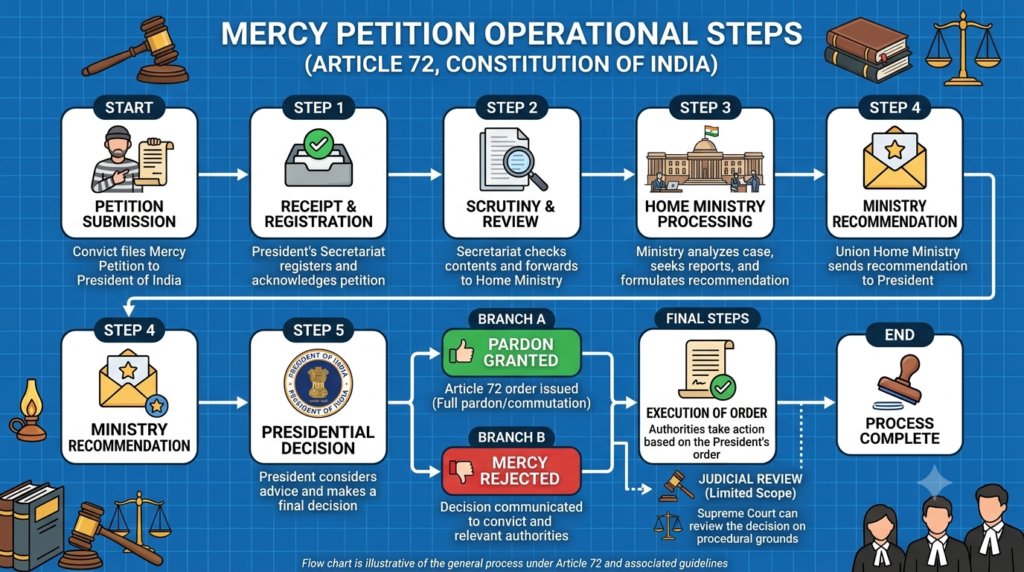
Key Takeaway: While convicts cannot demand oral hearings, the courts retain jurisdiction to ensure executive authorities do not misinterpret their constitutional power.
Comparative Analysis of Executive and Judicial Powers
To understand the legal mechanics defined by this case, we evaluated the functional distinctions between judicial decisions and executive clemency:
| Dimension / Feature | Judicial Power (Courts) | Executive Clemency (Article 72) |
|---|---|---|
| Primary Function | Determines guilt and passes sentence based on strict legal rules. | Grants relief from undue harshness or evident mistake. |
| Evidence Scrutiny | Bounded by procedural laws and statutory evidence standards. | Can scrutinize record freely on broader grounds of justice. |
| Hearing Procedure | Requires open court oral arguments and adversarial trials. | Decided on written submissions without mandatory oral hearing. |
Frequently Asked Questions
Q1. What was the central ratio decidendi of Kehar Singh v. Union of India?
The primary ratio decidendi is that the President under Article 72 can scrutinize trial evidence on merits independently of judicial findings. However, the convict has no constitutional right to insist on an oral hearing.
Q2. Does a Presidential pardon alter or overrule a Supreme Court judgment?
No, executive clemency operates on a different plane. It remits or eliminates the punishment without altering or superseding the judicial record itself.
Q3. Can courts subject Presidential mercy orders to judicial review?
Judicial review applies only to determine whether the authority understood the amplitude of its power or acted arbitrarily. Courts do not review the mercy decision on its pure merits.
Conclusion
Ultimately, Kehar Singh v. Union of India remains a foundational authority on constitutional mercy jurisprudence. By confirming that executive clemency can re-examine case merits while respecting judicial integrity, the Supreme Court preserved a critical safeguard for human liberty.