Supreme Court Advocates-on-Record Association (SCAORA) v. Union of India (1993), also known as the Second Judges Case, is a landmark nine-judge Supreme Court ruling that established the primacy of the Chief Justice of India in judicial appointments. It effectively created the Collegium System, shifting appointment power from the executive to the judiciary.
Written by Kapil Balhara | Technically Reviewed for Accuracy | Last Updated: October 2026
In our analysis of Indian constitutional jurisprudence, few decisions match the structural impact of the Second Judges Case. This ruling fundamentally altered how judges are selected for higher courts across India. Consequently, it established a strong shield for judicial independence.
scaora v union of india supreme court
Historical Context: From First Judges Case to Second Judges Case
To understand this milestone, we must first review the legal landscape preceding 1993. The journey began with S.P. Gupta v. Union of India (1981), commonly called the First Judges Case.
In the S.P. Gupta decision, a seven-judge bench held that the executive held ultimate power over judicial appointments. Furthermore, the court ruled that “consultation” with the Chief Justice did not mean concurrence. Therefore, the Central Government could override judicial recommendations.
S.P. Gupta Case (1981)          --> Executive Primacy Established
Subhash Sharma Order (1990)     --> Referred Question to 9-Judge Bench
SCAORA v. Union of India (1993) --> Judicial Primacy & Collegium Born
However, this framework led to growing concerns over political interference in judicial selections. Subsequently, in Subhash Sharma v. Union of India (1990), the Supreme Court questioned the correctness of S.P. Gupta. As a result, a nine-judge bench was constituted to reconsider judicial primacy and judge strength fixation.
Key Constitutional Provisions: Article 124, Article 217, and Article 222
The dispute centered on interpreting three essential constitutional articles.
Constitutional Framework for Judicial Appointments
Article 124(2): Governs Supreme Court judge appointments. It states the President appoints judges after “consultation” with specified judges, making consultation with the CJI mandatory.
Article 217(1): Regulates High Court judge appointments. It mandates consultation with the CJI, the Governor, and the High Court Chief Justice.
Article 222(1): Empowers the President to transfer High Court judges after consulting the CJI.
Key Takeaway: The central debate turned on whether “consultation” required executive compliance or merely advisory discussion.
The petitioners argued that “consultation” must mean concurrence to protect judicial independence under Article 50. Conversely, the Union of India argued that Constituent Assembly debates showed the framers rejected judicial veto power.
The Majority Ruling: Primacy of the Chief Justice and Collegium Origin
On October 6, 1993, the nine-judge bench delivered a 7:2 majority decision. Justice J.S. Verma authored the leading opinion for himself and four colleagues, supported separately by Justices S. Ratnavel Pandian and Kuldip Singh.
================================================================================
                      COLLEGIUM STRUCTURE (1993 RULING)
================================================================================
 Supreme Court Appointments : CJI + 2 Senior-most SC Judges
 High Court Appointments    : CJI + 2 Senior-most SC Judges + HC Functionaries
 High Court Transfers       : CJI + Determinative Judicial Opinion
================================================================================
Core Principles Established by the Court
Primacy of the Judiciary: The CJI’s opinion carries primary weight in appointments and transfers.
Creation of the Collegium: The CJI’s opinion must be formed collectively alongside the two senior-most Supreme Court judges.
Binding Recommendations: The executive cannot appoint any candidate not approved by the CJI-led Collegium.
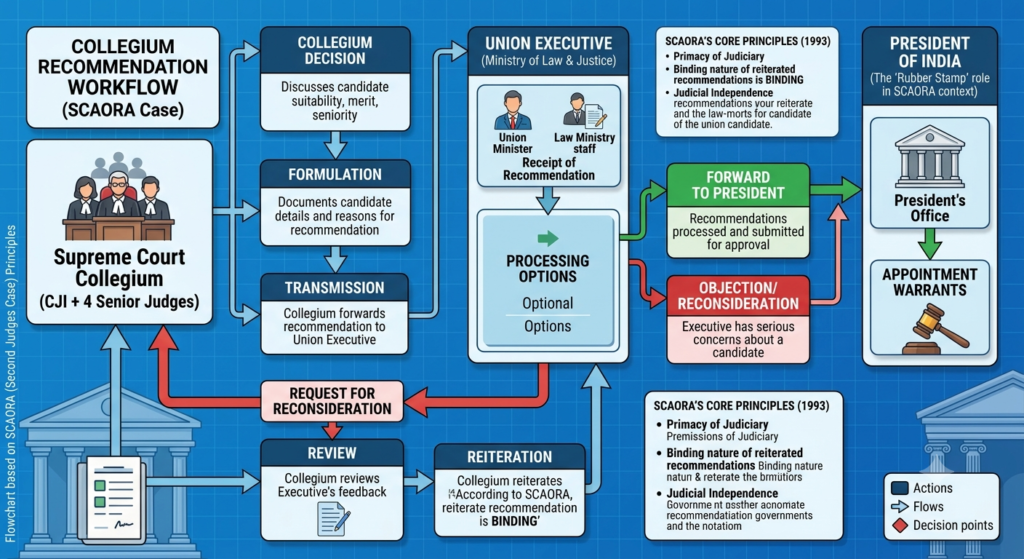
Limited Executive Veto: The executive may request reconsideration based on background checks, but must make the appointment if the Collegium unanimously reiterates its proposal.
Key Takeaway: The court ruled that judicial selection must be a participatory consultative process, but final selection authority rests with the judiciary.
Collegium system judicial appointment workflow diagram SCAORA case
Comparative Analysis: S.P. Gupta v. SCAORA v. Union of India
To clarify this legal shift, we compare the two decisions below:
Legal Aspect
S.P. Gupta Case (1981)
SCAORA v. Union of India (1993)
Primary Authority
Central Executive
Chief Justice of India & Collegium
Meaning of Consultation
Non-binding advisory dialogue
Pluralistic consultation with binding primacy
Initiation of Proposal
Executive or Judiciary
Must originate from Judicial Heads
High Court Judge Strength
Non-justiciable executive discretion
Justiciable under Article 216
Judicial Review Scope
Broader executive discretion
Limited to lack of consultation or eligibility
In our analysis of these rulings, the 1993 judgment significantly strengthened institutional autonomy by removing executive veto power.
Impact on Judicial Independence and Fixation of Judge Strength
In addition to appointments, the court addressed judge strength fixation under Article 216. Overturning S.P. Gupta, the bench held that judge strength fixation is justiciable.
Furthermore, the court ruled that failing to provide adequate judge strength violates the right to speedy justice under Article 21. Therefore, courts can issue directives requiring the executive to review and fix judge strength based on workload.
Judicial independence scales of justice Constitution of India
Besides judge strength, the ruling placed High Court transfers under Article 222 strictly within judicial oversight. Consequently, transfers recommended by the CJI are deemed non-punitive and non-justiciable except for lack of consultation.
Key Takeaway: The Second Judges Case established structural protections that safeguard the judiciary from political pressure.
Ultimately, SCAORA v. Union of India re-architected Indian constitutional law. By placing judicial selection within the judicial branch, the Supreme Court fortified the Rule of Law and secured functional independence for higher courts across India.
Frequently Asked Questions
What is the Second Judges Case in Indian Constitutional Law?
The Second Judges Case refers to SCAORA v. Union of India (1993). In this case, a nine-judge Supreme Court bench established the primacy of the Chief Justice of India in judicial appointments, effectively creating the Collegium System.
How did SCAORA v. Union of India change judicial appointments?
The judgment overruled S.P. Gupta (1981) by transferring appointment authority from executive control to a judicial Collegium headed by the CJI. Consequently, the executive can no longer appoint judges without judicial approval.
Is judicial transfer justiciable after the Second Judges Case?
Judicial transfers recommended by the CJI under Article 222 are generally non-justiciable. Courts will only review transfers if made without mandatory CJI consultation.
Are you preparing a legal brief or researching landmark constitutional cases? Share your thoughts or questions in the comments below!