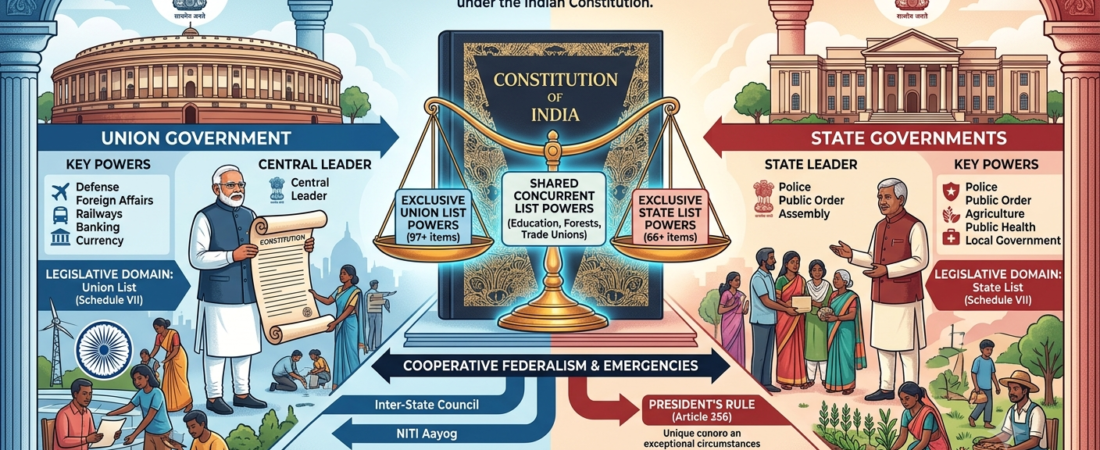
The arbitrary dismissal of state governments once threatened Indian democracy. However, the landmark judgment in S.R. Bommai v. Union of India changed everything by establishing strict judicial boundaries.
Written by Kapil Balhara | Technically Reviewed for Accuracy | Last Updated: October 2026
Table of Contents
- What is S.R. Bommai v. Union of India Case?
- Background and Key Legal Facts
- Core Issues Before the Nine-Judge Bench
- Key Rulings: Article 356, Floor Test, and Federalism
- Comparative Analysis Across Affected States
- Impact on Indian Constitutional Law
- Frequently Asked Questions
What is S.R. Bommai v. Union of India Case?
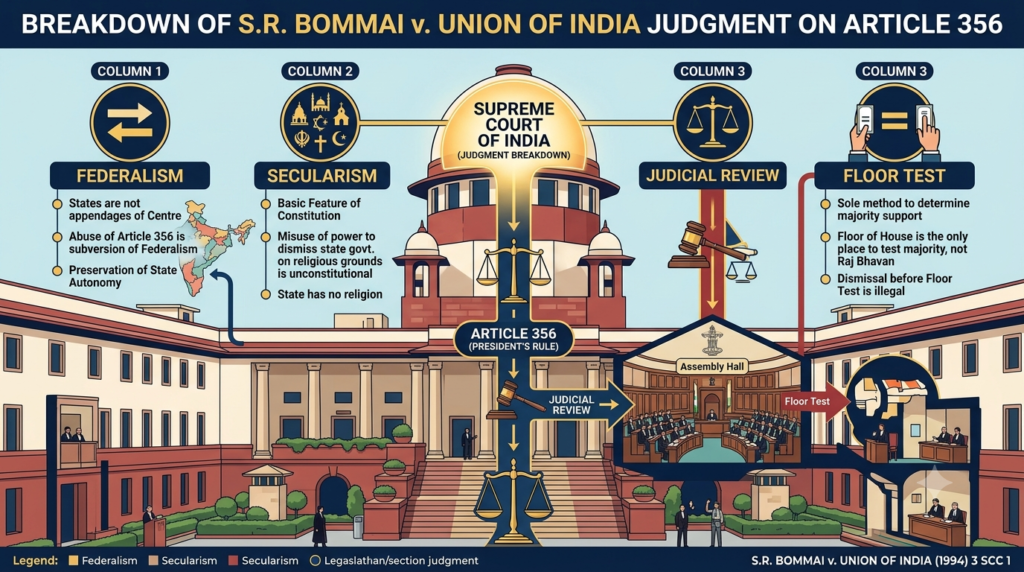
S.R. Bommai v. Union of India (1994) is a nine-judge landmark Supreme Court judgment that restricted the arbitrary misuse of Article 356. It declared federalism and secularism as basic structure features, while making a mandatory floor test the sole objective standard to prove a government’s legislative majority.
Background and Key Legal Facts
In September 1988, S.R. Bommai formed the Janata Dal ministry in Karnataka. Subsequently, in April 1989, twenty legislators defected, prompting the Governor to recommend President’s Rule.
Although seven MLAs promptly retracted their defections, Governor P. Venkatasubbaiah refused to allow a floor test. As a result, the Central Government dismissed the ministry and dissolved the Legislative Assembly.
Key Takeaway: The Governor dismissed a elected state government without testing its legislative strength on the floor of the House.
In addition to Karnataka, similar proclamations under Article 356 were challenged from Meghalaya, Nagaland, Madhya Pradesh, Himachal Pradesh, and Rajasthan.
Core Issues Before the Nine-Judge Bench
The Supreme Court examined several pivotal questions of constitutional interpretation:
- Judicial Review: Is the President’s proclamation under Article 356 subject to judicial scrutiny?
- Floor Test Obligation: Is a floor test mandatory before dismissing a state government?
- Article 74(2) Limits: Does the bar on inquiring into ministerial advice protect the underlying material?
- Basic Structure Test: Do secularism and federalism form part of the basic structure of the Constitution?
Key Rulings: Article 356, Floor Test, and Federalism
1. Scope of Judicial Review under Article 356
The Supreme Court ruled that Presidential satisfaction under Article 356 is not absolute. Consequently, courts can examine the objective material placed before the Union Council of Ministers.
- Objective Material Required: The President’s decision must rely on verifiable facts, not political whim.
- Mala Fide Actions: Courts will strike down any proclamation issued with bad faith or improper motives.
- Restoration Power: If a proclamation is declared unconstitutional, courts can restore the dismissed government and assembly.
2. Mandatory Floor Test
Furthermore, the bench established that the floor of the Legislative Assembly is the only constitutional forum to test a ministry’s majority.
- Step 1: The Governor receives claims that the ruling government has lost its majority.
- Step 2: The Governor summons the Legislative Assembly to conduct a floor test.
- Step 3: A open, public vote determines the ministry’s survival before invoking Article 356.
3. Interplay with Article 74(2) and Evidence Act
Although Article 74(2) prevents courts from asking what advice ministers gave the President, it does not hide the supporting material. Thus, the Union must produce the underlying facts when challenged.
Comparative Analysis Across Affected States
The court analyzed each state’s specific political context separately:
| State | Grounds for Imposition | Supreme Court Verdict | Legal Rationale |
|---|---|---|---|
| Karnataka | Defection of 19 MLAs; floor test denied | Unconstitutional | Bypassed mandatory floor test on unverified claims. |
| Meghalaya | Speaker ignored Supreme Court interim orders | Unconstitutional | Acting in direct violation of judicial orders was mala fide. |
| Nagaland | Allegations of political bargaining and insurgency | Unconstitutional | Denied alternative government chance without floor test. |
| Madhya Pradesh | Post-Babri Masjid demolition communal unrest | Upheld | Anti-secular acts violated the basic structure. |
| Himachal Pradesh | Participation of ministers in Kar Seva | Upheld | Failure to maintain secular governance standards. |
| Rajasthan | Non-enforcement of ban on certain groups | Upheld | Threat to national secular fabric justified intervention. |
Impact on Indian Constitutional Law
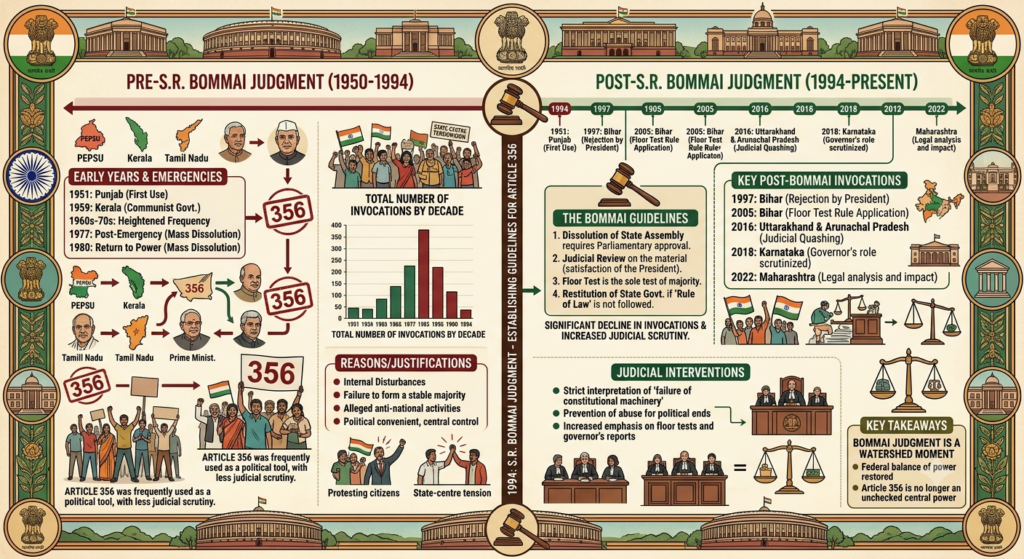
Key Takeaway: The S.R. Bommai ruling converted Article 356 from a political weapon into a true emergency provision of last resort.
In addition, the judgment cemented two foundational principles:
- Secularism as Basic Structure: The court held that state governments acting against secularism violate the Constitution’s core identity.
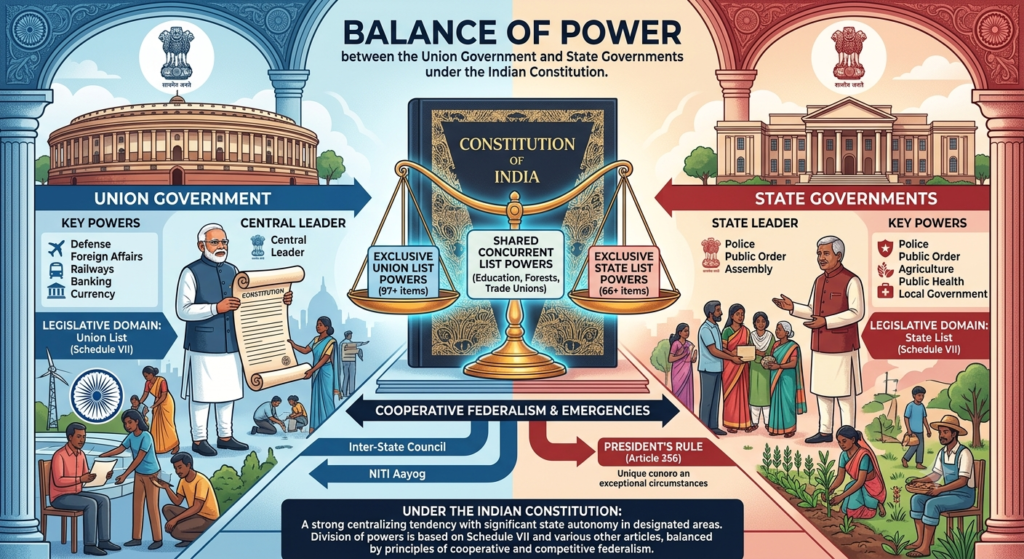
- Protection of State Autonomy: States are not administrative arms of the Central Government. Therefore, political differences between the Centre and States do not justify President’s Rule.
Frequently Asked Questions
1. Why is the S.R. Bommai case significant in Indian constitutional history?
The judgment placed strict legal controls on the power to impose President’s Rule under Article 356. It established that state governments cannot be dismissed arbitrarily based on political considerations.
2. Is a floor test always mandatory before imposing President’s Rule?
Yes, holding a floor test on the floor of the Legislative Assembly is the standard procedure to check a ruling party’s majority. Exceptions only exist in rare situations involving widespread, severe violence where voting is impossible.
3. Can the judiciary restore a dissolved Legislative Assembly?
Yes, if the court finds a proclamation under Article 356 unconstitutional, it has the authority to restore both the Legislative Assembly and the dismissed ministry.
4. How did the judgment define secularism in India?
The court held that secularism requires equal treatment of all religions by the State. Consequently, any state government attempting to subvert secularism violates the basic structure of the Constitution.