Table of Contents
- Introduction & Case Background
- What is Subhash Chandra Agarwal v. Supreme Court of India?
- Key Issues Addressed by the Constitution Bench
- Landmark Findings on Judicial Transparency
- The Delicate Balance: Right to Privacy vs. Right to Information
- Comparative Analysis of Disclosure Metrics
- Frequently Asked Questions
Introduction & Case Background
In our extensive legal research, few constitutional cases have reshaped governance as profoundly as Subhash Chandra Agarwal v. Supreme Court of India. Furthermore, this historic ruling established that the Office of the Chief Justice of India (CJI) falls under the definition of a “public authority” pursuant to the Right to Information Act, 2005 (RTI Act).
Written by Kapil Balhara | Technically Reviewed for Accuracy | Last Updated: October 2026
The long-standing conflict between institutional secrecy and democratic oversight came to a head when RTI activist Subhash Chandra Agarwal sought key judicial disclosures. Consequently, the Supreme Court of India held that judicial independence cannot serve as a shield against public accountability.
What is Subhash Chandra Agarwal v. Supreme Court of India?
Key Takeaway: The landmark judgment in Subhash Chandra Agarwal v. Supreme Court of India affirmed that the Office of the Chief Justice of India is a public authority under Section 2(h) of the RTI Act. It established that judicial independence and judicial accountability work together to uphold public trust.
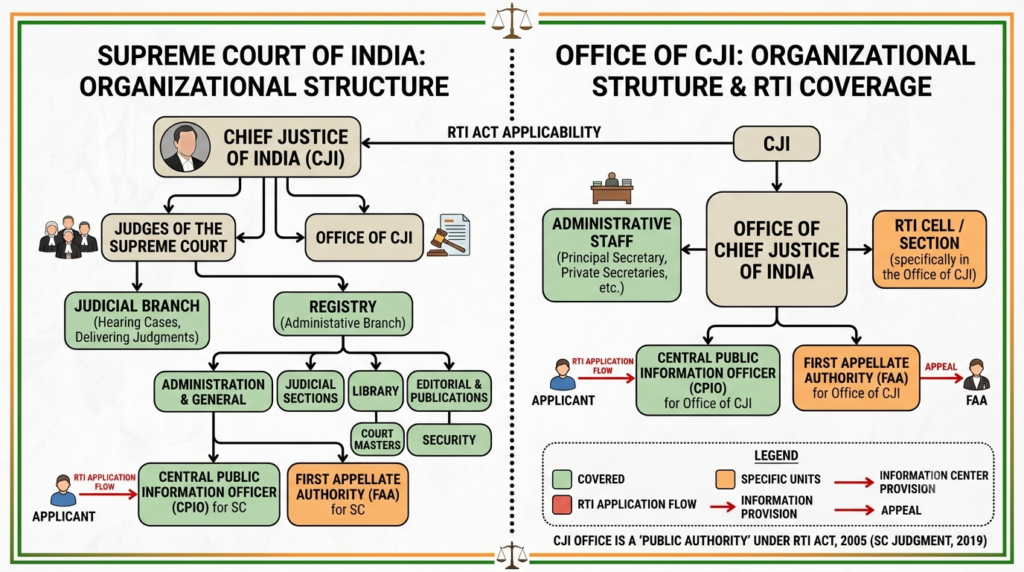
Subhash Chandra Agarwal v. Supreme Court of India is a landmark 2019 Constitution Bench ruling. Specifically, the five-judge bench held that the Chief Justice of India and the Supreme Court constitute a single public authority. Therefore, information held by the CJI’s office is subject to disclosure under the RTI Act, provided it balances privacy and public interest.
Furthermore, in our analysis of the judgment, three distinct RTI applications filed by Subhash Chandra Agarwal formed the foundation of this litigation:
- Asset Declarations: Information regarding asset disclosures made by judges of the Supreme Court and High Courts.
- Judicial Appointments: File notings and correspondence concerning the appointment of Supreme Court judges that superseded senior colleagues.
- Allegations of Judicial Influence: Complete correspondence relating to a Union Minister attempting to influence Justice R. Reghupathi of the Madras High Court.
Key Issues Addressed by the Constitution Bench
When we evaluated the reference order, the Constitution Bench examined several substantial questions of constitutional law:
- Separate Public Authorities: Whether the Supreme Court of India and the CJI constitute distinct public authorities under Section 2(h).
- Fiduciary Capacity: Whether the CJI holds asset disclosures and appointment details in a fiduciary capacity under Section 8(1)(e).
- Judicial Independence: Whether furnishing administrative details interferes with the independent functioning of the judiciary.
Key Takeaway: The Supreme Court observed that transparency does not undermine judicial independence. On the contrary, openness enhances institutional credibility and protects against arbitrariness.
Landmark Findings on Judicial Transparency
First, Justice Sanjiv Khanna, writing for the majority, clarified that the Chief Justice of India and the Supreme Court are not two distinct public authorities. Rather, the CJI is the administrative head of the institution. Because the Supreme Court is established by Article 124 of the Constitution, it fits squarely under Section 2(h) of the RTI Act.
Secondly, the court rejected the argument that the CJI holds asset declarations in a fiduciary capacity. In addition, judges declare assets under a voluntary resolution to maintain probity, not as private beneficiaries. Thus, Section 8(1)(e) exemptions do not apply automatically to asset declarations.
┌───────────────────────────────────────────────────────────────────────────────────────────┐
│                            STEPS TO PROCESS JUDICIAL RTI REQUESTS                         │
├───────────────────────────────────────────────────────────────────────────────────────────┤
│ 1. File application with the CPIO of the Supreme Court under Section 6.│
│ 2. CPIO evaluates if information is "personal" under Section 8(1)(j).  │
│ 3. If third-party rights are engaged, invoke procedural notice under Section 11.│
│ 4. Apply the proportionality test balancing public interest against potential harm.│
└───────────────────────────────────────────────────────────────────────────────────────────┘
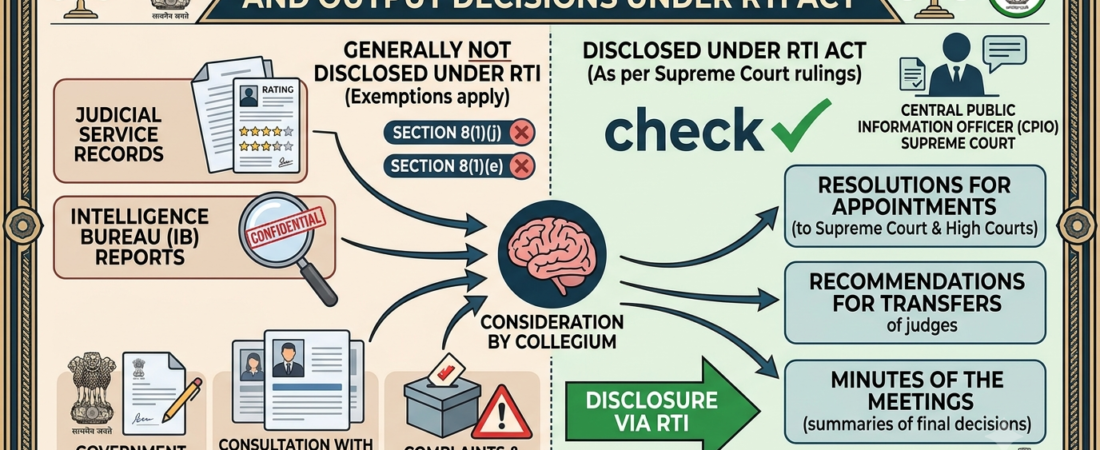
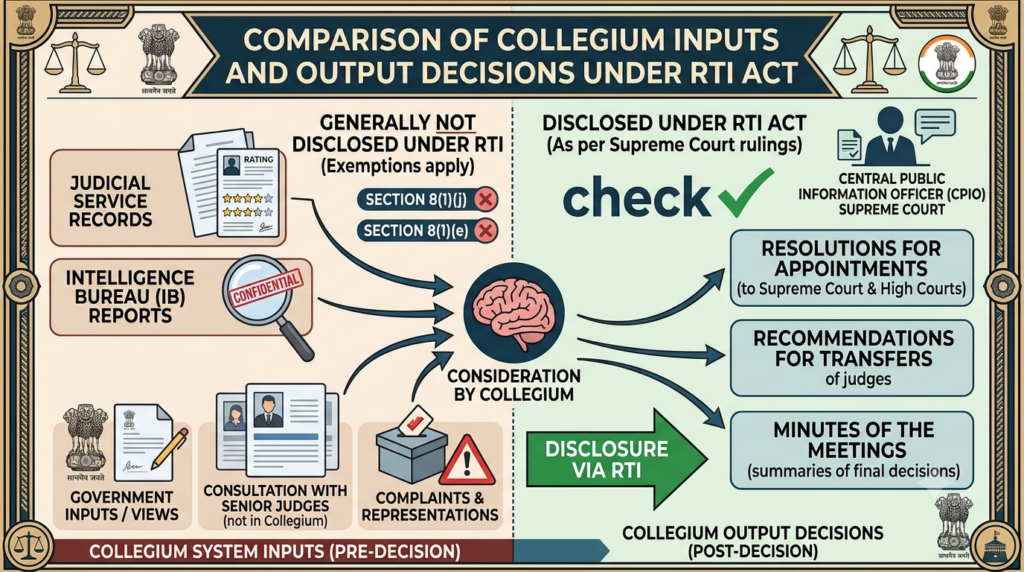
Thirdly, the court highlighted a distinction between the “inputs” examined by the Collegium and the final “output” decision. While final resolutions must be transparent, internal inputs, personal details, and privacy of candidates require strict protection.
The Delicate Balance: Right to Privacy vs. Right to Information
In our analysis, the court emphasized that the Right to Privacy (Article 21) and the Right to Information (Article 19(1)(a)) are co-equal rights. Moreover, Justice N.V. Ramana noted that neither right takes automatic precedence over the other.
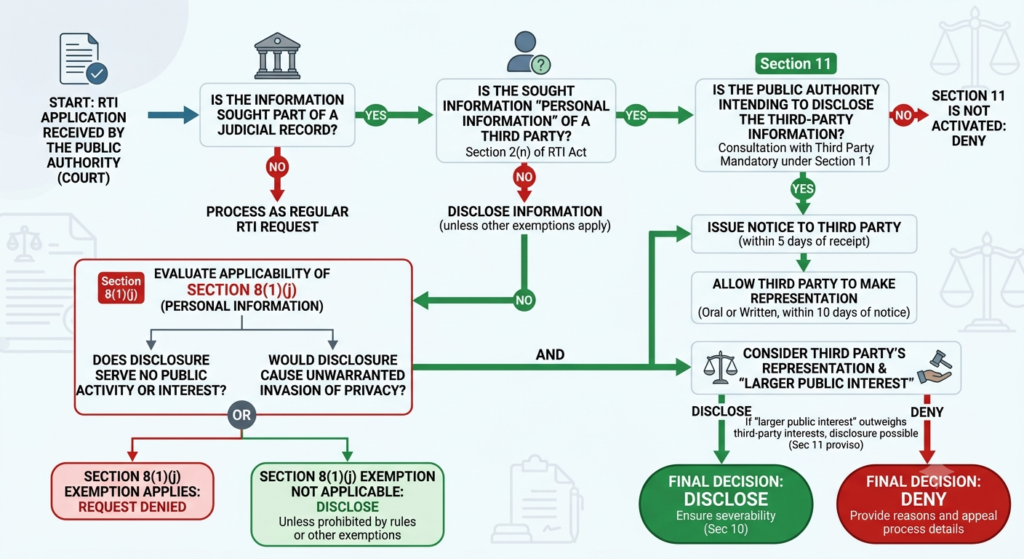
To resolve conflicts between personal privacy and public access, the CPIO must execute a mandatory multi-step test:
1. The Personal Information Threshold
The authority determines if requested details constitute “personal information”. Personal records include income tax returns, medical history, and personal assets.
2. The Third-Party Procedure
When information relates to or was supplied by a third party in confidence, Section 11 notice is mandatory. Consequently, the third party must be given an opportunity to object.
3. The Larger Public Interest Test
Finally, personal information is exempt from disclosure under Section 8(1)(j) unless a larger public interest outweighs individual privacy harm.
Key Takeaway: Public interest does not mean “matters interesting to the public”. Instead, it requires demonstrating a genuine public welfare need or exposure of wrongdoing.
Comparative Analysis of Disclosure Metrics
Below is a structured comparison evaluating how different categories of judicial information are treated under the RTI Act pursuant to this ruling:
| Information Category | Statutory Provision | Default Status | Public Interest Exception |
|---|---|---|---|
| Asset Declaration (Fact of Filing) | Section 2(j) / Section 3 | Disclosable | N/A (Innocuous Info) |
| Asset Declaration (Detailed Contents) | Section 8(1)(j) / Section 11 | Conditionally Exempt | Disclosable if public interest outweighs privacy |
| Collegium Final Recommendations | Section 2(f) / Section 4 | Disclosable | Always in public interest |
| Collegium Input Details & Candidate Backgrounds | Section 8(1)(j) / Section 11 | Exempt | Disclosable only under exceptional public interest |
| Judicial Medical Records | Section 8(1)(j) | Strictly Exempt | Rarely disclosable |
Frequently Asked Questions
Is the Chief Justice of India subject to the RTI Act?
Yes. The Supreme Court held that the Office of the Chief Justice of India is a public authority under Section 2(h) of the RTI Act. Therefore, it is covered under the provisions of the RTI Act.
Can citizens access the personal asset details of Supreme Court judges?
While the fact of whether a judge has filed asset declarations is disclosable, the granular contents of asset declarations are treated as personal information. They can only be disclosed if the applicant proves that larger public interest justifies the invasion of privacy.
Are Collegium deliberations fully open to the public?
No. The court distinguished between final Collegium decisions (which are disclosable) and internal background inputs regarding candidates. Personal inputs, medical reports, and candidate evaluations remain protected under Section 8(1)(j) and Section 11.
What happens when an RTI query affects a third party?
If requested information relates to or was supplied by a third party in confidence, the CPIO must issue notice under Section 11. The CPIO then decides whether public interest outweighs potential harm after considering the third party’s objections.