Table of Contents
- Introduction to the Landmark Verdict
- Sovereignty and Constitutional Integration of Jammu and Kashmir
- Was Article 370 Temporary or Permanent?
- Executive Power, Presidential Proclamations, and CO 272/273
- Comparative Analysis of Legal Issues and Rulings
- Impact on Asymmetric Federalism and State Reorganisation
- Frequently Asked Questions
Introduction to the Landmark Verdict
The Supreme Court ruling In Re Article 370 of the Constitution represents a pivotal moment in Indian constitutional jurisprudence. On December 11, 2023, a five-judge Constitution Bench unanimously upheld the constitutional validity of the executive orders that abrogated the special status of Jammu and Kashmir.
Written by Kapil Balhara | Technically Reviewed for Accuracy | Last Updated: October 2026
Definition/In Re Article 370 of the Constitution is a historic Supreme Court judgment upholding the Union Government’s 2019 decisions. It affirmed that Article 370 was a temporary provision, Jammu and Kashmir held no residual sovereignty upon accession, and the application of the entire Indian Constitution to the territory was valid.
Furthermore, this decision addressed crucial questions concerning asymmetric federalism, presidential powers during President’s Rule, and the procedure for state reorganisation under Article 3. Consequently, legal scholars and practitioners must carefully examine its long-term constitutional implications.
Sovereignty and Constitutional Integration of Jammu and Kashmir
To begin with, the Supreme Court meticulously evaluated whether Jammu and Kashmir retained any element of internal sovereignty after joining the Union of India. The petitioners argued that residual sovereignty remained because no merger agreement was signed.
However, the Court firmly rejected this contention. Chief Justice D.Y. Chandrachud observed that signing the Instrument of Accession in October 1947 surrendered sovereignty to the Dominion of India. Subsequently, the 1949 Proclamation issued by Yuvraj Karan Singh fully integrated the state under the Indian Constitution.
Key Takeaway: Jammu and Kashmir held no residual internal sovereignty after accession. Its constitutional relationship was completely subordinated to the supreme authority of the Constitution of India.
Additionally, the Court held that the Constitution of Jammu and Kashmir was merely intended to further define its internal governance. Therefore, it remained subordinate to the Indian Constitution rather than operating as a parallel sovereign document.
Was Article 370 Temporary or Permanent?
Next, the Bench analyzed the structural placement and historical context of Article 370. Placed within Part XXI of the Constitution, the marginal note explicitly labeled it as a temporary provision.
Historical Context (1947 War & Integration)
       │
       ▼
Insertion of Article 370 (Temporary Mechanism)
       │
       ▼
Dissolution of J&K Constituent Assembly (1957)
       │
       ▼
Presidential Power Under Article 370(3) Persists
       │
       ▼
Complete Constitutional Integration (2019 Verdict)
In addition, the Court outlined key reasons why the provision remained temporary throughout its existence:
- Wartime Conditions: It was framed during exceptional conflict conditions to facilitate gradual integration.
- Constituent Assembly Role: It served as an interim measure until the State Constituent Assembly could deliberate.
- Presidential Authority: Dissolution of the State Constituent Assembly in 1957 did not eliminate the President’s power to abrogate the provision under Article 370(3).
Thus, the Court clarified that holding Article 370 as permanent would undermine federal integration and create an insurmountable constitutional anomaly.
Executive Power, Presidential Proclamations, and CO 272/273
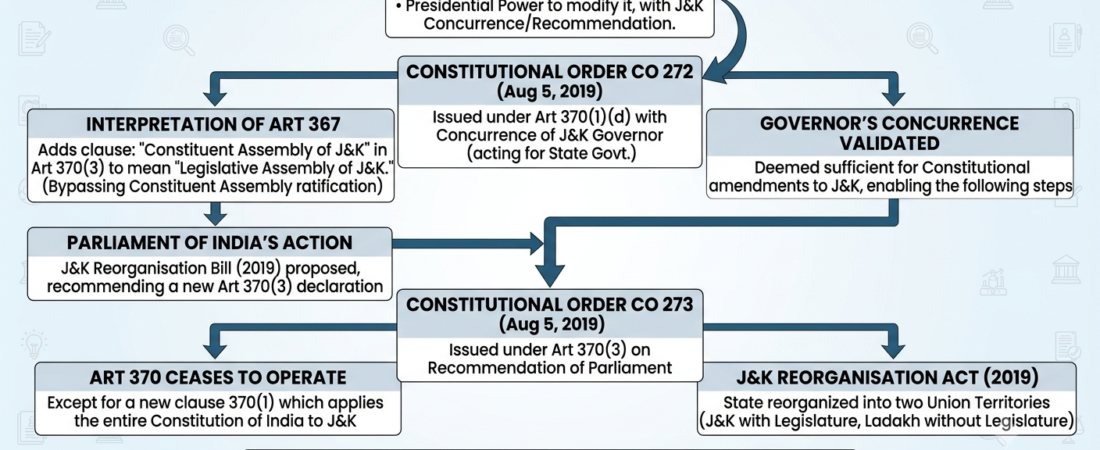
Moreover, the petitioners heavily challenged Constitutional Orders (CO) 272 and 273 issued under President’s Rule. They argued that the Union Government misused emergency powers to alter the state’s constitutional architecture unilaterally.
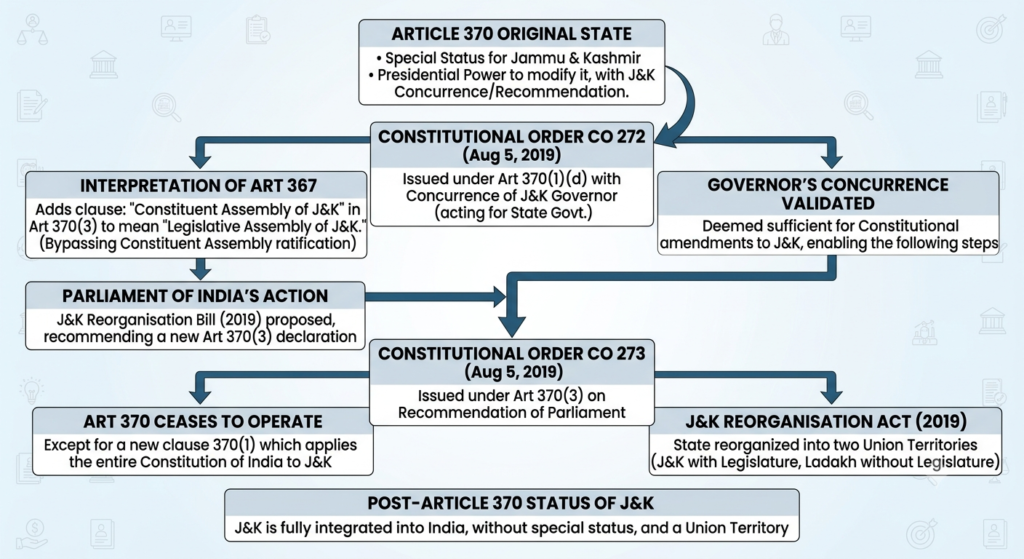
In response, the Court made a crucial distinction regarding the modification of Article 367:
- Modification via Article 367 Invalid: Amending Article 367 through CO 272 to replace “Constituent Assembly” with “Legislative Assembly” was held ultra vires because it altered Article 370 indirectly.
- Abrogation Power Upheld: Despite this procedural defect, the President held direct authority under Article 370(3) to declare the article inoperative.
- Application of Entire Constitution: Consequently, applying the entire Constitution of India to Jammu and Kashmir via CO 272 was valid under Article 370(1)(d).
Key Takeaway: Indirect amendments to constitutional provisions through interpretation clauses like Article 367 are impermissible. However, plenary executive power under Article 370(3) remains valid for complete integration.
Comparative Analysis of Legal Issues and Rulings
For clarity, the following structured table summarizes the primary legal questions evaluated by the Supreme Court and their final determinations:
| Legal Issue Evaluated | Petitioner’s Argument | Supreme Court’s Final Holding |
|---|---|---|
| Internal Sovereignty | J&K retained residual sovereignty as no merger deed was signed. | Rejected. Sovereignty was fully surrendered via IoA and 1949 Proclamation. |
| Nature of Article 370 | Became permanent after the J&K Constituent Assembly dissolved. | Held as temporary. Presidential power under 370(3) remains intact. |
| Validity of CO 272 | Amending Article 367 to alter Article 370 is unconstitutional. | Modification of 367 was ultra vires, but full application of Indian Constitution was valid. |
| Validity of CO 273 | Abrogation without Constituent Assembly consent is void. | Upheld. Recommendation of Constituent Assembly was not mandatory post-1957. |
| State Reorganisation | Degrading a State into Union Territories violates federalism. | Upheld UT of Ladakh creation. Left J&K UT conversion open due to Centre’s promise to restore statehood. |
Impact on Asymmetric Federalism and State Reorganisation
Furthermore, the verdict examined the limits of Parliament’s power under Article 3 to alter state boundaries. The Court upheld the creation of the independent Union Territory of Ladakh.
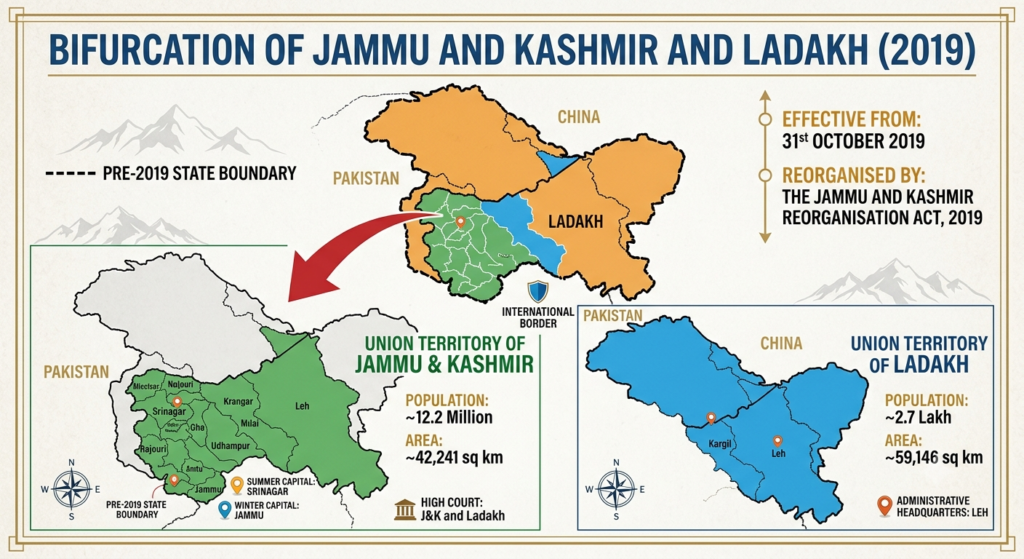
Regarding the conversion of Jammu and Kashmir into a Union Territory, the Court chose not to adjudicate its constitutionality. This was because the Solicitor General assured that statehood would be restored.
Specifically, the Court issued the following procedural directions:
- Restoration of Statehood: The Centre must restore full statehood to Jammu and Kashmir at the earliest opportunity.
- Elections Mandate: The Election Commission of India was directed to conduct elections for the J&K Legislative Assembly by September 30, 2024.
- Truth and Reconciliation Commission: Justice Sanjay Kishan Kaul recommended setting up an independent commission to investigate human rights violations by state and non-state actors since the late 1980s.
Key Takeaway: Asymmetric federalism remains a valid structural feature of the Indian Constitution, but it does not prevent complete legal and administrative integration.
In conclusion, the decision in In Re Article 370 of the Constitution conclusively settled decades of constitutional ambiguity. It affirmed the political integrity of India while establishing clear parameters for executive action under President’s Rule.
For legal researchers and analysts looking for updated case commentaries and constitutional law trackers, explore our full library of legal summaries today.
Frequently Asked Questions
What was the main ruling in In Re Article 370 of the Constitution?
The Supreme Court unanimously upheld the abrogation of Article 370, ruling that Jammu and Kashmir held no internal sovereignty and that Article 370 was a temporary, transitional provision.
Did Jammu and Kashmir retain any sovereignty after joining India?
No, the Court held that Jammu and Kashmir surrendered its sovereignty completely upon signing the Instrument of Accession and issuing the 1949 Proclamation.
Was the modification of Article 367 through CO 272 declared invalid?
Yes, the Court ruled that using Article 367 to indirectly alter Article 370 was unconstitutional and ultra vires. However, the abrogation under Article 370(3) was upheld independently.
What directions did the Supreme Court give regarding J&K statehood and elections?
The Court directed the Election Commission to hold assembly elections by September 30, 2024, and ordered the Centre to restore statehood to Jammu and Kashmir as soon as possible.