
Written by Kapil Balhara | Technically Reviewed for Accuracy | Last Updated: October 2026
Table of Contents
- What Is Danial Latifi v. Union of India (2001) Case?
- Factual Background and the Statutory Post-Shah Bano Context
- Constitutional Challenge: Article 14, Article 15, and Article 21
- Harmonious Construction of Section 3(1)(a) of the 1986 Act
- Key Holdings and Supreme Court Directives
- Impact on Muslim Women’s Maintenance Rights
- Frequently Asked Questions
What Is Danial Latifi v. Union of India (2001) Case?
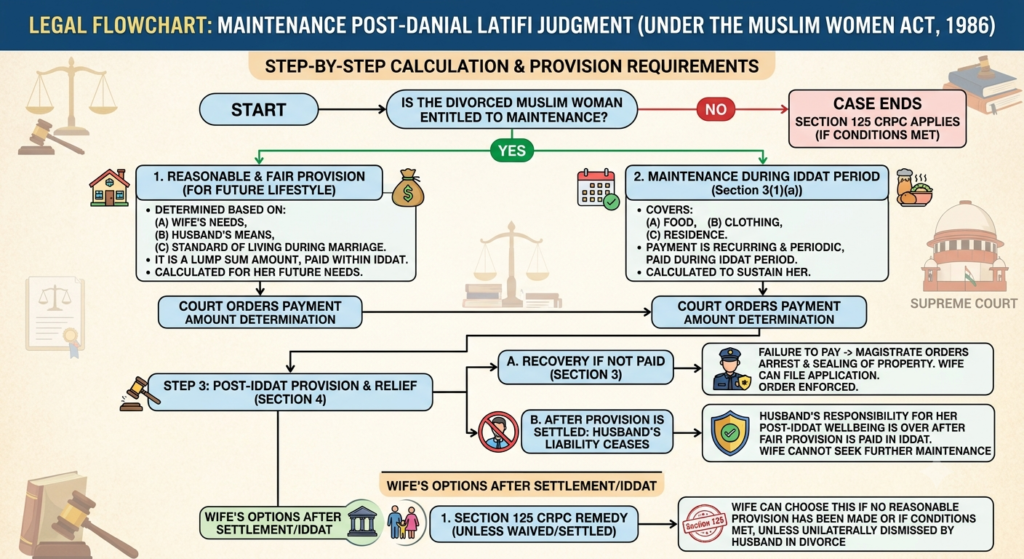
Key Takeaway: The Supreme Court in Danial Latifi v. Union of India (2001) upheld the constitutional validity of the Muslim Women (Protection of Rights on Divorce) Act, 1986. The Court ruled that a Muslim husband must make a fair and reasonable provision for his divorced wife’s future maintenance within the iddat period, extending beyond iddat for her lifetime or until remarriage.
The Danial Latifi v. Union of India case arose through writ petitions filed by prominent advocate Danial Latifi and women’s rights organizations. A Five-Judge Constitution Bench of the Supreme Court, comprising Justice G.B. Pattanaik, Justice S. Rajendra Babu, Justice D.P. Mohapatra, Justice Doraiswamy Raju, and Justice Shivaraj V. Patil, evaluated whether the 1986 Act violated fundamental rights.
Furthermore, the bench harmonized the statutory provisions of the 1986 Act with constitutional equality principles. Consequently, the decision ensured that divorced Muslim women retain comprehensive financial protections without rendering the legislative framework unconstitutional.
Factual Background and the Statutory Post-Shah Bano Context
To begin with, the background of this litigation traces directly back to the landmark decision in Mohd. Ahmed Khan v. Shah Bano Begum (1985). In Shah Bano, the Supreme Court held that Section 125 of the Code of Criminal Procedure (CrPC) applies to all women regardless of religion.
However, following widespread public debate, Parliament enacted the Muslim Women (Protection of Rights on Divorce) Act, 1986 to specify statutory rights at the time of divorce. Section 3(1)(a) of the new Act provided that a divorced Muslim woman is entitled to “a reasonable and fair provision and maintenance to be made and paid to her within the iddat period by her former husband”.

Petitioners argued that the 1986 Act deprived Muslim women of the quick, summary maintenance remedy available under Section 125 CrPC. In our analysis of Indian family law, this legislative shift created fears that divorced Muslim women would face destitution after the iddat period expired.
Key Takeaway: The 1986 Act sought to address personal law concerns, but faced immediate constitutional challenges regarding potential vagrancy and gender discrimination.
Constitutional Challenge: Article 14, Article 15, and Article 21
Besides statutory interpretation, the petitioners argued that excluding Muslim women from Section 125 CrPC violated core constitutional guarantees.
Ground of Constitutional Discrimination
First, petitioners contended that creating a separate, less beneficial regime for Muslim women constituted discrimination solely on the ground of religion under Article 15.
Secondly, senior advocates Kapila Hingorani and Indira Jaising highlighted that forcing destitute divorcees to seek support from relatives or State Wakf Boards under Section 4 infringed the right to live with dignity under Article 21.
| Constitutional Provision | Legal Argument of Petitioners | Supreme Court Finding (Danial Latifi) |
|---|---|---|
| Article 14 | Denies equal protection of laws by excluding Muslim women from Section 125 CrPC. | Upheld via harmonious reading; statutory protections equal or exceed Section 125. |
| Article 15 | Discriminates against women on religious grounds. | The Act does not discriminate when interpreted to secure long-term maintenance. |
| Article 21 | Causes vagrancy and deprives women of life with dignity. | A lump-sum provision made within iddat covers lifetime livelihood needs. |
  [ Section 3(1)(a) Challenge: Maintenance Limited to Iddat? ]
                                │
                                ▼
  [ Danger of Article 14, 15, and 21 Unconstitutionality ]
                                │
                                ▼
    [ Supreme Court Applies Doctrine of Presumption of Validity ]
                                │
                                ▼
 [ "Provision" = Lifetime Livelihood Made/Arranged WITHIN Iddat ]
- Evaluate whether the statute completely strips maintenance rights after iddat.
- Distinguish between the two distinct statutory verbs: “to be made” (provision) and “paid” (maintenance).
- Establish that the former husband must make a reasonable and fair provision for the future during iddat.
Harmonious Construction of Section 3(1)(a) of the 1986 Act
Rather than striking down the 1986 Act as unconstitutional, the Constitution Bench applied the doctrine of harmonious construction. The Court emphasized that courts must prefer interpretations that preserve legislative enactments while fulfilling constitutional mandates.
Justice S. Rajendra Babu observed that Section 3(1)(a) contains two separate obligations for the former husband:
- Maintenance: Periodic payments paid for the actual duration of the iddat period.
- Provision (Mata): A fair and reasonable lump-sum arrangement made within the iddat period to meet the woman’s future livelihood needs for her entire life.
Therefore, the word “within” specifies the timeframe during which the husband must finalize the financial arrangement, rather than limiting the coverage period of the support itself.
Key Takeaway: The Supreme Court ruled that while the financial arrangement must be concluded within the iddat period, the provision itself must cover the divorced woman’s entire future.
Key Holdings and Supreme Court Directives
Ultimately, the Five-Judge Constitution Bench summarized its conclusions as follows:
- Lifetime Liability of Husband: A Muslim husband is liable to make a reasonable and fair provision for the future of his divorced wife, including her maintenance beyond iddat.
- Time of Execution: This fair and reasonable provision extending beyond the iddat period must be made by the husband within the iddat period under Section 3(1)(a).
- Secondary Liability under Section 4: If a divorced Muslim woman who has not remarried cannot maintain herself after iddat, she may proceed under Section 4 against relatives who would inherit her property, or ultimately against the State Wakf Board.
- Constitutional Validity Upheld: The provisions of the 1986 Act do not offend Articles 14, 15, or 21 of the Constitution when read harmoniously.

Impact on Muslim Women’s Maintenance Rights
Consequently, the ruling resolved years of conflicting High Court decisions across India. For instance, High Courts in Gujarat, Bombay, and Kerala had previously interpreted Section 3 broadly, while others took a restrictive view.
Furthermore, the decision transformed Section 3 into a powerful protective tool. Instead of receiving small monthly payments under Section 125 CrPC (which had a statutory cap at the time), divorced Muslim women became entitled to substantial, one-time lump-sum settlements covering housing, food, and clothing needs.
Ultimately, the judgment demonstrated how judicial interpretation can reconcile statutory text with constitutional equality and basic human rights.
Frequently Asked Questions
1. What was the main holding in Danial Latifi v. Union of India (2001)?
The Supreme Court held that a Muslim husband’s liability to provide a fair and reasonable provision for his divorced wife extends beyond the iddat period for her entire life or until she remarries.
2. Does the Muslim Women Act 1986 violate Article 14 of the Constitution?
No. The Supreme Court held that when Section 3(1)(a) is interpreted to secure long-term financial provisions, the Act does not violate Articles 14, 15, or 21.
3. What is the difference between “maintenance” and “provision” under Section 3(1)(a)?
“Maintenance” refers to support paid during the iddat period, whereas “provision” (mata) refers to a lump-sum arrangement made within iddat to cover the woman’s future livelihood needs.
4. What happens if a divorced Muslim woman has no relatives and cannot maintain herself?
Under Section 4 of the Act, if she has no relatives with sufficient means to support her, the Magistrate can direct the State Wakf Board to provide her maintenance.