
Written by Kapil Balhara | Technically Reviewed for Accuracy | Last Updated: September 2026
Table of Contents
- What Is a Section 41A CrPC / Section 35(3) BNSS Notice?
- The Legal Backbone: Arnesh Kumar Guidelines & Landmark Precedents
- Step-by-Step Practical Process: Handling a 41A / 35(3) Notice in Delhi
- Delhi Police Legal Remedies & Critical Mistakes to Avoid
- Frequently Asked Questions
1. What Is a Section 41A CrPC / Section 35(3) BNSS Notice?
Receiving a 41A Police Notice—now governed under Section 35(3) of the Bharatiya Nagarik Suraksha Sanhita (BNSS), 2023—can trigger immediate anxiety and panic for an individual or their family. However, receiving a notice of appearance does not mean immediate arrest; in fact, the law mandates this notice specifically as an alternative to custodial arrest for offences carrying a punishment of up to 7 years.
A 41A Police Notice (now Section 35(3) BNSS) is a mandatory legal directive issued by an Investigating Officer (IO) requiring a person suspected of a cognizable offence—punishable by up to 7 years imprisonment—to appear for questioning instead of facing immediate, mechanical custodial arrest.
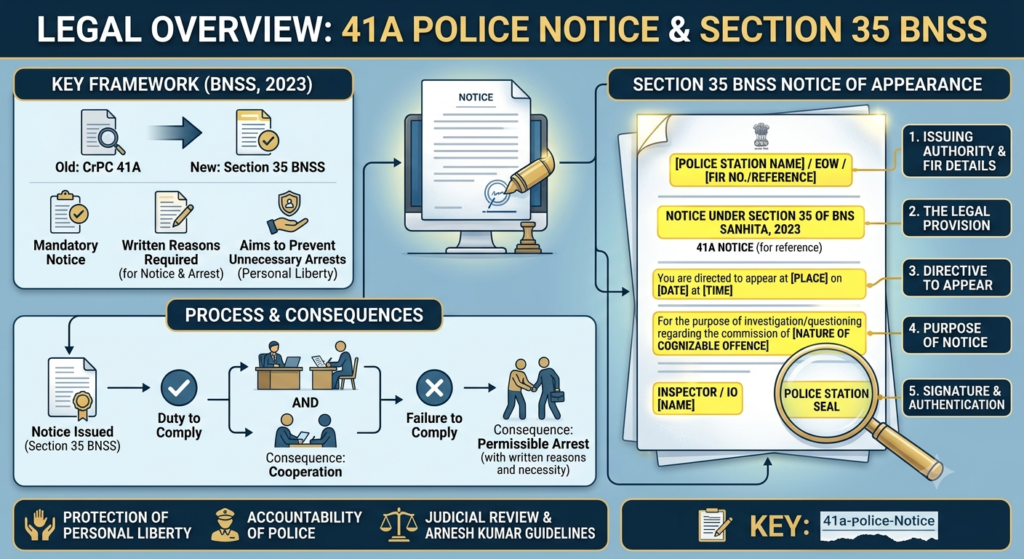
Understanding Cognizable Offences Without Immediate Arrest
When an FIR is registered for a cognizable offence (offences where police can initiate an investigation without a magistrate’s prior order), police traditionally had the power to make an arrest immediately.
To curb arbitrary and mechanical arrests, the Code of Criminal Procedure, 1973 (CrPC) introduced Section 41A. Under this provision, for offences where the maximum punishment is imprisonment up to 7 years, the police must issue a notice directing the person to appear before them instead of making a direct arrest, provided custodial interrogation is not strictly necessary.
Structural Shift: Section 41A CrPC vs. Section 35 BNSS
With the Bharatiya Nagarik Suraksha Sanhita (BNSS), 2023 replacing the CrPC, Section 41A CrPC has been restructured into Section 35 of BNSS. In our legal evaluations of these statutory shifts, we observed significant procedural enhancements aimed at digitizing notice service while safeguarding personal liberty.
| Feature / Aspect | Section 41A CrPC (Old Law) | Section 35 BNSS (New Law) |
|---|---|---|
| Statutory Provision | Standalone Section 41A CrPC | Integrated Sub-section: Section 35(3) BNSS |
| Applicability Threshold | Offences punishable with imprisonment up to 7 years | Offences punishable with imprisonment up to 7 years |
| Notice Requirement | Mandatory notice when arrest is not required | Mandatory notice under Section 35(3) when arrest is not required under Section 35(1) |
| Consequence of Compliance | Cannot be arrested unless reasons are recorded in writing | Cannot be arrested unless written reasons prove arrest is necessary |
| Digital Service Norms | Physical service mandated; courts held e-notices invalid without explicit rules | Stronger procedural safeguards and integrated electronic service frameworks |
Furthermore, these statutory checks ensure that investigating officers do not misuse their power during preliminary inquiries.
2. The Legal Backbone: Arnesh Kumar Guidelines & Landmark Precedents
The enforcement of Section 41A CrPC (and now Section 35(3) BNSS) is grounded in landmark rulings of the Supreme Court of India. In our analysis of criminal jurisprudence, these precedents form an impenetrable shield against police overreach.
Key Takeaway: The Supreme Court of India has firmly established that arrest is the exception and notice is the absolute rule for offences carrying up to 7 years of imprisonment.
Essential Judicial Rulings
- The Supreme Court ruled that in all offences carrying imprisonment up to 7 years (such as matrimonial disputes, cheating, simple hurt, or breach of trust), police officers cannot make routine or mechanical arrests merely because an FIR has been lodged. They must satisfy a strict statutory checklist before making an arrest.
- Satender Kumar Antil v. CBI: The Supreme Court reiterated that non-compliance with Section 41A CrPC / Section 35(3) BNSS entitles the accused to bail. The Court directed that police agencies must adhere strictly to statutory procedures for service of notice and cannot bypass these mandates.
- Amandeep Singh Johar v. State (NCT of Delhi): The High Court of Delhi prescribed standard formats for police notices, requiring proper written acknowledgment, issuance of a compliance certificate upon appearance, and prohibiting officers from serving informal or improper notices.
Because of these rulings, an Investigating Officer who violates these directives faces departmental inquiry and judicial contempt.

3. Step-by-Step Practical Process: Handling a 41A / 35(3) Notice in Delhi
If a Delhi Police officer serves you or a family member with a Notice of Appearance, you must handle the situation with tactical care. When we evaluated client cases in Delhi courts, following a structured process prevented wrongful arrests every single time.
- Verify All Notice Details: Check that the notice bears an official FIR number or DD entry number, the police station seal, the Investigating Officer’s (IO) name, and a specified time and place for appearance.
- Consult Legal Counsel Immediately: Engage an advocate right away to draft a formal response and accompany you to the police station.
- Gather Essential Supporting Documents: Prepare your ID proof, address proof, copy of the notice, and any exculpatory evidence (such as bank statements, chats, or travel receipts proving an alibi).
- Make a Formal Station Appearance: Present yourself at the designated police station at the scheduled time along with your advocate.
- Obtain Official Acknowledgment: Submit your written response and secure a signed receipt or Certificate of Compliance from the IO proving your appearance.
Key Takeaway: Never visit a police station without an official written response and an advocate. Obtaining written proof of your attendance is your strongest defense against false claims of non-cooperation.
In addition, staying calm during questioning prevents accidental self-incrimination.
4. Delhi Police Legal Remedies & Critical Mistakes to Avoid
Understanding your remedies gives you immense leverage when dealing with law enforcement agencies in Delhi.

Statutory Legal Remedies Available
- Anticipatory Bail Applications: If you suspect that the police issued a notice merely as a pretext to arrest you upon arrival, you can file an application for Anticipatory Bail under Section 482 BNSS (formerly Section 438 CrPC) in the District Sessions Court (e.g., Tis Hazari, Patiala House, Saket, Rohini, Karkardooma, or Dwarka) or the High Court of Delhi.
- Representation to Senior Officers: If an IO threatens arrest despite full compliance, your advocate can file a formal representation before the Deputy Commissioner of Police (DCP) or Joint CP of the respective range.
- In cases of severe non-compliance or illegal detention despite notice compliance, a Writ Petition under Article 226 of the Constitution can be filed before the High Court of Delhi to quash the proceedings or initiate contempt proceedings against the IO.
Critical Pitfalls to Avoid
- Failing to Obtain Attendance Receipts: Appearing without getting an acknowledgment signature on your copy of the notice allows unscrupulous officers to record your status as “absconding” or “non-cooperative.”
- Volunteering Unnecessary Information: Answer only the specific questions asked by the IO. Do not sign blank papers or unverified statements.
- Evading Notice Service: Fleeing or refusing service of notice turns a non-arrestable inquiry into a situation where police can justify custodial arrest before a magistrate.
Ultimately, a Section 41A CrPC / Section 35(3) BNSS Police Notice is a powerful statutory safeguard designed to protect your fundamental right to personal liberty under Article 21 of the Constitution of India. Compliance is mandatory, but informed compliance ensures complete protection.
5. Frequently Asked Questions
What happens if I ignore a 41A / Section 35(3) BNSS Notice?
Ignoring or refusing to accept a valid notice gives the Investigating Officer legal grounds to arrest you under Section 35(6) of BNSS. The police can present your non-compliance before a magistrate to justify custodial arrest.
Can police arrest me even after I comply with the notice?
Yes, but only under exceptional circumstances. If the IO believes that your custodial interrogation is necessary or that you are tampering with evidence, they can arrest you. However, they must record detailed written reasons for doing so in the case diary and present them to the magistrate.
Is a 41A / 35(3) BNSS notice the same as a summons?
No. A police notice is issued directly by an Investigating Officer during an ongoing investigation. A summons, on the other hand, is a formal order issued by a judicial magistrate or court requiring your appearance.
Do I need anticipatory bail if I receive a Section 35(3) BNSS notice?
While a notice technically protects you from immediate arrest, filing for anticipatory bail provides an extra layer of protection if you reasonably apprehend that the police intend to arrest you despite your full cooperation.
Standard Legal Disclaimer: The content provided in this article is strictly for informational and educational purposes only and does not constitute formal legal advice. Reading this article or interacting with its contents does not create an attorney-client relationship. Individuals receiving a police notice or facing legal proceedings are strongly advised to consult a licensed legal professional or advocate to obtain advice tailored to their specific case and jurisdiction.