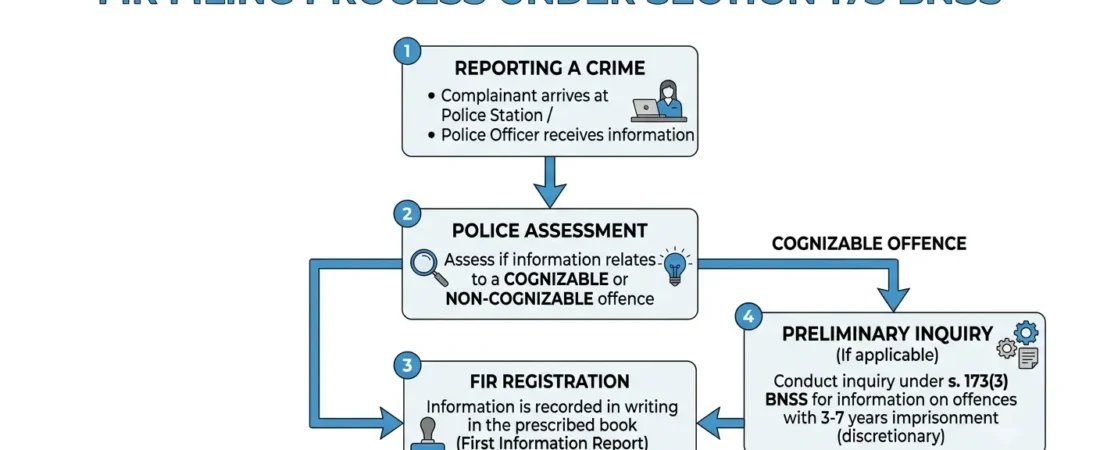
Facing a crime causes intense anxiety and immediate distress for victims across India. Therefore, understanding How to File an FIR at a Police Station ensures you protect your fundamental rights without facing unlawful harassment.
Written by Kapil Balhara | Technically Reviewed for Accuracy | Last Updated: October 2026
Table of Contents
- Understanding the Foundations of an FIR
- Essential Details to Mention in Your FIR Statement
- Navigating the Police Station: Roles and Complaint Formats
- Critical Steps Before Submission: Verification, Signing, and Copies
- Legal Remedies: What to Do If the Duty Officer Refuses Entry
- Post-Registration Timeline: What Happens Right After Registration
- Frequently Asked Questions
Understanding the Foundations of an FIR
Navigating the criminal justice system requires absolute legal clarity from the start. Consequently, understanding how police complaints operate safeguards your statutory protections effectively.
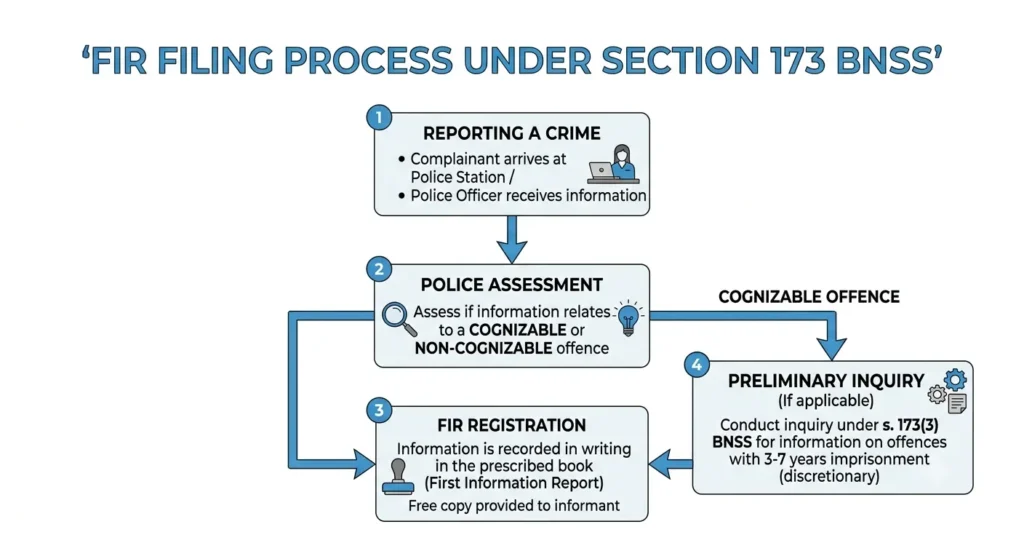
Section 173 of the Bharatiya Nagarik Suraksha Sanhita (BNSS) governs the registration of a First Information Report. This statutory provision mandates police action whenever an individual reports a serious crime.
Key Takeaway: An FIR sets criminal law into motion. Police cannot initiate a formal investigation into serious offences without logging this foundational document first.
Definition and Summary Block
Learning how to file an FIR at a police station allows citizens to report cognizable offences officially. An FIR is a written document recorded by police officers upon receiving details of a serious crime. It grants officers immediate authority to investigate, collect forensic evidence, and arrest suspects without requiring prior judicial warrants.
In our legal practice, we routinely observe citizens confusing a formal FIR with a standard police complaint. Therefore, review the comparison table below to understand their structural differences clearly.
| Legal Feature | First Information Report (FIR) | Police Complaint / Non-Cognizable Report (NCR) |
|---|---|---|
| Offence Classification | Cognizable (e.g., robbery, assault, theft) | Non-Cognizable (e.g., simple harassment, minor disputes) |
| Arrest Authority | Police can arrest suspects without a warrant | Police require an explicit warrant from a Magistrate |
| Investigation Trigger | Immediate mandatory investigation | Requires direct orders from a Judicial Magistrate |
| Statutory Cost | Provided free of cost by statutory mandate | May require formal court application fees for certified copies |
| Governing Statute | Section 173 BNSS | Section 177 BNSS |
Essential Details to Mention in Your FIR Statement
Preparing a complaint requires systematic organization of all facts beforehand. Therefore, collect every piece of information before approaching police personnel directly.
Essential Details to Mention in Your FIR Statement
When drafting your statement, maintain absolute factual accuracy throughout the narrative. Specifically, state your full name, father’s name, contact information, and permanent address at the top.
In addition, clearly state whether the accused persons are known or unknown to you. If suspects are known, provide their exact names, residential addresses, and phone numbers.
Conversely, if suspects are unknown, describe their physical characteristics carefully. For instance, note their height, approximate age, skin tone, clothing, language, and visible marks.
In the landmark case of State of Andhra Pradesh v. Goloconda Linga Swamy (2004), the Supreme Court emphasized that an FIR need not be an encyclopaedia of all facts. However, essential ingredients disclosing a cognizable offence must be stated clearly.
Documenting Exact Time and Location
Documenting exact time and location details strengthens your case significantly. Specify the precise date, hour, and minute when the incident occurred.
Furthermore, describe the place of occurrence with geographic precision. Include exact building numbers, street names, landmarks, or GPS coordinates if available.
If the offence occurred over an extended duration, mention the exact starting and ending times. Clear timelines prevent opposing counsel from alleging fabrication during trial proceedings.
Role of Witnesses in Writing the FIR
In our analysis, incorporating witness testimony early enhances complaint credibility. Therefore, evaluate the role of witnesses in writing the FIR statement thoroughly.
List the full names and contact details of every individual who witnessed the incident. Eyewitness observations provide immediate corroboration for your initial police report.
Additionally, state what each witness observed during the commission of the crime. Explicit statements prevent witnesses from altering their accounts during subsequent court depositions.

Key Takeaway: Never include speculative claims or exaggerated allegations in your complaint. Stick strictly to observed facts to keep your legal standing ironclad.
Navigating the Police Station: Roles and Complaint Formats
Entering a station house can feel overwhelming for victims. However, understanding administrative hierarchies ensures smooth communication with station personnel.
Choosing the Right Officer at the Police Station
When entering the premises, choosing the right officer at the police station saves critical time. Approach the Station House Officer (SHO) or the designated Duty Officer directly.
The Duty Officer remains responsible for receiving incoming citizens and recording initial entries. Meanwhile, the SHO holds administrative charge over all station operations and investigative assignments.
If your case involves specialized crimes like cyber fraud, request the Cyber Crime Cell officer. Likewise, female victims reporting personal offences should request a woman police officer as mandated under BNSS provisions.
Oral vs Written Complaints Process
Understanding the oral vs written complaints process ensures your account gets documented correctly. Under Indian law, you possess the legal right to submit complaints in either format.
- Written Complaint Submission: Draft your statement clearly in your native language or English. Sign the document and hand it directly to the officer.
- Oral Dictation Process: Dictate the facts orally if you cannot write. The officer must reduce your statement to writing verbatim.
- Mandatory Reading Back: The recording officer must read the drafted statement back to you to confirm total accuracy before finalization.
While oral dictation works legally, submitting a typed written application remains far superior. It prevents officers from misinterpreting facts or omitting crucial details from the record.
Critical Steps Before Submission: Verification, Signing, and Copies
Once the officer transfers your statement into the official FIR register, execute strict verification steps. Never rush this critical procedural phase.
Verifying and Signing Your Draft Before Final Submission
Verifying and signing your draft before final submission prevents costly investigative errors. Read every single line of the printed or handwritten FIR entry carefully.
Confirm that the officer recorded all dates, times, suspect descriptions, and stolen property details correctly. If you find errors or omissions, demand immediate corrections before signing.
After verifying the contents, sign the document or affix your thumb impression. Importantly, only sign after confirming that the document accurately reflects your statement.
Key Takeaway: Never sign a blank paper or an incomplete FIR draft under any circumstances. Signing unverified papers exposes you to severe legal risks.
Claiming Your Free Copy of the FIR
After signing, focus on claiming your free copy of the FIR immediately. Under Section 173(2) BNSS, police officers must provide an official copy to the informant free of charge.
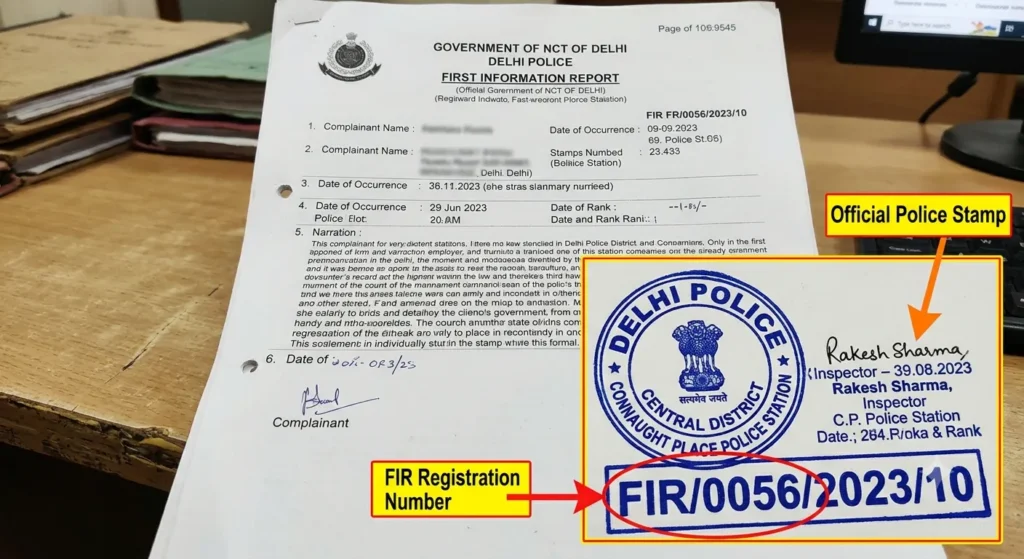
Ensure the officer hands you a stamped copy containing the official station seal. Do not accept casual assurances that a copy will be dispatched later.
Having an immediate copy prevents unauthorized alterations to the record later. Furthermore, insurance claims and court applications require this official document.
Understanding the FIR Registration Number
Every registered report carries a unique administrative identifier. Therefore, understanding the FIR registration number helps you track progress effectively.
The registration number follows a standardized format, such as FIR No. 0123/2026. It incorporates the specific police station code, sequential report number, and registration year.
Always reference this complete number during all subsequent communications with police personnel or courts. It allows instant retrieval of case files across national databases.
Legal Remedies: What to Do If the Duty Officer Refuses Entry
Regrettably, citizens sometimes encounter resistance from station personnel when lodging reports. Knowing your statutory rights enables you to overcome unlawful refusals efficiently.
What to Do If the Duty Officer Refuses Entry
Knowing what to do if the duty officer refuses entry or registration is vital for justice. First, remain calm and request an audience with the Station House Officer.
Explain clearly that refusing to register a cognizable offence violates statutory mandates. In the landmark judgment of Lalita Kumari v. Govt. of U.P. (2014), a Constitution Bench of the Supreme Court held that registration of an FIR is mandatory under law if the information discloses the commission of a cognizable offence.
Furthermore, in Youth Bar Association of India v. Union of India (2016), the Supreme Court directed that copies of FIRs should be uploaded on police websites within 24 to 48 hours to ensure transparency.
If local officers persist in refusing your report, escalate the matter immediately through formal legal channels:
- Written Representation to Senior Officers: Send your written complaint via Registered Post AD to the Superintendent of Police (SP) or Deputy Commissioner of Police (DCP) under Section 173(4) BNSS.
- Judicial Magistrate Intervention: File an application before the local Judicial Magistrate under Section 175(3) BNSS. The Magistrate can direct police to lodge the FIR and investigate.
- State Police Grievance Portals: Submit an official online complaint on the state police portal detailing officer refusal.
- High Court Writ Petitions: Approach the High Court under Article 226 of the Constitution to seek judicial directions against non-registration.
FORMAL COMPLAINT TO SUPERINTENDENT OF POLICE

To,
The Superintendent of Police / Deputy Commissioner of Police,
[District Name / City Name],
[State Name]

Subject: Application under Section 173(4) BNSS regarding refusal to register FIR by SHO [Police Station Name]

Respected Sir/Madam,

I am writing to bring to your immediate attention a cognizable offence committed on [Date] at approximately [Time] at [Location Details].

Despite approaching the Duty Officer and SHO at [Police Station Name] on [Date], the officers unlawfully refused to record my First Information Report.

Details of the Offence:
1. Complainant Name: [Your Full Name]
2. Accused Details: [Name / Unknown Description]
3. Offence Committed: [Brief Summary of Crime e.g., Theft, Physical Assault]

I request your urgent intervention to direct the registration of my FIR and initiate a formal investigation.

Sincerely,

[Your Name]
[Contact Number]
[Postal Address]
In our testing of legal escalation workflows, sending complaints via Registered Post to senior officers yields rapid administrative results. It creates an undeniable paper trail that officers cannot ignore.
Need expert help reviewing your draft? Contact our legal team today for a confidential complaint review.
Post-Registration Timeline: What Happens Right After Registration
Registering your report represents only the initial step in the criminal justice process. Consequently, tracking post-registration procedures ensures officers conduct thorough investigations.
What Happens Right After the FIR Is Recorded
Understanding what happens right after the FIR is recorded reduces anxiety for victims. Once recorded, the SHO assigns an Investigating Officer (IO) to lead the case.
The IO immediately visits the scene of the crime to prepare a detailed spot map. Simultaneously, the officer collects physical, digital, and forensic evidence from the location.
- Site Inspection: The IO inspects the crime scene and secures physical evidence.
- Recording Statements: Officers record detailed witness statements under Section 180 BNSS.
- Medical Examinations: Victims of physical violence undergo mandatory medico-legal examination at government hospitals.
- Arrest Procedures: The IO exercises statutory powers to arrest suspects when necessary, strictly adhering to guidelines laid down in Arnesh Kumar v. State of Bihar (2014) regarding unnecessary arrests.
- Final Report Submission: The investigation concludes with a Charge Sheet under Section 193 BNSS or a Closure Report.
Meanwhile, track your case status digitally through the Crime and Criminal Tracking Network & Systems (CCTNS) portal. Use your FIR registration number to check investigation updates online.
Ultimately, remaining proactive during the investigation safeguards your legal interests. Keep regular contact with your assigned Investigating Officer and maintain copies of all submitted documents.
Frequently Asked Questions
Can police charge money for providing an official copy of the FIR?
No, police cannot charge any money for providing an FIR copy. Under Section 173(2) of the BNSS, the informant possesses an absolute statutory right to receive an official copy free of cost immediately after registration.
What is the legal difference between a regular FIR and a Zero FIR?
A regular FIR is registered at the police station holding territorial jurisdiction over the location where the crime occurred. Conversely, a Zero FIR can be filed at any police station across India regardless of jurisdiction, after which it is transferred to the appropriate station.
Can I file an FIR if there is a significant delay in reporting the crime?
Yes, you can file an FIR even if there is a delay in reporting. As affirmed in Apren Joseph v. State of Kerala (1972), delay in lodging an FIR is not automatically fatal to the prosecution case, provided the delay is satisfactorily explained by the informant.
What should I do if an FIR contains incorrect factual details after registration?
If an FIR contains factual errors, submit a formal written representation to the Investigating Officer and the Station House Officer immediately. Request that your supplementary statement be recorded under Section 180 BNSS to clarify the correct facts on record.
Secure Your Legal Rights Today
Filing an FIR correctly sets the foundation for a successful prosecution. By following this step-by-step guide, you ensure your complaint remains legally sound and actionable.
Do not let procedural confusion delay your search for justice. Prepare your written application carefully, verify every detail, and assert your statutory rights at the police station.