Table of Contents
- Introduction: The Landmark Ruling on Mandatory FIR
- What is Lalita Kumari vs Government of U.P.?
- Background and Core Facts of the Case
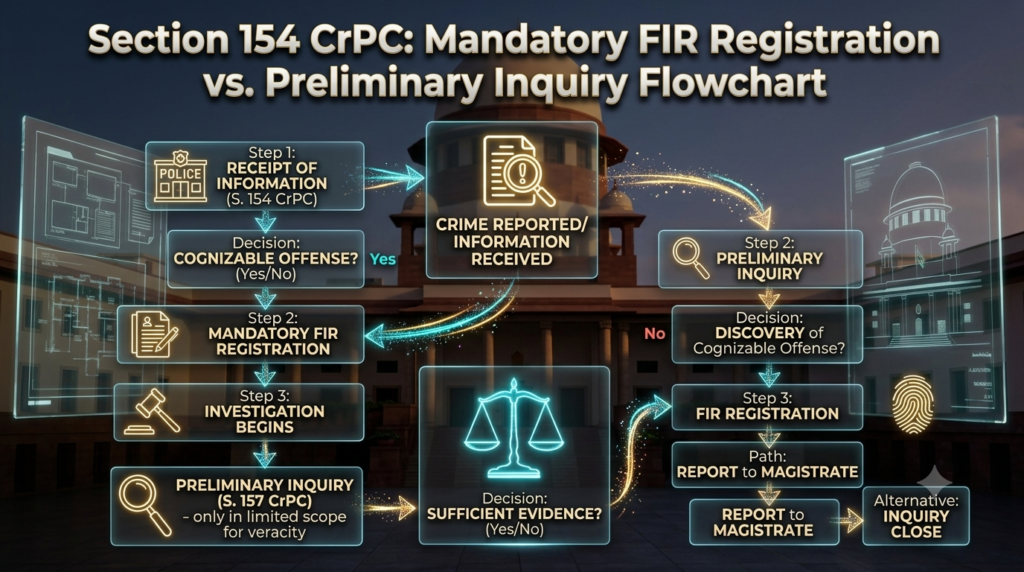
- Section 154 CrPC: Mandatory FIR vs Preliminary Inquiry
- Key Guidelines Issued by the Supreme Court
- Comparative Breakdown: Section 154 CrPC Framework
- Frequently Asked Questions
Introduction: The Landmark Ruling on Mandatory FIR
When a cognizable crime occurs, immediate action by law enforcement is critical. Unfortunately, citizens frequently face police inaction or outright refusal when trying to report serious crimes.
The landmark Supreme Court judgment in Lalita Kumari vs Government of U.P. changed this reality forever. Written by Kapil Balhara | Technically Reviewed for Accuracy | Last Updated: August 2026
By directly interpreting Section 154 CrPC, the Constitution Bench established that registering a First Information Report (FIR) is mandatory whenever information discloses a cognizable offense.
What is Lalita Kumari vs Government of U.P.?
Key Takeaway: The Lalita Kumari case established the absolute mandatory registration of FIR under Section 154 CrPC upon receiving information disclosing a cognizable offense, strictly limiting preliminary inquiries to specific exceptional categories.
The Lalita Kumari vs Government of U.P. case is a historic Constitution Bench judgment delivered by the Supreme Court of India. It definitively ruled that under Section 154 of the Code of Criminal Procedure, 1973 (CrPC), a police officer is statutorily bound to register an FIR if the complaint discloses a cognizable offense. The police have no latitude to conduct a preliminary inquiry to test veracity beforehand, except in very narrow categories.
Background and Core Facts of the Case
The case originated from a heartbreaking incident involving a minor girl child. The petitioner, Bhola Kamat, filed a writ petition after his minor daughter, Lalita Kumari, was kidnapped.
Although a written report was submitted to the local police station in May 2008, no immediate action was taken. An FIR was registered only after approaching the Superintendent of Police, yet no active steps were taken to recover the victim or arrest the accused.
Because different benches of the Supreme Court held conflicting views on whether police could hold a preliminary inquiry before filing an FIR, the matter was referred to a 5-Judge Constitution Bench.
Furthermore, the court needed to resolve whether immediate non-registration leads to police manipulation or whether mandatory registration infringes on the rights of the accused.
Section 154 CrPC: Mandatory FIR vs Preliminary Inquiry
Specifically, the statutory provision uses the word “shall”, leaving no room for judicial or administrative discretion. Furthermore, the legislature deliberately used the word “information” rather than “credible information” or “reasonable complaint”.
Consequently, the police officer cannot decide to hold back an FIR simply because they doubt the credibility of the informant.
Furthermore, the judgment clarified that the FIR must be entered directly into the FIR Book (Register) under Section 154, rather than substituting it with an entry in the Station General Diary under Section 44 of the Police Act, 1861.
Key Takeaway: Reasonableness or credibility of information is not a condition precedent for registering an FIR. The sole requirement is that the information must disclose a cognizable offense.
Key Guidelines Issued by the Supreme Court
To ensure uniform application across all state police departments, the Constitution Bench laid down mandatory operational directions.
Here’s how the court structured the legal requirements:
- Mandatory Registration: If the information received discloses a cognizable offense, the police officer must mandatorily register an FIR.
- Preliminary Inquiry Scope: If the information does not clearly disclose a cognizable offense, a preliminary inquiry may be conducted solely to ascertain if such an offense is made out.
- Time-Bound Inquiry: Any preliminary inquiry must be completed within a strict, reasonable timeline (ordinarily not exceeding 7 days).
- General Diary Entries: All details regarding the receipt of information and any preliminary inquiry steps must be meticulously recorded in the General Diary.
Specifically, the court permitted preliminary inquiries only in limited categories such as matrimonial disputes, commercial offenses, medical negligence cases, corruption allegations, and cases involving abnormal delays.
Comparative Breakdown: Section 154 CrPC Framework
To better understand the distinct pathways available to an Investigating Officer, review the comparative framework below:
| Parameter | Direct FIR Registration | Preliminary Inquiry |
|---|---|---|
| Trigger Condition | Complaint clearly discloses a cognizable offense | Complaint does not clearly disclose a cognizable offense |
| Police Discretion | Zero discretion; registration is mandatory | Limited to checking if a cognizable offense exists |
| Time Limit | Immediate / Forthwith | Strictly time-bound (usually within 7 days) |
| Permitted Categories | All cognizable offenses | Matrimonial, commercial, medical negligence, corruption |
| Primary Goal | Initiate criminal investigation immediately | Prevent misuse and verify if offense is cognizable |
Key Takeaway: Preliminary inquiry is not meant to verify the veracity or truthfulness of allegations, but only to check if the facts reveal a cognizable crime.
Need immediate legal advice regarding an unregistered complaint or police inaction? Contact our legal team at [Placitum Advocates] today for an expert case evaluation.
Link to Download Lalita Kumari vs Govt. of U.P. Judgement
Frequently Asked Questions
What happens if a police officer refuses to register an FIR?
If a police officer refuses to register an FIR disclosing a cognizable offense, you can send the written complaint to the Superintendent of Police under Section 154(3) CrPC. Alternatively, you can move a Magistrate under Section 156(3) or Section 190 read with Section 200 CrPC. Delinquent officers may also face departmental action or criminal prosecution under Section 166A IPC.
Is a preliminary inquiry mandatory before every FIR?
No, a preliminary inquiry is not mandatory in every case. It is permitted only when the information received fails to clearly disclose a cognizable offense or falls under specific categories like medical negligence, commercial disputes, or matrimonial issues.
What is the time limit for completing a preliminary inquiry?
The Supreme Court specified that a preliminary inquiry should be completed within a strict timeline, ordinarily not exceeding 7 days, and any delay must be recorded in the General Diary.
Why is the Lalita Kumari case considered a landmark judgment?
It settled long-standing judicial conflicts across India by affirming that registration of an FIR is a mandatory statutory duty under Section 154 CrPC, reinforcing access to justice and protecting individual liberty.