Police Refusing to File Your FIR? Here’s What You Can Do Legally
Facing police refusal when reporting a crime leaves victims feeling outraged, helpless, and deeply betrayed by public authorities. Therefore, knowing What to Do If Police Refuse to File Your FIR gives you immediate legal leverage to compel law enforcement action.
Written by Kapil Balhara | Technically Reviewed for Accuracy | Last Updated: October 2026
Understanding Statutory Obligations and Citizen Rights
When police personnel refuse to log a complaint, they directly breach mandatory statutory duties laid down under Indian criminal law. Consequently, citizens possess absolute rights to enforce compliance through administrative and judicial channels.
Under Section 173 of the Bharatiya Nagarik Suraksha Sanhita (BNSS), police officers must record every written or oral disclosure regarding a cognizable offence. This statutory mandate leaves no room for arbitrary officer discretion at local station desks.
Key Takeaway: Registration of an FIR for a cognizable offence remains a statutory duty, not an administrative favor. Police officers cannot refuse registration based on personal doubts regarding factual truth.
Definition and Summary Block
Knowing what to do if police refuse to file your FIR helps citizens enforce their legal rights effectively. If local officers refuse registration, you can dispatch written complaints to senior officers via Registered Post, petition Judicial Magistrates under Section 175(3) BNSS, log online police grievances, or file High Court writ petitions.
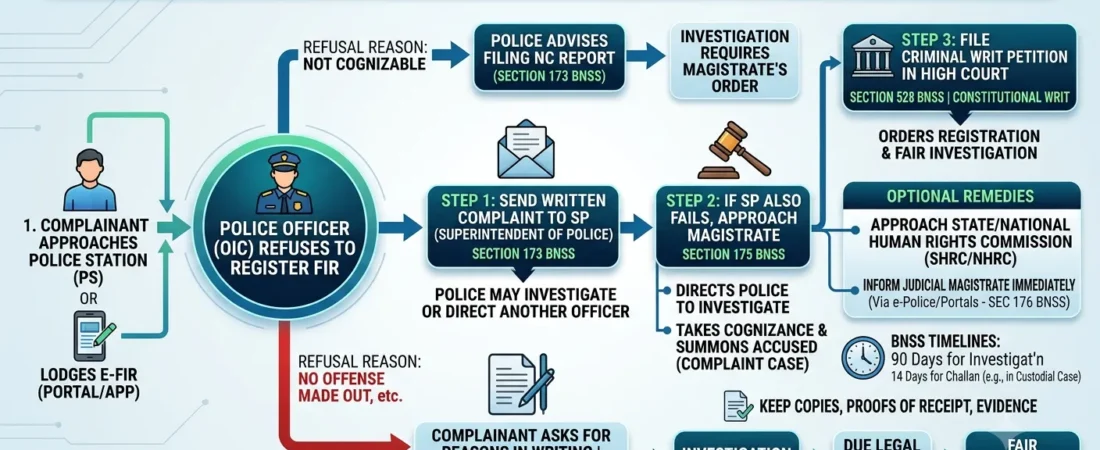
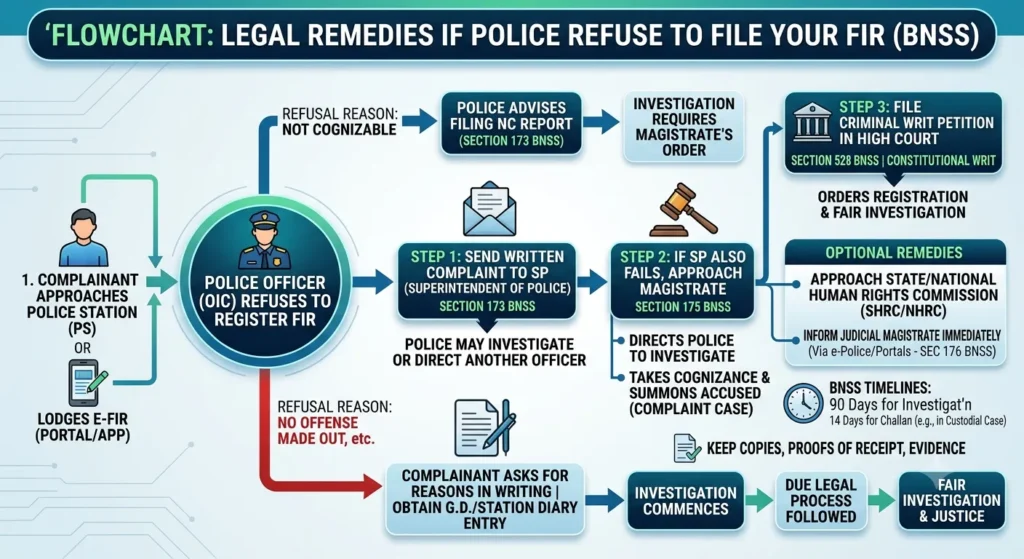
Flowchart outlining what to do if police refuse to file your FIR step by step
In our legal practice, we routinely observe citizens getting confused between administrative complaints and judicial petitions. Therefore, review the comparative breakdown below to select the most appropriate legal route for your situation.
Legal Escalation Route
Governing Statute / Authority
Processing Timeframe
Primary Legal Outcome
Written Representation to SP/DCP
Section 173(4) BNSS
3 to 7 Days
Directs SHO to lodge FIR or assigns independent IO
Petition to Judicial Magistrate
Section 175(3) BNSS
14 to 30 Days
Court orders mandatory FIR registration and investigation
State Police Grievance Portal
State Administrative Oversight
7 to 15 Days
Initiates departmental inquiry into station officer refusal
High Court Writ Petition
Article 226 of Constitution
Priority / Urgent Hearing
Issues Writ of Mandamus compelling immediate FIR logging
Human Rights Commission (NHRC)
Protection of Human Rights Act
30 to 60 Days
Investigates systemic police misconduct and officer bias
Step 1: Administrative Escalations to Senior Police Officers
When local station personnel turn you away, your immediate legal response involves escalating the matter to higher departmental authorities.
Citizen Rights Regarding Mandatory FIR Registration
First, understand your fundamental entitlement under criminal procedure law. Whenever information discloses a cognizable offence, station officers must log it immediately.
Officers cannot demand preliminary evidence, demand bribes, or send you away claiming lack of territorial jurisdiction. If an offence occurred outside local limits, officers must log a Zero FIR and transfer records later.
Escalating to the Superintendent of Police or DCP
If the Station House Officer (SHO) refuses your application, elevate the matter to the Superintendent of Police (SP) or Deputy Commissioner of Police (DCP).
Under Section 173(4) BNSS, senior officers hold direct statutory authority to investigate complaints or instruct subordinate officers to log FIRs immediately.
Sending Written Complaints via Registered Post
When delivering complaints to senior officers, physical delivery can sometimes face administrative barriers. Therefore, sending written complaints via Registered Post AD or Speed Post creates unchallengeable documentary proof.
Attach a copy of your original station complaint alongside a covering letter detailing officer refusal. Postal delivery receipts serve as primary documentary evidence when approaching courts later.
FORMAL APPLICATION TO SUPERINTENDENT OF POLICE UNDER SECTION 173(4) BNSS

To,
The Superintendent of Police / Deputy Commissioner of Police,
[District / City Name], [State Name]

SUBJECT: Application under Section 173(4) BNSS regarding unlawful refusal to register FIR by SHO [Police Station Name]

Respected Sir/Madam,

I am writing to bring to your urgent attention a cognizable offence committed on [Date] at approximately [Time] at [Location Details].

Despite approaching the Duty Officer and SHO at [Police Station Name] on [Date], the officers unlawfully refused to record my First Information Report.

Details of the Incident:
1. Complainant Name: [Your Full Name]
2. Accused Persons: [Names or Physical Descriptions]
3. Offence Details: [Clear Summary of Crime e.g., Armed Robbery / Violent Assault]

I request your immediate intervention to order the registration of an FIR under Section 173 BNSS and assign an independent Investigating Officer.

Sincerely,

[Your Signature]
[Your Printed Name]
Postal Tracking No: [Attach Postal Receipt]
In our testing of administrative escalation workflows, sending formal notices via Registered Post to SP offices triggers quick supervisory action. It forces senior officers to seek written explanations from local station heads.
Key Takeaway: Always preserve original postal receipts and delivery tracking slips. Courts require proof of administrative escalation before entertaining judicial petitions under Section 175(3) BNSS.
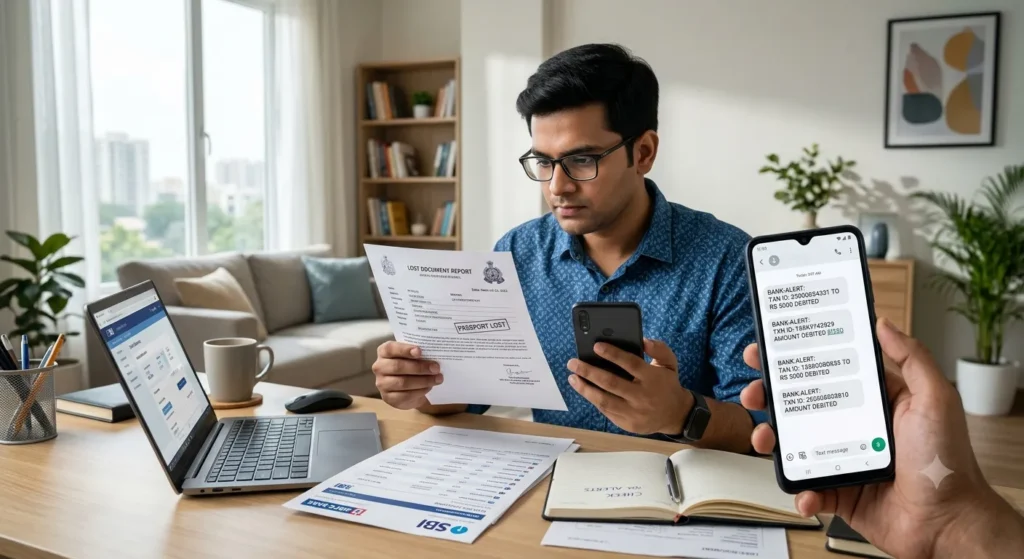
Legal complaint letter prepared for sending via Registered Post to Superintendent of Police
Step 2: Judicial Remedies via Magistrates and High Courts
If senior police officers fail to act on your postal representation, judicial intervention becomes your primary legal remedy.
Approaching the Judicial Magistrate under Criminal Law
Under Section 175(3) BNSS (formerly Section 156(3) CrPC), you can file a formal application before the local Judicial Magistrate.
The Magistrate examines your application, verifies your postal proof of sending complaints to senior officers, and assesses whether a cognizable offence is disclosed.
If satisfied, the Magistrate issues a binding judicial order directing the police station to log the FIR and submit progress reports.
When lower remedies face systemic delays, approach the State High Court directly under Article 226 of the Constitution.
You can file a Writ of Mandamus requesting judicial directions against police inaction and supervisory negligence. High Courts possess broad constitutional powers to enforce statutory compliance immediately.
In addition, High Courts can transfer investigations to independent agencies like the CBI or CID if local police display clear bias.
Key Takeaway: Judicial orders under Section 175(3) BNSS carry strict penalty threats for non-compliance. Station House Officers face contempt of court proceedings if they ignore magistrate directions.
Step 3: Administrative Grievance Portals and Human Rights Oversight
Parallel to judicial proceedings, leverage government oversight portals and human rights commissions to increase administrative pressure on non-compliant officers.
Registering Complaints on State Police Grievance Portals
Every state police department operates dedicated online grievance portals integrated into the national CCTNS network.
Log onto your state’s portal, upload your refused complaint, and attach postal proof of sending applications to the SP office.
Online portal entries bypass local station control and generate automated tracking alerts monitored by state police headquarters.
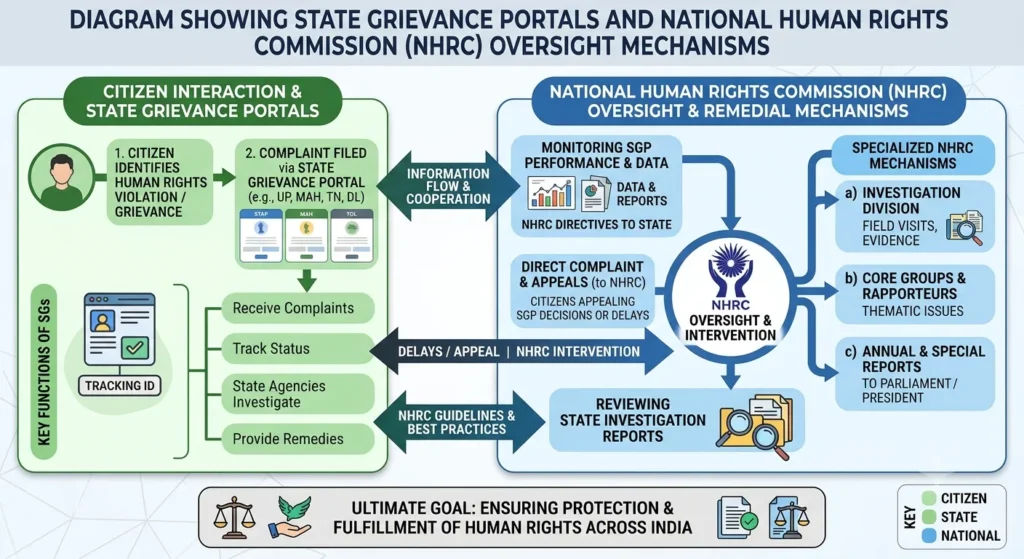
Role of National Human Rights Commission in Police Inaction
When police refusal overlaps with custodial harassment, discrimination, or protection of influential perpetrators, approach oversight commissions.
File a formal complaint with the National Human Rights Commission (NHRC) or State Human Rights Commission (SHRC).
Commissions possess statutory authority to summon senior officers, demand detailed inquiry reports, and recommend disciplinary action against guilty personnel.
Diagram showing state grievance portals and National Human Rights Commission oversight mechanisms
Landmark Supreme Court Rulings and Legal Action Against Officers
Indian jurisprudence strictly protects citizens against arbitrary police inaction. Consequently, landmark judicial precedents make FIR registration mandatory while establishing strict penalties for officer misconduct.
Landmark Supreme Court Rulings on FIR Refusal
In our legal analysis, relying on binding judicial precedents compels immediate administrative compliance. Below are foundational judgments governing FIR registration:
Lalita Kumari v. Govt. of U.P. (2014) 2 SCC 1: A Constitution Bench of the Supreme Court held that registration of an FIR is mandatory under Section 154 CrPC (now Section 173 BNSS) if information discloses a cognizable offence. The court ruled that no preliminary inquiry is permissible in such cases.
Youth Bar Association of India v. Union of India (2016) 16 SCC 654: The court directed that FIR copies must be uploaded on official police websites within 24 to 48 hours to preserve public transparency.
P. Sirajuddin v. State of Madras (1970) 1 SCC 595: The court emphasized that police inquiries must remain unbiased, transparent, and strictly compliant with procedural law.
Legal Action Against Police Under Misconduct Rules
Refusing to register an FIR constitutes a punishable offence under specialized penal statutes.
Under Section 199 of the Bharatiya Nyaya Sanhita (BNS) (formerly Section 166A IPC), public servants who knowingly disobey law directions face rigorous imprisonment up to two years alongside mandatory fines.
Furthermore, file departmental misconduct complaints before the Police Complaints Authority (PCA) established in every state under Prakash Singh v. Union of India (2006) guidelines.
Key Takeaway: Quoting Lalita Kumari v. Govt. of U.P. in your written complaints signals deep legal awareness. It warns station officers that continued refusal exposes them to personal criminal liability under Section 199 BNS.
Need expert help drafting your judicial petition or notice? Contact our legal team today for immediate consultation and case evaluation.
Strategic Public, Media, and Digital Escalation Pathways
While statutory remedies remain primary, strategic public visibility often accelerates official administrative action when dealing with influential perpetrators.
How Media and Social Escalation Can Help
Document your station visit carefully, maintaining written logs of officer names, dates, and specific reasons offered for refusal.
Tag official police handles on social media platforms, highlighting your postal tracking numbers and detailed complaint copies publicly.
In addition, alert local journalists and news outlets regarding police inaction in serious matters. Public media coverage prevents local authorities from hushing up sensitive cases.
STRATEGIC PUBLIC ESCALATION WORKFLOW

[Step 1: Document Station Visit, Date, Time & Officer Name]
      │
      ▼
[Step 2: Send Written Complaint via Registered Post to SP]
      │
      ▼
[Step 3: Tag Official Police Handles on Social Media with Postal Proof]
      │
      ▼
[Step 4: Engage Local Media / Press Conference for Sensitive Cases]
      │
      ▼
[Step 5: Execute Parallel Judicial Application under Section 175(3) BNSS]
Ultimately, combining formal judicial petitions with public accountability mechanisms creates unstoppable pressure. Stand firm on your statutory rights, preserve every paper trail, and demand justice boldly.
Frequently Asked Questions
Can a police officer be jailed for refusing to register an FIR?
Yes, a police officer can face imprisonment for refusing to register an FIR. Under Section 199 BNS (formerly Section 166A IPC), public servants who fail to record information regarding specified cognizable offences face rigorous imprisonment up to two years.
What should I do if police register an NCR instead of an FIR?
If police register a Non-Cognizable Report (NCR) for a serious crime, submit a written representation to the Superintendent of Police explaining how facts disclose a cognizable offence. If the SP does not act, file an application before the Judicial Magistrate under Section 175(3) BNSS.
How long does a Judicial Magistrate take to pass an order on FIR refusal?
Judicial Magistrates typically hear applications under Section 175(3) BNSS within 14 to 30 days. In urgent matters involving ongoing threats or evidence destruction, courts can issue immediate directions to police stations within a few days.
Can I file an FIR directly in court without visiting a police station?
No, you cannot approach a Magistrate directly without trying police channels first. Under Priyanka Srivastava v. State of U.P. (2015), you must show proof of submitting complaints to local police and senior officers (SP/DCP) before a Magistrate can entertain your application.
Assert Your Statutory Rights Today
Police refusal should never end your search for legal justice. By executing statutory escalations under BNSS and relying on Supreme Court precedents, you force law enforcement authorities to act.
Prepare your written documentation carefully, send representations via Registered Post, and execute judicial remedies confidently. The legal system provides robust protections to ensure your voice gets heard.