Police Refusing Your Complaint? How Zero FIR Protects Your Rights
Facing a serious crime while traveling or far from home triggers panic, anger, and deep anxiety. Therefore, understanding Zero FIR ensures you secure immediate police action without getting turned away by jurisdiction excuses.
Written by Kapil Balhara | Technically Reviewed for Accuracy | Last Updated: October 2026
Understanding the Foundations and Legal Purpose of Zero FIR
When a cognizable crime occurs, immediate police intervention preserves critical evidence, protects victims, and halts escaping criminals. Consequently, procedural technicalities must never delay initial law enforcement responses during medical or safety emergencies.
Under Section 173 of the Bharatiya Nagarik Suraksha Sanhita (BNSS), police officers must record every disclosure regarding a serious crime. This statutory mandate applies across all police stations regardless of where the incident originally happened.
Key Takeaway: A Zero FIR eliminates geographic boundary excuses. It compels any nearby police station to log your complaint immediately and initiate medical care or evidence preservation.
Definition and Legal Purpose of Zero FIR
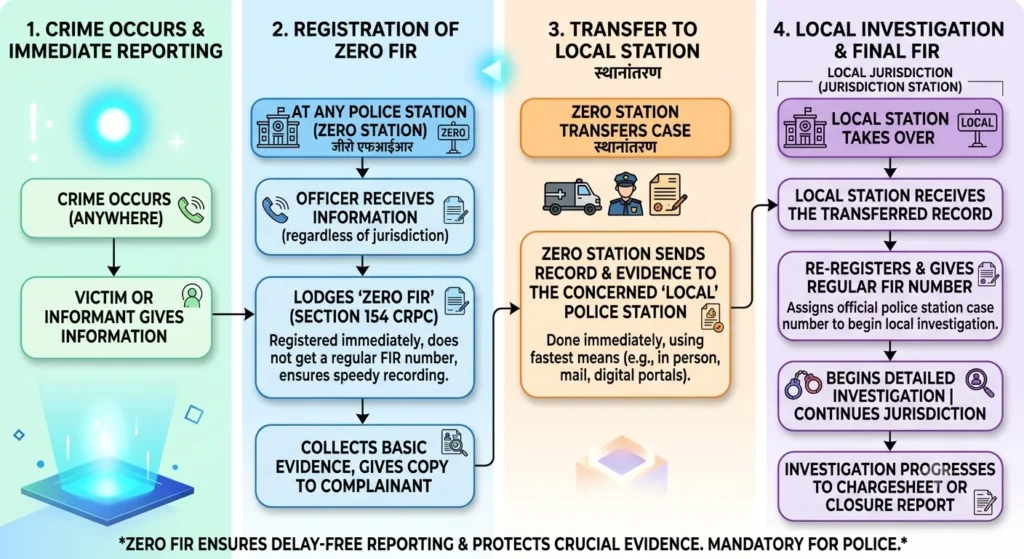
Understanding Zero FIR explained: how to file an FIR anywhere empowers citizens to seek immediate police help anywhere in India. A Zero FIR is a First Information Report registered at a police station regardless of territorial jurisdiction. It receives the serial number “0”, triggers immediate emergency action, and transfers to the appropriate local station later.
Diagram showing how a Zero FIR is registered at any station and transferred to the local station
In our legal practice, we routinely assist citizens who face station officers citing jurisdictional limits to avoid work. Therefore, review the comparative breakdown below to understand how Zero FIRs function alongside regular reports.
Legal Feature
Zero FIR System
Regular FIR System
Territorial Jurisdiction
Registered at any police station across India
Registered strictly at the station covering the crime scene
Serial Number Format
Assigned serial number “0” (Zero)
Assigned a sequential annual number (e.g., FIR No. 123/2026)
Initial Police Action
Immediate medical assistance, crime scene preservation, and suspect detention
Full comprehensive investigation from start to charge sheet filing
File Transfer Duty
Must be transferred to the local station via CCTNS after initial action
Retained at the registering station until trial conclusion
Governing Statutory Rule
Section 173 BNSS / Ministry of Home Affairs Directives
Section 173 BNSS
Key Differences Between Zero FIR and Regular FIR
While both documents set criminal law into motion, their administrative processing follows distinct legal paths.
Structural Breakdown of Registration Numbers
A regular FIR carries a permanent sequential number tied to a specific police station register. For instance, FIR No. 45/2026 identifies the 45th crime recorded at that specific station in 2026.
Conversely, a Zero FIR receives no sequential annual number at the registering station. Officers enter the digit “0” in the registration field to prevent numbering discrepancies in local station books.
Once the receiving station transfers the file to the competent local station, that competent station assigns its own regular sequential number.
Scope of Initial Police Investigation
When an officer registers a regular FIR, that station conducts the complete investigation from start to finish.
In contrast, an officer recording a Zero FIR focuses strictly on immediate, time-sensitive emergency duties. The officer records the informant’s statement, secures the crime scene, collects perishable forensic evidence, and conducts medico-legal checks.
After completing initial emergency measures, the registering station transfers the complete case file to the competent station for full investigation.
Key Takeaway: A Zero FIR guarantees immediate emergency intervention. It prevents loss of forensic evidence while solving geographic border disputes between adjacent police stations.
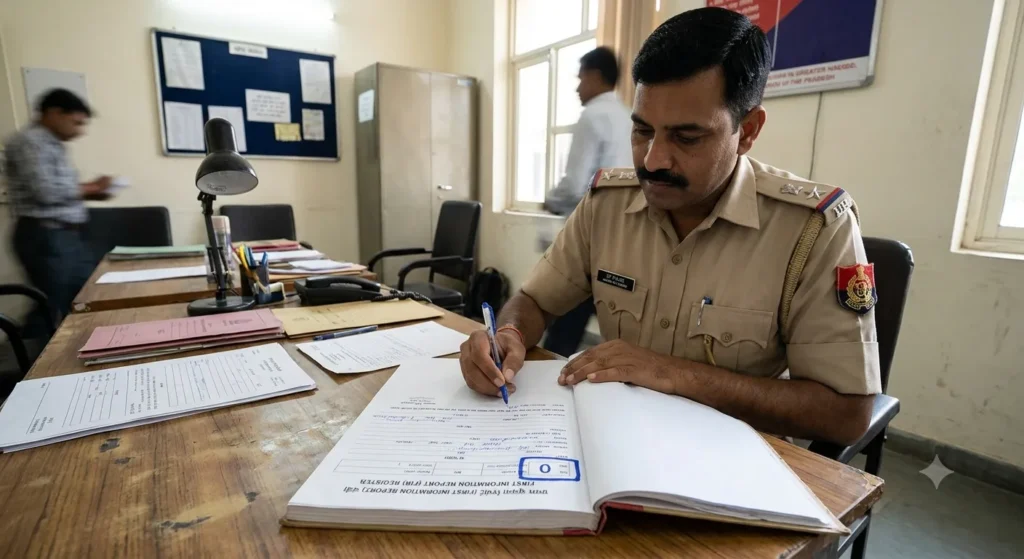
Official FIR document displaying serial number zero assigned at a police station
Why Jurisdiction Limits Do Not Apply in Emergencies
Historically, police personnel routinely turned away crime victims by arguing that the incident occurred outside their assigned territory. Consequently, judicial mandates and legal reforms eliminated these jurisdictional barriers completely for cognizable offences.
Justice Verma Committee Recommendations
Following the tragic 2012 Delhi gang-rape incident, the Justice Verma Committee recommended systemic criminal law reforms to protect victims.
The committee emphasized that police inaction during initial hours causes severe harm to crime victims. Consequently, the government issued mandatory Ministry of Home Affairs (MHA) guidelines instructing all states to implement Zero FIR procedures strictly.
Landmark Judicial Rulings on Jurisdiction
In our legal analysis, relying on binding court precedents stops police officers from making unlawful territorial excuses. Below are foundational judgments governing Zero FIRs:
Lalita Kumari v. Govt. of U.P. (2014) 2 SCC 1: A Constitution Bench of the Supreme Court held that FIR registration is mandatory for cognizable offences. The court ruled that jurisdictional questions must be addressed after recording the complaint, not before.
State of Andhra Pradesh v. Punati Ramulu (1994) Supp (1) SCC 59: The Supreme Court held that a police officer who refuses to record information regarding a cognizable offence occurring outside his territory fails in his statutory duty.
Kirti Vashisht v. State (NCT of Delhi) (2019): The Delhi High Court reiterated that police stations must record Zero FIRs immediately for out-of-station offences without delaying for preliminary inquiry.
Ramesh Kumari v. State (NCT of Delhi) (2006) 2 SCC 677: The Supreme Court affirmed that statutory provisions do not allow police officers to evaluate territorial jurisdiction before logging a cognizable complaint.
How Zero FIR Helps in Travel and Highway Crimes
Crimes occurring on moving trains, long-distance buses, or state highways create complex jurisdictional confusion for victims.
For instance, if a passenger suffers robbery on a train traveling across multiple districts, determining the exact crime location remains difficult.
Under Zero FIR rules, the victim can disembark at the next railway station or bus terminal and lodge an FIR immediately. The local Railway Protection Force (RPF) or station officer must record the Zero FIR without delay.
Key Takeaway: Quoting Justice Verma Committee recommendations and MHA circulars prevents station officers from delaying emergency action. Jurisdiction claims can never override urgent victim safety.
Step-by-Step Process of Demanding a Zero FIR
When approaching a police station far from the crime scene, follow a structured process to ensure officers record your report without friction.
Real-Life Emergency Scenarios Requiring Zero FIR
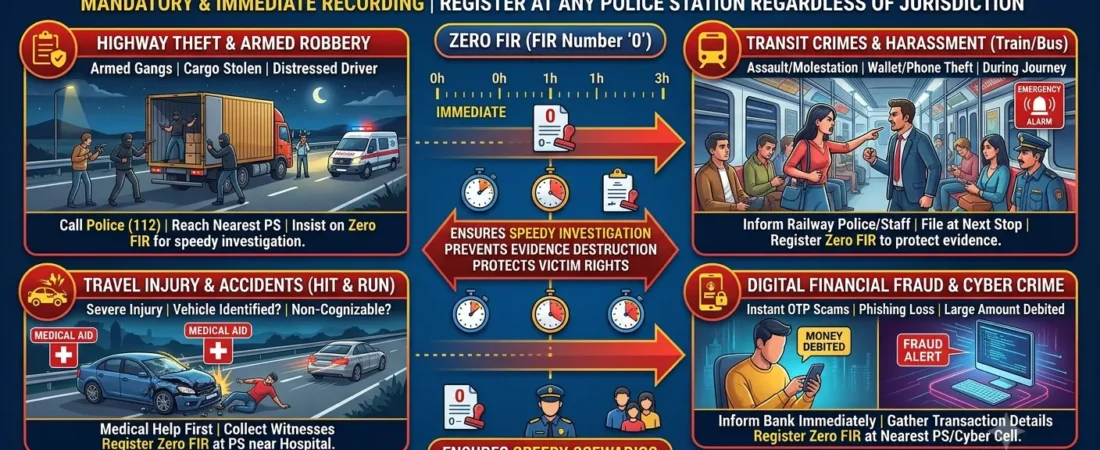
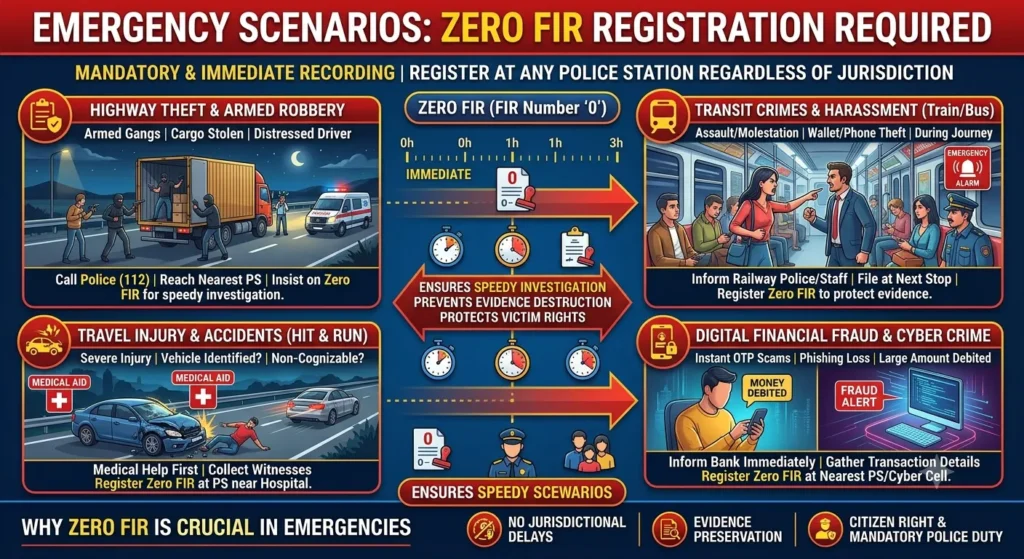
In our testing of legal workflows, Zero FIRs prove vital across several urgent situations:
Highway Accidents & Assaults: Serious road crashes or physical attacks occurring on remote highways between cities.
Crimes Against Women: Sexual assault, domestic violence, or harassment occurring during travel or at a relative’s house in another state.
Inter-State Cyber Crimes & Kidnapping: Financial fraud or abduction where victim, suspect, and crime scenes span multiple state borders.
Property Theft During Transit: Stolen luggage, vehicles, or valuables lost during long-distance train or air travel.
Step-by-Step Process of Demanding a Zero FIR
Follow these practical steps when filing your emergency report at any police station:
Approach the Duty Officer: Walk into the nearest police station and request to meet the Duty Officer or Station House Officer (SHO).
State Emergency Facts Clearly: Explain that a cognizable crime occurred and that you require an immediate Zero FIR registration.
Submit Written Complaint: Provide a clear written application detailing dates, times, suspect descriptions, and crime scene location.
Cite Statutory Directives: If officers cite jurisdiction excuses, respectfully mention Section 173 BNSS and MHA Zero FIR circulars.
Verify and Sign: Read the drafted report carefully, confirm that the serial number reflects “0”, and sign the document.
Collect Free Stamped Copy: Under Section 173(2) BNSS, demand your official stamped copy free of charge before leaving.
Infographic displaying emergency scenarios requiring immediate Zero FIR registration
How Police Assign Zero Serial Numbers and Transfer File Records
Understanding internal police station administration helps you track your document as it moves between state departments.
How Police Assign Zero Serial Numbers
When an officer enters your complaint into the Crime and Criminal Tracking Network & Systems (CCTNS) portal, the system prompts for a station code.
Because the crime occurred outside local station limits, the officer selects the “Zero FIR” option in the software module.
The portal generates a document titled “FIR No. 0” associated with that calendar year. This digital entry prevents the system from locking the local station’s sequential annual FIR ledger.
Transferring Zero FIR Records to the Local Station
After recording the Zero FIR and completing preliminary emergency tasks, the registering station initiates file transfer.
The officer uploads all recorded statements, medico-legal certificates, seized physical evidence, and site maps onto the CCTNS network.
The system transfers the electronic file directly to the CCTNS portal of the competent local police station. Simultaneously, the registering station dispatches physical original copies via Registered Post AD or police courier.
ZERO FIR ADMINISTRATIVE TRANSFER PROCESS

[Step 1: Citizen Files Complaint at Nearest Police Station]
      │
      ▼
[Step 2: Officer Selects 'Zero FIR' Module in CCTNS & Assigns No. 0]
      │
      ▼
[Step 3: Police Conduct Emergency Checks, MLC & Evidence Seizure]
      │
      ▼
[Step 4: CCTNS System Digitally Transfers File to Local Station]
      │
      ▼
[Step 5: Local Station Assigns Regular FIR Number & Begins Full Investigation]
Key Takeaway: Digital CCTNS transfer ensures that file transfer happens rapidly between states without relying solely on physical postal mail.
Police Obligations, Penalties for Refusal, and Tracking Progress
Law enforcement officers face severe legal penalties if they refuse to register a Zero FIR for a cognizable crime.
Police Obligations and Penalties for Refusal
Under Section 199 of the Bharatiya Nyaya Sanhita (BNS) (formerly Section 166A IPC), public servants who knowingly disobey law directions face rigorous imprisonment up to two years alongside mandatory fines.
Furthermore, state police discipline rules treat refusal to record a Zero FIR as gross misconduct resulting in suspension.
If an officer refuses entry or registration, execute administrative escalations immediately:
Postal Complaint to SP/DCP: Send your complaint to the Superintendent of Police via Registered Post under Section 173(4) BNSS.
Judicial Magistrate Petition: File a petition before the Judicial Magistrate under Section 175(3) BNSS seeking direct orders for FIR registration.
State Police Grievance Portals: Log an urgent complaint on the state police web portal detailing officer refusal.
Once the registering station transfers your file, contact the competent local station using your Zero FIR reference details.
The receiving local station registers the transferred file as a regular FIR, assigning it a permanent annual number (e.g., FIR No. 210/2026).
Track the converted regular FIR on the receiving state’s CCTNS portal or stay in direct touch with the assigned Investigating Officer.
Need expert legal help resolving a jurisdiction dispute? Contact our legal team today for immediate drafting support and case evaluation.
Frequently Asked Questions
Can police charge any money for transferring a Zero FIR to another station?
No, police cannot charge any money for registering or transferring a Zero FIR. Under Section 173(2) BNSS, registering reports and providing official copies to informants remains completely free of charge.
What happens if the registering station loses my physical Zero FIR documents during transfer?
Because modern police stations log Zero FIRs digitally on the national CCTNS network, digital copies remain preserved permanently online. If physical copies get lost in transit, the receiving station prints fresh copies directly from CCTNS.
Is a Zero FIR valid for claiming motor vehicle insurance after theft?
Yes, a Zero FIR is fully valid for initiating motor insurance claims. However, insurance companies require the final transferred regular FIR number from the local station before settling final claim payouts.
Can I file a Zero FIR online through state police citizen portals?
Yes, several state police portals accept online e-FIRs for specified property crimes like vehicle theft. The digital system automatically routes the report as a Zero FIR if location data indicates an outside jurisdiction.
Assert Your Right to Immediate Legal Action
Understanding Zero FIR procedures ensures that distance or jurisdictional confusion never stops you from seeking immediate police help. Knowing your statutory rights enables you to overcome administrative excuses confidently.
Do not let station officers turn you away during emergencies. Demand a Zero FIR, secure your free stamped copy, and ensure the legal system works for your protection everywhere in India.