Difference Between FIR, NCR, and Police Complaint (Explained Simply)
Navigating police station procedures during a legal crisis causes overwhelming confusion, panic, and anxiety. Therefore, understanding the Difference Between FIR, NCR, and Police Complaint ensures you demand the correct legal document and protect your fundamental rights.
Written by Kapil Balhara | Technically Reviewed for Accuracy | Last Updated: October 2026
Understanding the Core Legal Classifications of Offences
Before analyzing specific station documents, you must grasp how Indian criminal law classifies illegal acts. Consequently, procedural paths depend entirely on whether an offence falls under a cognizable or non-cognizable category.
Under Section 2(g) of the Bharatiya Nagarik Suraksha Sanhita (BNSS) (formerly Section 2(c) CrPC), a cognizable offence represents a serious crime. For instance, murder, robbery, rape, kidnapping, and severe physical assault qualify as cognizable offences.
Conversely, Section 2(o) BNSS (formerly Section 2(l) CrPC) defines non-cognizable offences as less severe illegal acts. Examples include simple defamation, minor verbal altercations, cheating without forgery, and simple trespass.
Key Takeaway: The statutory classification of an offence dictates whether police officers can act independently or must await direct orders from a Judicial Magistrate.
Definition and Summary Block
Understanding the difference between FIR, NCR, and police complaint helps citizens navigate criminal procedure effectively. An FIR records serious cognizable offences authorizing immediate arrest and investigation. An NCR logs minor non-cognizable disputes requiring Magistrate permission for investigation. A police complaint refers to any written grievance submitted to police or court.
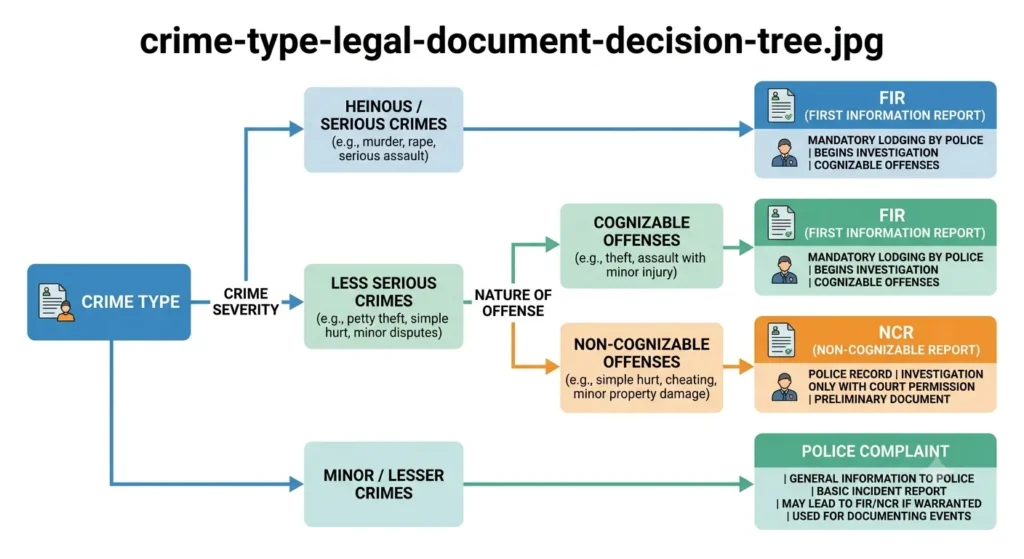
Decision tree displaying difference between FIR, NCR, and police complaint based on crime severity
In our legal practice, we routinely observe citizens getting confused when station clerks issue an NCR entry instead of registering a formal FIR. Therefore, review the comprehensive comparison table below to evaluate their key legal specs.
Feature / Spec
First Information Report (FIR)
Non-Cognizable Report (NCR)
Written Police Complaint
Governing Statute
Section 173 BNSS
Section 177 BNSS
Section 2(h) / Section 223 BNSS
Offence Classification
Cognizable Offences Only
Non-Cognizable Offences Only
Cognizable or Non-Cognizable
Arrest Authority
Police can arrest without warrant
Police require Magistrate warrant
No arrest power until converted
Investigation Authority
Immediate mandatory investigation
Requires Magistrate order under Section 177(2)
Police conduct informal inquiry
Statutory Document Copy
Free of cost to informant by law
Entered in Daily Diary / Station Register
Receipt stamp on duplicate copy
Court Submission
Dispatched to Magistrate within 24 hours
Retained in station register until summoned
Filed directly before Magistrate or SHO
Anatomy of a First Information Report (FIR)
A First Information Report serves as the foundational document that sets the entire criminal justice machinery into motion across India.
Characteristics of a First Information Report
An FIR represents the earliest written information logged by police regarding a serious crime. Specifically, it must disclose the commission of a cognizable offence clearly.
Furthermore, any victim, witness, or person with knowledge of the crime can file an FIR. In fact, even the perpetrator or a police officer can record an FIR upon discovering a crime scene.
Under Section 173(2) BNSS, the recording officer must read back the statement to the informant. In addition, the officer must provide an official stamped copy to the informant free of charge.
Legal Powers Triggered by an FIR
Once police log an FIR, the Station House Officer (SHO) assigns an Investigating Officer (IO) immediately. The IO possesses statutory authority to visit the crime scene, record witness statements under Section 180 BNSS, and seize physical evidence.
In addition, officers hold statutory powers to arrest suspects without obtaining prior court warrants. The IO must conclude the investigation by filing a Charge Sheet under Section 193 BNSS or a Closure Report.
In Lalita Kumari v. Govt. of U.P. (2014) 2 SCC 1, a Constitution Bench of the Supreme Court held that registration of an FIR is mandatory if information discloses a cognizable offence.
Key Takeaway: Police officers cannot refuse to register an FIR for a cognizable crime. Furthermore, conducting preliminary inquiries in cognizable matters violates Supreme Court mandates.
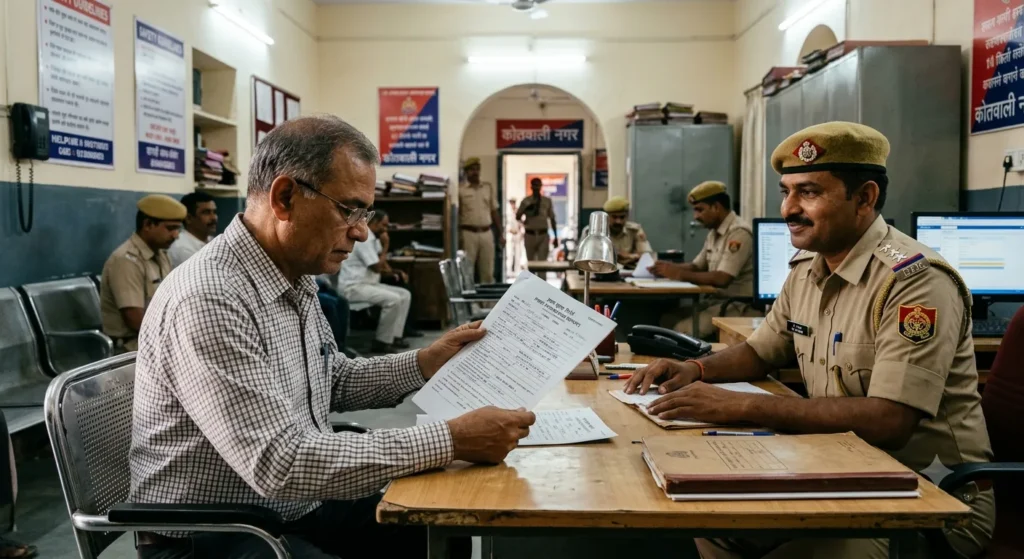
Citizen checking characteristics of a First Information Report form at police station
Understanding Non-Cognizable Reports (NCR) and Police Complaints
When information discloses minor grievances or petty disputes, police officers record alternative legal entries rather than formal FIRs.
Purpose and Scope of Non-Cognizable Reports
A Non-Cognizable Report (NCR) documents minor offences defined under Section 177 BNSS. When citizens report petty quarrels, simple intimidation, or minor land boundary arguments, police enter details into the station’s Daily Diary (General Diary).
However, police officers possess zero legal authority to investigate an NCR on their own initiative. Furthermore, officers cannot arrest accused individuals without an explicit arrest warrant issued by a competent Judicial Magistrate.
The police officer must advise the informant to approach the Judicial Magistrate Court to seek formal directions under Section 177(2) BNSS.
Understanding Written Complaints to Police Officers
A written police complaint represents a broad, informal grievance submitted by an aggrieved person. Under Section 2(h) BNSS, a complaint refers to any allegation made orally or in writing to a Magistrate or police officer.
Unlike an FIR, a simple written complaint does not automatically set formal criminal investigation in motion. Instead, police officers treat it as an initial application to verify facts.
If the preliminary inquiry reveals a cognizable offence, the SHO converts the written complaint into a formal FIR. Conversely, if it reveals a non-cognizable issue, the officer logs an NCR.
Key Takeaway: Always demand an official receiving stamp with date and time on your copy when submitting a written complaint to a police station.
Comparative Breakdown of Police Powers across Documents
Understanding how officer powers shift across different station entries helps you prevent police overreach or improper inaction.
How Police Powers Differ Between FIR and NCR
The table below illustrates the stark operational contrast in police powers between FIR and NCR entries:
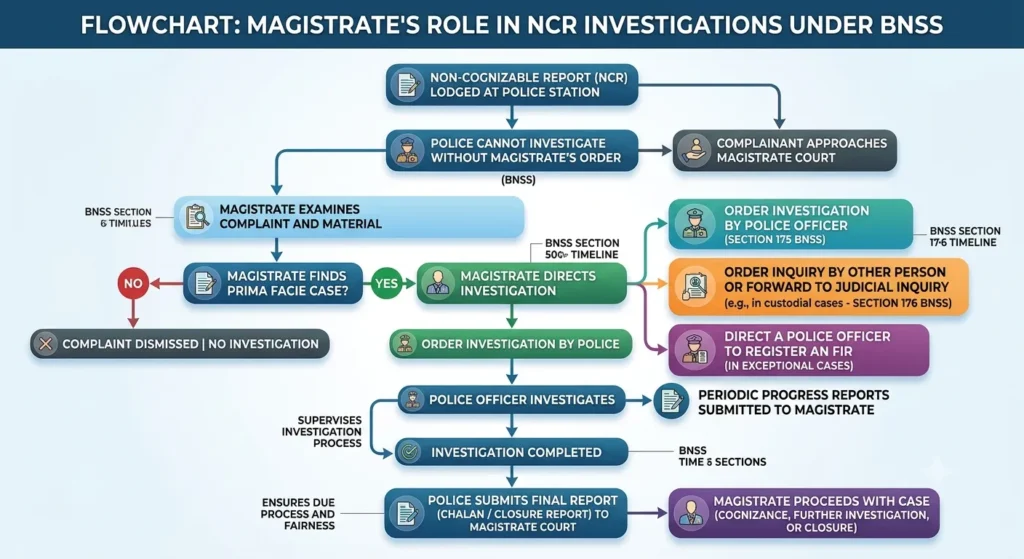
Role of Magistrates in Directing NCR Investigations
Because police cannot investigate an NCR independently, the Judicial Magistrate plays a decisive supervisory role.
Under Section 177(2) BNSS, an aggrieved citizen can present their NCR copy directly before the local Magistrate. If satisfied, the Magistrate orders the police to conduct an investigation.
Once the Magistrate issues an investigation order for an NCR, the police officer receives identical investigative powers as in an FIR case, except the power to arrest without a warrant.
Key Takeaway: If police log your serious matter as an NCR improperly, approach the Judicial Magistrate immediately under Section 177(2) BNSS to force a full police investigation.
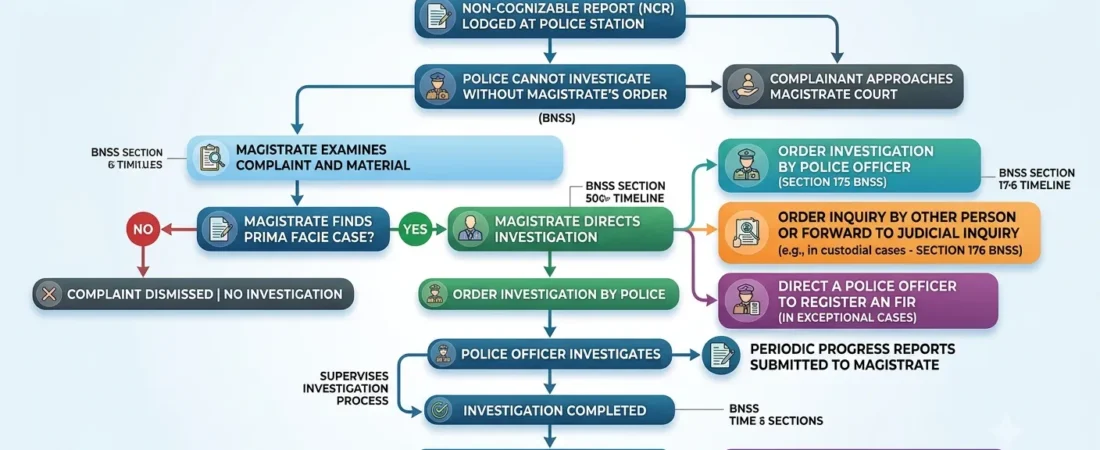
Flowchart showing the role of magistrates in directing NCR investigations under BNSS
Procedural Transitions: Converting Complaints into FIRs
A written application or an NCR entry does not remain static; procedural mechanisms allow converting initial grievances into full FIRs.
Converting a Police Complaint or NCR into an FIR
In many instances, police officers initially record a simple written complaint or an NCR to evaluate incoming information. However, if ongoing inquiries reveal serious cognizable elements, the SHO must convert the file.
For example, if a minor verbal quarrel documented in an NCR escalates into physical assault involving dangerous weapons, the matter transforms into a cognizable crime. Consequently, the officer logs a fresh FIR.
Furthermore, citizens can file an application under Section 175(3) BNSS (formerly Section 156(3) CrPC) before the Magistrate to convert a ignored written complaint into an FIR directly.
Court Rules Governing Police Action in Petty Disputes
Courts enforce strict guidelines to prevent police officers from converting minor civil or commercial disagreements into criminal FIRs.
Similarly, in Priyanka Srivastava v. State of U.P. (2015) 6 SCC 287, the Supreme Court mandated that applications under Section 156(3) CrPC (now Section 175(3) BNSS) seeking FIR registration must be supported by a sworn affidavit. This rule deters citizens from abusing court processes for petty disputes.
Key Takeaway: Attaching a sworn affidavit proving prior approach to police officers remains mandatory when petitioning a Magistrate to convert a complaint into an FIR.
Judicial Precedents, Evidentiary Weight, and Practical Guidance
Understanding how courts evaluate different station entries prepares you for trial proceedings and legal representation.
Legal Weight of FIR vs Complaint During Trial
In criminal trials, an FIR does not constitute substantive evidence by itself. Instead, it operates as a foundational document used to corroborate or contradict the informant’s testimony under Indian Evidence law.
In Tirhashi Nath v. State of U.P. (1992), the Supreme Court clarified that an FIR sets the investigation into motion, but guilt must be established through independent trial evidence.
Conversely, a private complaint filed directly before a Magistrate under Section 223 BNSS (formerly Section 200 CrPC) initiates judicial inquiry directly. The Magistrate records complainant and witness statements under oath before issuing summons to the accused.
Which Document to Demand Based on Crime Type
When visiting a police station, assert your statutory rights by demanding the appropriate legal document based on the specific incident:
Demand an FIR Immediately: For serious violent crimes, armed robbery, vehicle theft, house burglary, cyber financial fraud, sexual harassment, or kidnapping.
Accept an NCR Entry: For lost non-essential personal items, minor verbal disputes without physical injury, or simple property trespass without damage.
Submit a Written Complaint: For complex financial fraud, corporate disputes, or contractual breaches requiring detailed document verification before FIR logging.
QUICK DECISION GUIDE FOR CITIZENS

[CRIME OCCURRED]
       │
       ├─► Serious / Violent / Theft / Fraud ──► DEMAND FIR (Sec 173 BNSS)
       │
       ├─► Minor Quarrel / Petty Argument   ──► ACCEPT NCR (Sec 177 BNSS)
       │
       └─► Complex Dispute / Document Loss  ──► SUBMIT WRITTEN COMPLAINT
In our testing of station escalation workflows, quoting landmark judgments like Lalita Kumari stops officers from giving an NCR for serious crimes.
Need expert legal help determining which document to file for your case? Contact our legal team today for an immediate, confidential case review.
Frequently Asked Questions
Can police arrest someone based solely on a Non-Cognizable Report (NCR)?
No, police officers cannot arrest anyone based solely on an NCR. Because non-cognizable offences represent minor violations, police officers must secure an explicit arrest warrant from a Judicial Magistrate before making an arrest.
Is an FIR copy provided free of cost to the complainant?
Yes, under Section 173(2) of the BNSS, the police officer recording the FIR must provide an official stamped copy to the informant free of cost immediately after registration.
What should I do if police issue an NCR for a serious cognizable crime?
If police issue an NCR for a serious crime improperly, send a written representation to the Superintendent of Police via Registered Post under Section 173(4) BNSS. If the SP fails to act, file a petition before the Judicial Magistrate under Section 175(3) BNSS.
Can a private written complaint to a Magistrate be converted into an FIR?
Yes, when you file a private complaint before a Judicial Magistrate under Section 223 BNSS, the Magistrate can direct the local police station to register an FIR and investigate under Section 175(3) BNSS.
Assert Your Legal Rights Confidently
Understanding the difference between FIR, NCR, and police complaint empowers you to navigate law enforcement systems without fear or confusion. Demanding the correct statutory document protects your legal standing from day one.
Do not let station personnel downplay serious crimes with improper NCR entries. Assert your statutory rights, preserve official receiving copies, and ensure the legal system works for your protection.