Terrified of Police Investigation? What Happens After an FIR is Lodged?
Lodging or facing a First Information Report triggers intense anxiety, uncertainty, and fear of sudden police action. Therefore, understanding What Happens After an FIR is Lodged? (The Investigation Process) empowers you to navigate criminal procedure confidently and protect your legal rights.
Written by Kapil Balhara | Technically Reviewed for Accuracy | Last Updated: October 2026
Once police register an FIR, the statutory criminal machinery moves into active motion immediately across Indian jurisdictions. Consequently, understanding how investigating officers execute their statutory duties prevents procedural errors and police overreach.
Section 173 of the Bharatiya Nagarik Suraksha Sanhita (BNSS) (formerly Section 154 CrPC) sets the formal recording of an FIR. Subsequently, Section 176 BNSS (formerly Section 157 CrPC) authorizes police officers to initiate comprehensive field investigations.
Key Takeaway: Registration of an FIR triggers an official investigation pipeline. Police officers hold statutory authority to collect evidence, interrogate suspects, and search crime scenes without prior court permission.
Definition and Summary Block
Understanding what happens after an FIR is lodged clarifies the complete police investigation process. Upon registration, the Station House Officer assigns an Investigating Officer who conducts site inspections, collects physical evidence, records witness statements, enforces arrest guidelines, interrogates suspects, and submits a final Charge Sheet or Closure Report to court.
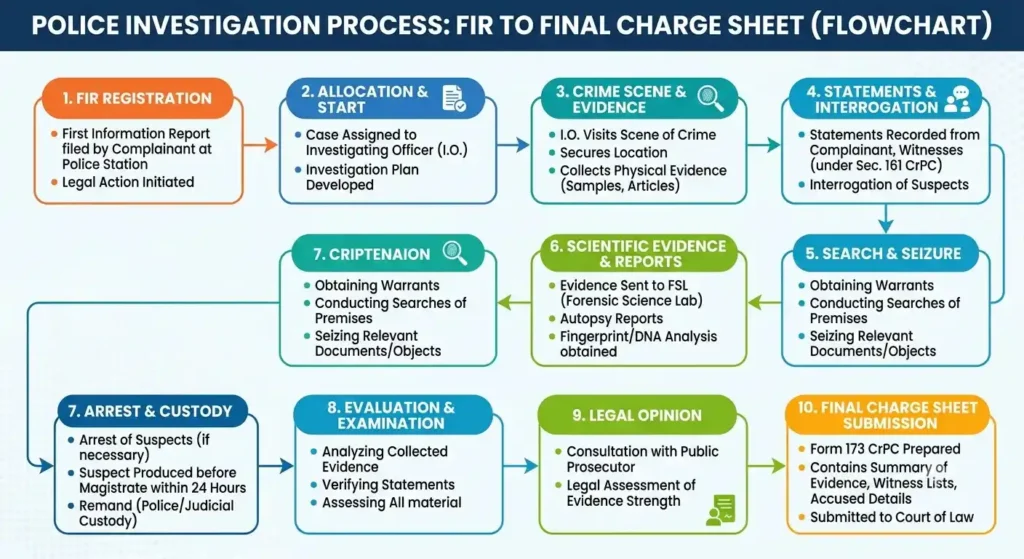
Flowchart displaying what happens after an FIR is lodged step by step
In our legal practice, we routinely guide victims and accused individuals through complex police inquiries. Therefore, review the comparative breakdown below to understand how police procedures transition across distinct investigative phases.
Investigation Phase
Key Legal Provision
Primary Police Activity
Primary Legal Document Produced
Phase 1: Initiation
Section 176 BNSS
IO appointment, crime scene inspection, spot map drafting
Crime Scene Map & Panchnama
Phase 2: Evidence Gathering
Section 180 & Section 183 BNSS
Witness examinations, forensic collection, digital backups
Filing final report (Charge Sheet or Closure Report)
Final Report under Section 193 BNSS
Initial Investigation Steps: Officer Assignment and Crime Scene Analysis
Following FIR registration, administrative directives allocate responsibility to specific station officers to ensure systematic field operations.
Appointment and Duties of the Investigating Officer
First, the Station House Officer (SHO) issues an official administrative order assigning an Investigating Officer (IO).
Usually, an officer holding the rank of Sub-Inspector (SI) or Inspector leads the investigation.
The IO assumes complete legal responsibility for managing the file, securing physical evidence, examining witnesses, and maintaining the daily Case Diary under Section 192 BNSS (formerly Section 172 CrPC).
Conducting Site Inspection and Preparing Spot Map
Next, the IO visits the location where the crime occurred immediately to preserve physical evidence.
The officer conducts a thorough site inspection, isolating the crime scene to prevent contamination by bystanders.
Furthermore, the IO drafts a detailed “Spot Map” (Site Plan) depicting geographic landmarks, entry-exit routes, and relative distances.
In addition, the officer prepares a formal “Panchnama” (Seizure Memo) signed by independent local witnesses to record physical items seized at the scene.
Key Takeaway: Independent witnesses must sign the Panchnama at the spot. Unwitnessed or backdated site seizures weaken prosecution arguments significantly during trial.
Investigating Officer drafting site plan and collecting forensic evidence after an FIR is lodged
Collecting Evidence: Statements, Forensics, and Digital Records
A successful prosecution relies heavily on objective, verified evidence collected during the initial days of inquiry.
Recording Statements of Victims Complainants and Witnesses
The IO examines individuals acquainted with the facts of the case under Section 180 BNSS (formerly Section 161 CrPC).
The officer records these statements in writing or through audio-video electronic means.
Importantly, witness statements recorded under Section 180 BNSS do not carry witness signatures.
However, for sensitive offences, the IO presents victims before a Judicial Magistrate to record formal statements under Section 183 BNSS (formerly Section 164 CrPC), which carry full evidentiary weight.
Collecting Forensic Medical and Digital Evidence
In cases involving physical violence, the IO sends victims and suspects to government hospitals for compulsory Medico-Legal Examination (MLC).
Furthermore, the IO secures physical biological samples, weapons, and clothing, dispatching them to the Forensic Science Laboratory (FSL).
In addition, the IO collects digital evidence, including CCTV video footage, mobile phone call detail records (CDR), and electronic banking receipts.
Under Section 63 of the Bharatiya Sakshya Adhiniyam (BSA) (formerly Section 65B Evidence Act), electronic records must carry valid electronic certificates to remain admissible during trial.
Key Takeaway: Statements made to police officers under Section 180 BNSS cannot be used as substantive evidence. They serve only to contradict or corroborate witnesses during court cross-examination.
Statutory Rules Governing Arrests, Interrogations, and Custody
Exercising powers of arrest requires strict adherence to constitutional guarantees and statutory safeguards laid down by higher courts.
Rules Guidelines and Procedures Governing Arrests
Police officers do not possess unrestricted authority to arrest individuals automatically after an FIR gets lodged.
In Arnesh Kumar v. State of Bihar (2014) 8 SCC 273, the Supreme Court mandated that for offences carrying imprisonment up to seven years, police must issue a formal Notice of Appearance under Section 35 BNSS (formerly Section 41A CrPC) instead of making immediate arrests.
The IO conducts formal questioning of suspects to uncover factual details and identify hidden evidence.
However, under Section 23 of the BSA (formerly Section 25 Evidence Act), confessions made to police officers remain completely inadmissible in court.
Only information leading to the actual discovery of physical facts or stolen property remains admissible under Section 23(2) BSA (formerly Section 27 Evidence Act).
Police Custody vs Judicial Custody Differences
When police execute an arrest, they must produce the arrested individual before the nearest Judicial Magistrate within 24 hours under Section 58 BNSS.
The Magistrate decides whether to grant Police Custody or Judicial Custody under Section 187 BNSS (formerly Section 167 CrPC):
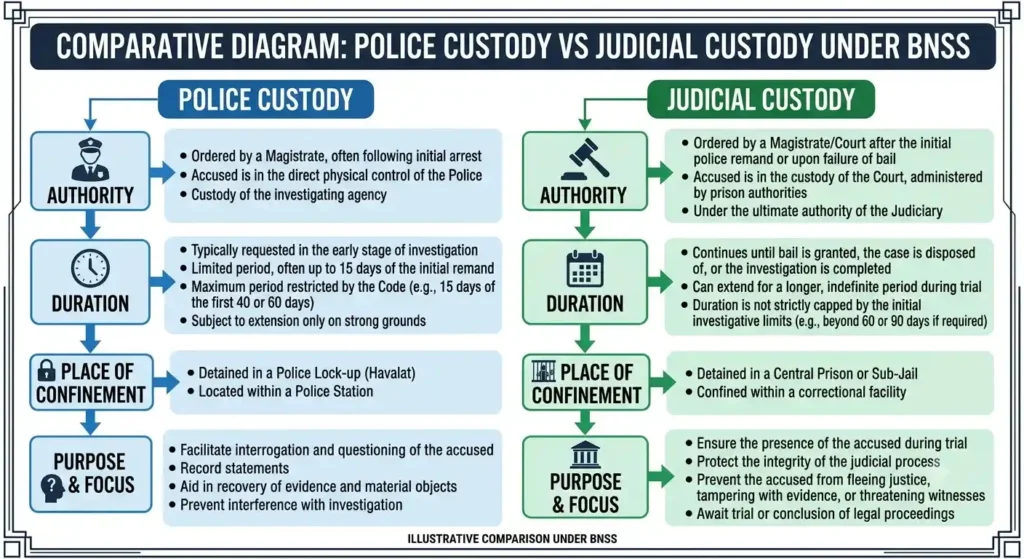
Police Custody: The accused remains in police station lockup for active interrogation and evidence recovery (maximum 15 days in tranches).
Judicial Custody: The accused gets transferred to central jail under judicial oversight, where police cannot interrogate without court permission.
CUSTODY TRANSITION WORKFLOW UNDER SECTION 187 BNSS

[Arrest Executed by Police]
            │
            ▼
[Compulsory Production Before Magistrate Within 24 Hours]
            │
            ├─► [Police Custody Granted] ──► Station Lockup for Active Recovery
            │
            └─► [Judicial Custody Granted] ──► Central Jail Under Judicial Oversight
Key Takeaway: Police custody cannot exceed the statutory limits prescribed under Section 187 BNSS. Magistrates reject custody requests if police fail to show clear grounds for interrogation.
Diagram showing structural differences between police custody and judicial custody under BNSS
Concluding the Investigation: Charge Sheet vs. Closure Report
Upon completing all field inquiries, the Investigating Officer must summarize the findings into a final formal report.
Submission of Final Report Charge Sheet vs Closure Report
Under Section 193 BNSS (formerly Section 173 CrPC), the IO submits a Final Investigation Report to the competent Judicial Magistrate.
If the investigation yields sufficient prima facie evidence against the accused, the IO files a formal Charge Sheet (Challan).
Conversely, if evidence remains insufficient or allegations prove false, the IO files a Closure Report (Final Report) requesting case dismissal.
The table below highlights the structural differences between these two final investigation reports:
Parameter
Final Charge Sheet
Final Closure Report
Evidentiary Finding
Sufficient prima facie evidence proving guilt
Insufficient evidence or false allegations
Primary Request
Requests court to frame charges and begin trial
Requests court to accept report and close case
Accused Status
Accused summoned to face formal criminal trial
Accused discharged from bail bonds
Victim Remedy
Complainant receives copy to support trial
Complainant receives notice to file Protest Petition
Judicial Review and Transferring Case Files to Trial Court
Submitting the final report shifts responsibility from the police administration to the judicial system.
Magistrate Review of Investigation Findings
Upon receiving the final report under Section 193 BNSS, the Judicial Magistrate evaluates the investigation material independently.
The Magistrate possesses legal authority to take Cognizance under Section 210 BNSS (formerly Section 190 CrPC).
If the IO files a Closure Report, the Magistrate must issue a formal notice to the complainant.
The complainant can file a Protest Petition challenging the closure. In Bhagwant Singh v. Commissioner of Police (1985) 2 SCC 537, the Supreme Court held that complainants hold an absolute right to be heard before a court accepts a police closure report.
If the Protest Petition succeeds, the Magistrate can reject the closure report and direct further investigation under Section 193(9) BNSS.
Transferring Case Files from Police Station to Trial Court
If the Magistrate takes cognizance on a Charge Sheet, the court supplies free copies of all investigation papers to the accused under Section 230 BNSS (formerly Section 207 CrPC).
Subsequently, if the offence is triable exclusively by a Court of Session (e.g., murder or rape), the Magistrate commits the case file to the Sessions Court under Section 232 BNSS.
The trial court then frames formal charges, initiating the judicial trial phase where witnesses give sworn testimony in open court.
POST-INVESTIGATION JUDICIAL WORKFLOW

[Final Report Submitted under Section 193 BNSS]
            │
            ├─► Charge Sheet Filed ──► Magistrate Takes Cognizance ──► Case Committed to Trial Court
            │
            └─► Closure Report Filed ──► Notice to Complainant ──► Complainant Files Protest Petition
In our analysis of criminal procedure, active monitoring during the investigation phase ensures that police record evidence accurately.
Need expert legal guidance tracking an ongoing police investigation or filing a Protest Petition? Contact our specialized legal team today for immediate consultation.
Frequently Asked Questions
How much time do police have to complete an investigation after lodging an FIR?
Under Section 187 BNSS, police must complete the investigation and file a charge sheet within 60 days for offences punishable up to ten years, or within 90 days for offences punishable with death or life imprisonment. If police fail, the accused secures Default Bail.
Can police arrest someone without a warrant after an FIR is lodged?
Yes, police can arrest suspects without a warrant in cognizable offences. However, under Arnesh Kumar guidelines, for offences punishable with imprisonment up to seven years, police must issue a Section 35 BNSS notice instead of making routine arrests.
What should a complainant do if police file a false Closure Report?
If police file a false Closure Report, the complainant should file a formal Protest Petition before the Judicial Magistrate. The complainant can present missing evidence, and the Magistrate can order further investigation under Section 193(9) BNSS.
What is a Case Diary and can an accused person see it?
A Case Diary is an official daily record maintained by the IO under Section 192 BNSS detailing investigation steps. An accused person cannot inspect the Case Diary, but courts can call for it to verify investigation timeline accuracy.
Take Control of Your Legal Proceedings Today
Understanding what happens after an FIR is lodged empowers you to navigate complex police procedures without fear or confusion. Knowing statutory rules ensures you protect your constitutional rights during every phase of investigation.
Do not let procedural delays or officer misconduct jeopardize your case. Monitor your investigation timeline, enforce your legal remedies, and assert your statutory rights confidently.