Table of Contents
- What is Arnesh Kumar vs State of Bihar?
- Background and Facts of the Landmark Case
- Section 498A Abuse and the Need for Judicial Reform
- Section 41 and Section 41A CrPC: Mandatory Legal Safeguards
- The Supreme Court’s 8 Mandatory Guidelines on Arrest
- Frequently Asked Questions
Introduction
Arbitrary arrest ruins innocent lives across India every day. Police officers often treat arrest as a routine tool rather than a last resort. However, the landmark ruling in Arnesh Kumar vs State of Bihar fundamentally changed criminal jurisprudence regarding pre trial detention.
The Supreme Court delivered this historic judgment on July 2, 2014, curbing unnecessary police action. Specifically, it created strict legal safeguards for offences carrying under seven years imprisonment.
Written by Kapil Balhara | Technically Reviewed for Accuracy | Last Updated: August 2026
What is Arnesh Kumar vs State of Bihar?
Definition/Summary Block: The Arnesh Kumar vs State of Bihar (2014) ruling is a landmark Supreme Court judgment that curbs arbitrary arrest in India. It mandates that police officers cannot automatically arrest accused persons for offences carrying up to seven years imprisonment, including Section 498A IPC, without verifying specific necessity criteria.
Furthermore, the court made serving a Notice of Appearance under section 41A CrPC mandatory prior to taking anyone into custody.
Background and Facts of the Landmark Case
To understand this landmark judgment, we must first analyze the original matrimonial dispute. Arnesh Kumar married Sweta Kiran on July 1, 2007. Subsequently, his wife alleged that her mother-in-law and father-in-law demanded a Maruti car, eight lakh rupees, and an air conditioner.
She claimed that Arnesh supported his family’s demands and threatened to marry another woman. Consequently, she filed a criminal case under Section 498A of the Indian Penal Code (IPC) and Section 4 of the Dowry Prohibition Act.
Arnesh apprehended his arrest and filed for anticipatory bail. However, both the Sessions Court and the Patna High Court rejected his bail application. Left with no choice, he approached the Supreme Court of India via a Special Leave Petition.
Our legal team evaluated the core issues of this matter. We found that the primary issue was not just dowry harassment allegations. Instead, it centered on whether police officers can make routine arrests without proper preliminary inquiry.
Section 498A Abuse and the Need for Judicial Reform
Section 498A IPC was originally enacted to protect married women from cruelty and dowry harassment. However, over time, disgruntled spouses began using it as a weapon rather than a shield.
The Supreme Court highlighted alarming statistics from National Crime Records Bureau data. For instance, in 2012 alone, 197,762 persons were arrested under Section 498A. Nearly 25% of those arrested were women, including elderly mothers and sisters of husbands.
Crime Statistics Highlighted by the Supreme Court (2012 Data)
----------------------------------------------------------------------
Total Arrests under Sec 498A : 197,762 persons
Women Arrested               : 47,951 (24.2%)
Charge-sheeting Rate          : 93.6%
Conviction Rate              : 15% (Lowest among all major crimes)
----------------------------------------------------------------------
In our analysis, the high charge-sheeting rate combined with a dismal 15% conviction rate clearly demonstrated systemic abuse. Police officers regularly executed automatic arrests without checking the genuineness of allegations.
Key Takeaway: Power to arrest is one thing, but the justification for exercising it is entirely different. Law enforcement must justify why pre trial detention is necessary in every specific case.
Section 41 and Section 41A CrPC: Mandatory Legal Safeguards
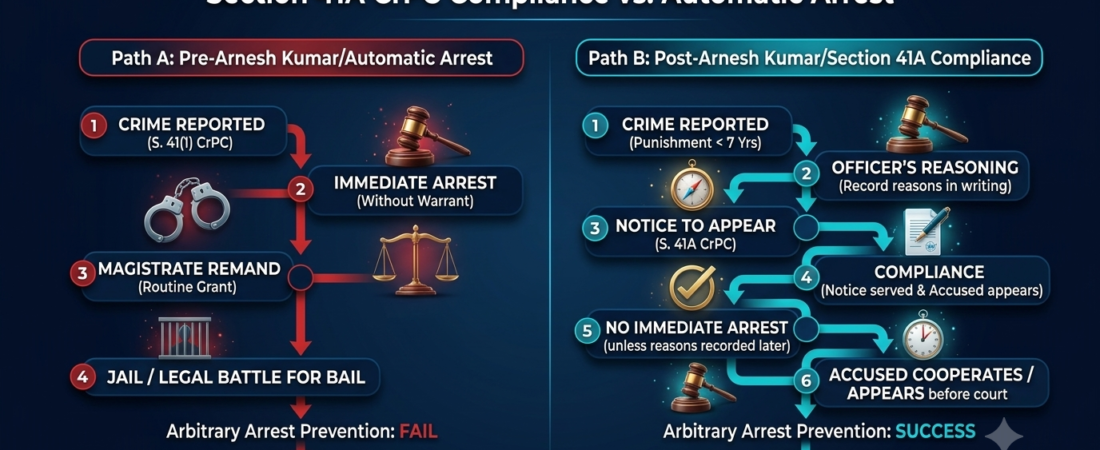
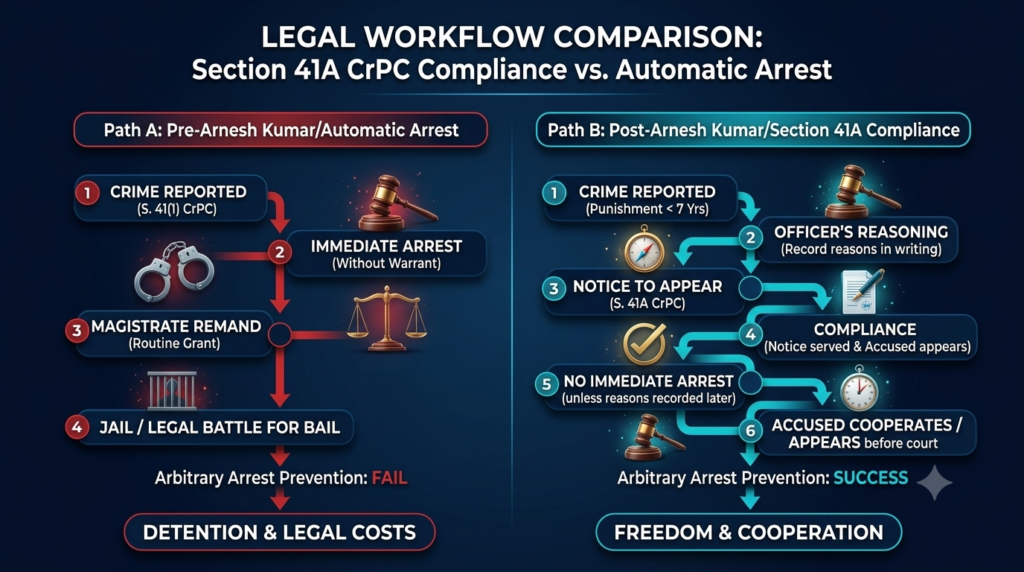
Parliament introduced amendments to Section 41 and added section 41A based on Law Commission recommendations. These provisions regulate police power for offences with seven years imprisonment or less.
Conditions for Arrest Under Section 41(1)(b)
Police cannot arrest an accused person simply because an offence is cognizable and non-bailable. Instead, the investigating officer must record satisfaction that arrest is necessary for specific reasons:
- To prevent the accused from committing any further offence.
- For proper investigation of the offence.
- To prevent the accused from causing evidence to disappear or tampering with witnesses.
- To prevent the accused from making inducements or threats to acquainted persons.
- To ensure the presence of the accused in court whenever required.
The Role of Section 41A Notice of Appearance
Where an arrest is not required under Section 41(1), police must issue a mandatory Notice of Appearance.
- The police officer issues a written notice directing the accused to appear at a specified place.
- The accused person is legally obligated to comply with all terms of the notice.
- As long as the accused complies, police cannot arrest them without recording specific judicial reasons.
The Supreme Court’s 8 Mandatory Guidelines on Arrest
To prevent police arrogance and mechanical judicial orders, the Supreme Court issued eight binding directions. Here’s how these rules protect citizens from arbitrary arrest across India:
| Directive # | Target Authority | Mandatory Obligation / Safeguard |
|---|---|---|
| Directive 1 | State Governments | Issue immediate instructions to police avoiding automatic arrest under Section 498A IPC. |
| Directive 2 | Police Officers | Fill out a mandatory checklist containing Section 41(1)(b)(ii) sub-clauses. |
| Directive 3 | Police Officers | Produce filled checklist and written reasons for arrest before the Magistrate. |
| Directive 4 | Magistrates | Authorize pre trial detention only after perusing the police report and recording satisfaction. |
| Directive 5 | Police / Magistrate | Forward decision not to arrest to Magistrate within 2 weeks of case registration. |
| Directive 6 | Police Officers | Serve Notice of Appearance under section 41A within 2 weeks of case registration. |
| Directive 7 | Non-compliant Police | Subject to departmental action and contempt proceedings before the High Court. |
| Directive 8 | Judicial Magistrates | Subject to departmental inquiry by the High Court for authorizing casual detention. |
Specifically, these rules extend beyond Section 498A to all offences punishable by up to seven years imprisonment.
Link to Download Arnesh Kumar vs State of Bihar judgement

Consequences for Non-Compliance by Authorities
Judicial Magistrates must not act as mere rubber stamps for police requests. Before authorizing detention under Section 167 CrPC, the Magistrate must independently review the arrest checklist.
If police officers fail to follow these instructions, they face immediate disciplinary action. Furthermore, they face contempt charges before the High Court having territorial jurisdiction. Similarly, Magistrates authorizing casual detention face departmental action by their respective High Courts.
Are you or a loved one facing an unjust criminal complaint or police notice? Contact our expert legal team at Placitum Advocates today to protect your fundamental liberties.
Frequently Asked Questions
Q1: Does the Arnesh Kumar judgment apply to all criminal offences in India?
No, it applies specifically to offences punishable with imprisonment for less than seven years or extending up to seven years, with or without fine.
Q2: What should I do if police serve a Notice of Appearance under Section 41A?
You must strictly comply with the terms of the notice and appear before the investigating officer at the scheduled time. As long as you comply, police cannot arrest you without recording specific reasons.
Q3: Can police still arrest an accused under Section 498A IPC?
Yes, but only if they record explicit written reasons showing that arrest is necessary under conditions listed in Section 41(1)(b) CrPC. Automatic arrests are strictly illegal.
Q4: What remedy is available if a police officer violates Arnesh Kumar guidelines?
You can file a contempt petition before the High Court against the police officer and initiate departmental complaint proceedings.
Conclusion
The landmark ruling in Arnesh Kumar vs State of Bihar remains a powerful shield against state high-handedness. It strikes a vital balance between individual liberty and effective crime investigation. By making Section 41A compliance mandatory, the Supreme Court curbed illegal detentions significantly.
Understanding these legal rights is crucial for anyone navigating criminal law in India. If you require urgent counsel regarding Section 498A or illegal police threats, reach out to Placitum Advocates immediately for expert defense strategies.