Facing a bail rejection in the District or Sessions Court causes immense emotional stress for families. However, an appeal against bail rejection offers a crucial statutory remedy to secure liberty under Article 21 of the Indian Constitution.
Written by Kapil Balhara | Technically Reviewed for Accuracy | Last Updated: August 2026
Table of Contents
- Understanding the Remedy After Bail Rejection
- Statutory Provisions Under CrPC and BNSS
- Key Grounds for Filing in the Delhi High Court
- Step-by-Step Procedure for Filing in High Court
- Landmark Supreme Court Precedents on Bail
- Frequently Asked Questions
Understanding the Remedy After Bail Rejection
An appeal against bail rejection refers to filing a fresh bail application before a higher judicial forum, such as the High Court, after a lower trial court denies relief. Alternatively, it involves filing a successive application in the same court when material facts change.
In our legal practice, we observe that families often panic after an initial dismissal. However, Indian criminal jurisprudence treats personal liberty as a fundamental right.
To begin the process, you must choose between two distinct legal paths based on your case status.
First, you can approach the High Court under its special supervisory powers. In contrast, you can file a second application in the trial court if new evidence emerges.
Furthermore, moving the High Court allows senior judges to correct legal errors committed by lower courts. Consequently, this step remains the most reliable path to freedom.
Statutory Provisions Under CrPC and BNSS
Understanding the statutory framework helps you navigate the legal system effectively. Therefore, comparing old and new procedural laws is essential for current litigation.
| Legal Provision (CrPC, 1973) | Legal Provision (BNSS, 2023) | Scope & Judicial Authority |
|---|---|---|
| Section 437 | Section 480 | Bail provisions for non-bailable offences in Magistrate courts. |
| Section 439 | Section 483 | Special powers of High Court and Sessions Court to grant bail. |
| Section 167(2) | Section 187 | Statutory or default bail when investigation exceeds timelines. |
In addition, Section 439 CrPC grants concurrent jurisdiction to the High Court and Sessions Court. Hence, an applicant can seek direct relief from High Court judges.
Key Takeaway: Section 439 CrPC and Section 483 BNSS empower the High Court to override lower court bail rejections and restore personal liberty.
Key Grounds for Filing in the Delhi High Court
When preparing bail application under Section 439 CrPC before the Delhi High Court, generic assertions fail. Instead, advocates must present precise legal grounds.
1. Primary Grounds for High Court Relief
- Judicial Error: The Sessions Court misconstrued facts or ignored established binding precedents.
- Lack of Absconding Risk: The accused possesses deep roots in society and stable local residence.
- No Tampering Potential: The police investigation relies on documentary evidence already seized by investigators.
- Rule of Parity: A co-accused with identical allegations has already obtained bail.
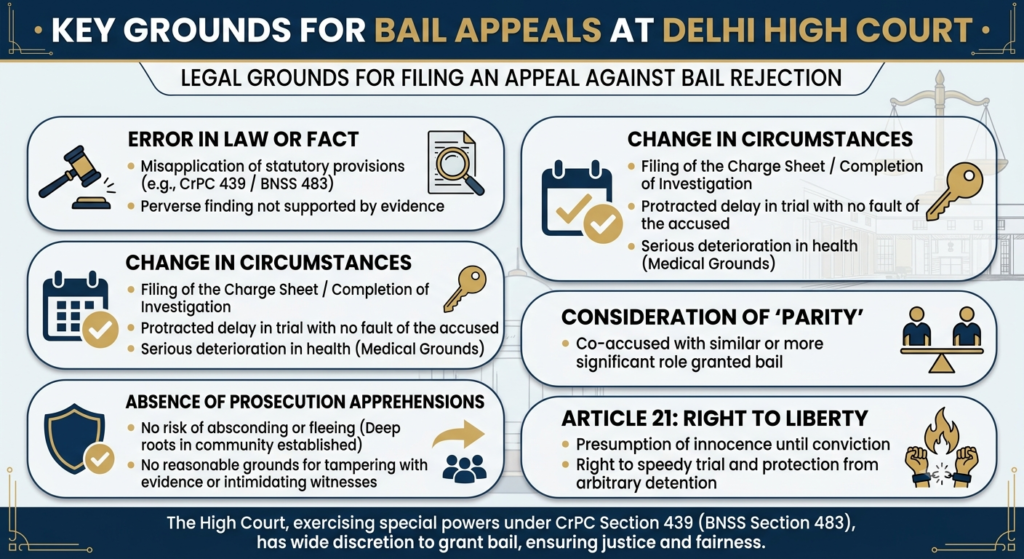
2. Grounds for Successive Trial Court Applications
- Filing of Chargesheet: Police completed the investigation, ending the need for custodial interrogation.
- Witness Examination: Key prosecution witnesses finished their testimony without any interference or threat.
- Medical Emergency: The accused requires urgent medical care unavailable inside prison facilities.
Moreover, our analysis revealed that parity serves as a strong argument during oral hearings. Therefore, gathering co-accused orders remains vital for success.
If you need urgent legal advice regarding detention, contact our senior legal team at Kapil Balhara Law Offices today for an immediate case review.
Step-by-Step Procedure for Filing in High Court
Navigating court procedure requires strict adherence to timelines and filing rules. Thus, following these ordered steps ensures your matter receives a quick hearing.
- Obtain Certified Copies: Apply immediately for certified copies of the rejection order and the original FIR.
- Draft the Petition: Prepare the petition highlighting legal errors, supported by affidavits and relevant annexures.
- Complete Advance Service: Serve an advance copy to the Standing Counsel for Delhi Police or State Prosecutors.
- Clear Registry Defects: File via the Delhi High Court e-portal and fix any procedural objections raised by the registry.
- Argue Before Bench: Present oral arguments on the listed date before the designated single-judge criminal bench.
Additionally, avoiding common filing errors prevents unnecessary delays. For example, failing to disclose prior rejections can lead to immediate dismissal.
Key Takeaway: Procedural precision during e-filing and advance service determines how quickly your bail matter reaches the courtroom judge.
Landmark Supreme Court Precedents on Bail
Judicial precedents form the foundation of effective bail advocacy. Furthermore, referencing binding judgments forces lower courts and High Courts to apply uniform standards.
- State of Rajasthan v. Balchand (1977): The Supreme Court established that bail is the rule and jail is the exception.
- Hussainara Khatoon v. State of Bihar (1979): The apex court ruled that speedy trial forms an integral part of Article 21.
- Satender Kumar Antil v. CBI (2022): The Supreme Court issued comprehensive guidelines to prevent routine arrests and mechanical bail denials.
In fact, these judgments emphasize that pre-trial detention must not turn into punitive punishment. Consequently, defense lawyers rely heavily on these decisions during arguments.
Ultimately, challenging a bail rejection requires swift action, deep legal research, and persuasive courtroom advocacy. Do not let trial court rejections exhaust your legal options.
Frequently Asked Questions
What is the time limit to file an appeal against bail rejection in High Court?
Indian law does not prescribe a strict statutory limitation period for filing a bail application in the High Court. However, because personal liberty is involved, applicants should file immediately after obtaining certified copies of the trial court order.
Can I apply for bail again in the Sessions Court after rejection?
Yes, you can file a second bail application in the Sessions Court. However, you must demonstrate a material change in circumstances, such as the filing of a chargesheet or examination of key witnesses.
Is Section 439 CrPC applicable under the new BNSS law?
Section 439 of the CrPC corresponds directly to Section 483 of the Bharatiya Nyaya Sanhita (BNSS). The legal powers of the High Court to grant or modify bail remain functionally identical under the new legal framework.
What happens if the High Court also rejects the bail application?
If the High Court rejects the bail plea, the applicant can file a Special Leave Petition (SLP) under Article 136 of the Constitution before the Supreme Court of India.
Legal Disclaimer: This article is written for informational and educational purposes only and does not constitute formal legal advice. Reading this content does not create an attorney-client relationship. Criminal law procedures depend heavily on specific facts and statutory nuances. Always consult a qualified advocate for guidance regarding your specific legal situation.