
Understanding Indian criminal procedure requires a deep knowledge of personal liberty. When courts analyze pre-trial release, one landmark decision always commands respect.
The landmark ruling State of Rajasthan vs Balchand revolutionized criminal jurisprudence across India. In fact, it firmly established the principle of personal liberty under Article 21 of the Constitution.
Written by Kapil Balhara | Technically Reviewed for Accuracy | Last Updated: August 2026
Table of Contents
- Definition & Summary Block
- Factual Background and Legal Context
- Key Legal Ratio: The “Bail Not Jail” Principle
- Comparative Analysis: Standard Bail vs Post-Conviction Bail
- Impact on Article 21 and Modern Criminal Practice
- Frequently Asked Questions
What is State of Rajasthan vs Balchand Case?
The Supreme Court ruling in State of Rajasthan vs Balchand (1977) established the seminal principle that bail is the rule and jail is the exception in Indian criminal law. Justice V.R. Krishna Iyer declared that courts must preserve personal liberty under Article 21 unless specific risks of fleeing, evidence tampering, or witness intimidation justify pre-trial or appellate detention.

Factual Background and Legal Context
To begin with, the respondent, Balchand alias Baliay, surrendered before the trial court after the Supreme Court granted leave to the State to appeal his High Court acquittal. Subsequently, he applied for bail under the applicable procedural rules during the appellate proceedings.
The State of Rajasthan opposed the application. Prosecutors argued that granting release after an appeal against acquittal is admitted undermines judicial authority. Furthermore, they insisted that the gravity of the offense mandated continuous detention.
However, Justice V.R. Krishna Iyer evaluated the broader social milieu of the accused. The record demonstrated that Balchand remained on bail throughout his trial without abusing his freedom. Additionally, he was a 27-year-old man supporting a family.
Key Takeaway: Historical compliance during trial serves as strong evidence when courts evaluate subsequent bail applications, proving the accused is not a flight risk.
Key Legal Ratio: The “Bail Not Jail” Principle
Most importantly, Justice Krishna Iyer formulated the cornerstone rule of criminal procedure: “The basic rule may perhaps be tersely put as bail, not jail…” Therefore, judicial discretion must lean toward enlargement unless clear disqualifying conditions exist.
The Court outlined key exceptions where detention becomes necessary:
- Fleeing from Justice: Clear evidence indicates the accused will abscond to avoid trial.
- Thwarting Justice: The applicant demonstrates an intent to destroy evidence or intimidate witnesses.
- Repeating Offenses: The individual shows a tendency to commit further crimes if released.
Besides outlining these risks, the Court addressed the traditional monetary surety system. In fact, the bench observed that requiring heavy financial bonds often discriminates against underprivileged litigants. Consequently, courts should consider non-monetary undertakings by family members or social organizations.
Link to Download State of Rajasthan vs Balchand Judgement
Comparative Analysis: Standard Bail vs Post-Conviction Bail
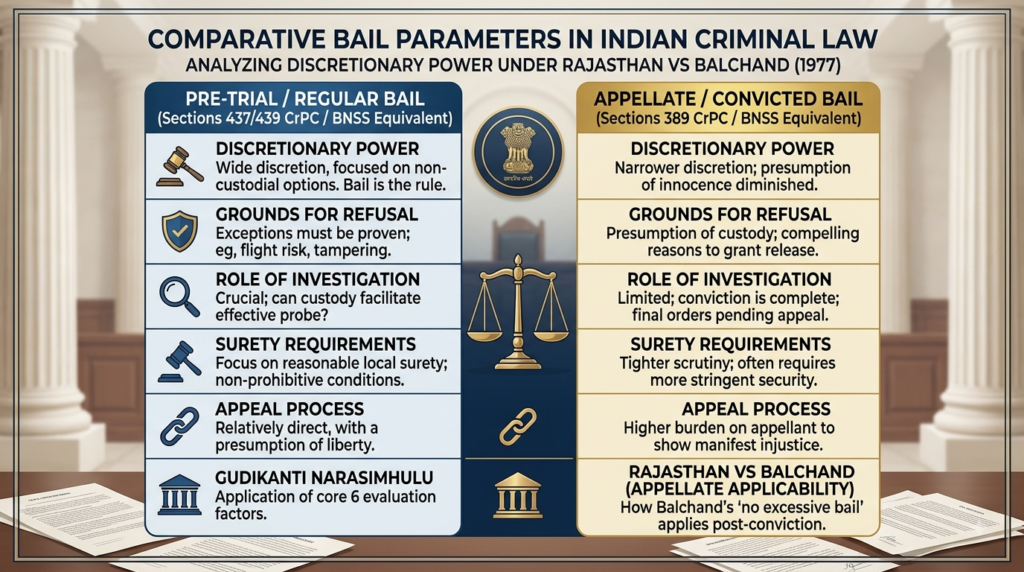
While State of Rajasthan vs Balchand specifically addressed bail pending appeal, its foundational principles apply across all stages of criminal proceedings.
| Evaluation Metric | Regular Pre-Trial Bail | Post-Conviction / Appellate Bail | Balchand Principle Approach |
|---|---|---|---|
| Presumption of Innocence | Operates fully in favor of the accused. | Weakened due to trial court conviction. | Focuses on conduct rather than conviction alone. |
| Primary Risk Assessed | Tampering with investigation. | Flight risk and evasion of sentence. | Evaluates specific evidence of absconding. |
| Judicial Focus | Necessity of custodial interrogation. | Gravity of sentence imposed. | Prevents punitive pre-appeal detention. |
| Default Position | Release on reasonable conditions. | Subject to statutory restrictions. | Bail remains the rule, jail the exception. |
Impact on Article 21 and Modern Criminal Practice
In our legal practice at Placitum Advocates, our analysis revealed that this 1977 precedent remains vital in trial and High Courts across India. Courts cite it to prevent unnecessary arrests and protect fundamental rights under Article 21.
Indeed, modern rulings under special statutes like PMLA and UAPA frequently cite Balchand to balance statutory strictness with constitutional guarantees. For instance, prolonged incarceration without trial progress triggers the core holding of this case.
Key Takeaway: Personal Liberty under Article 21 cannot be suspended purely based on the gravity of allegations without concrete proof of interference with justice.
What is the main legal ratio of State of Rajasthan vs Balchand?
The main legal ratio is that “bail is the rule, jail is the exception.” The Supreme Court held that liberty under Article 21 should not be curtailed unless specific factors like flight risk or witness intimidation exist.
Can bail be refused solely based on the gravity of the offense?
No, gravity alone does not justify denying release. While judges consider offense severity, they must also evaluate trial conduct, social ties, and potential abuse of freedom.
How does Balchand impact modern anticipatory and regular bail applications?
Advocates cite Balchand to argue against routine arrests and punitive detention. It reminds courts to use least-restrictive measures, such as periodic reporting, instead of keeping undertrials jailed.
Need Expert Guidance on Criminal Bail Matters?
Navigating complex bail hearings requires strategic legal counsel. If you or your family require representation rooted in constitutional protections, contact the experienced litigation team at Kapil Balhara / Placitum Advocates today to secure your fundamental rights.