The landmark case of A.K. Gopalan v. State of Madras (1950) stands as one of the most critical legal rulings in Indian constitutional history. It was the very first major decision by the Supreme Court of India concerning Fundamental Rights after the Constitution came into effect. The court examined the limits of executive power, the scope of personal liberty, and the validity of preventive detention laws.
Key Takeaway: A.K. Gopalan v. State of Madras (1950 AIR 27) is a pivotal Supreme Court judgment where a majority bench held that Article 21 guarantees protection against executive action only according to statutorily enacted law. The Court rejected the American “due process” standard, ruling that Fundamental Rights operate as mutually exclusive silos rather than an integrated framework.
| Case Attribute | Legal Details |
|---|---|
| Petitioner | A.K. Gopalan (Communist Leader) |
| Respondent | The State of Madras |
| Bench | H.J. Kania C.J., Saiyid Fazl Ali, M. Patanjali Sastri, M.C. Mahajan, B.K. Mukherjea, and S.R. Das JJ. |
| Date of Judgment | May 19, 1950 |
| Primary Legislation | Preventive Detention Act (Act IV of 1950) |
| Key Constitutional Articles | Articles 13, 19, 21, and 22 |
Written by Kapil Balhara | Technically Reviewed for Accuracy | Last Updated: October 2026
Factual Matrix: How the Dispute Reached the Supreme Court
A.K. Gopalan was a prominent communist leader who had been detained repeatedly since December 1947 under ordinary criminal laws and state-level detention regulations. Although courts had set aside his criminal convictions, state authorities kept him behind bars through successive administrative orders.
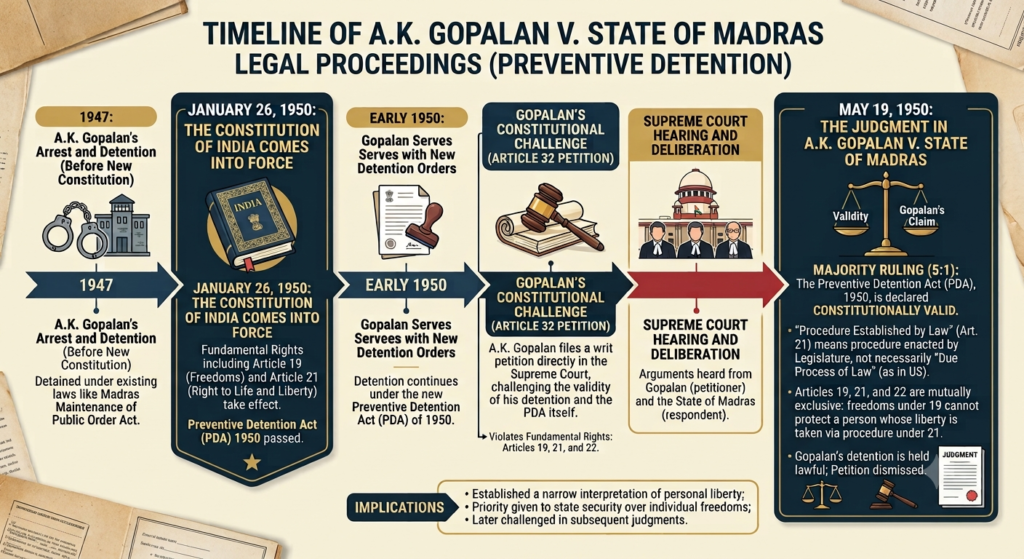
On March 1, 1950, authorities served him with a fresh detention order under Section 3(1) of the newly enacted Preventive Detention Act, 1950. Subsequently, Gopalan filed a habeas corpus petition directly before the Supreme Court under Article 32 of the Constitution.
He argued that the Act infringed upon his fundamental rights guaranteed under Articles 13, 19, 21, and 22. Additionally, he challenged Section 14 of the Act, which prohibited detenu persons from disclosing their grounds of detention to any court of law.
Key Constitutional Issues Raised
The Supreme Court had to resolve several fundamental questions regarding individual liberty and legislative power:
- Exclusivity of Rights: Does a law providing for preventive detention need to satisfy the tests of reasonableness under Article 19(5) in addition to Article 21?
- Procedure Established by Law: Does “procedure established by law” under Article 21 incorporate the principles of natural justice and American “due process of law”?
- Preventive Detention Safeguards: Did Sections 3, 7, 10, 11, 12, and 14 of the Preventive Detention Act, 1950 violate Constitutional guarantees under Article 22?
Legal Analysis of the Supreme Court Judgment
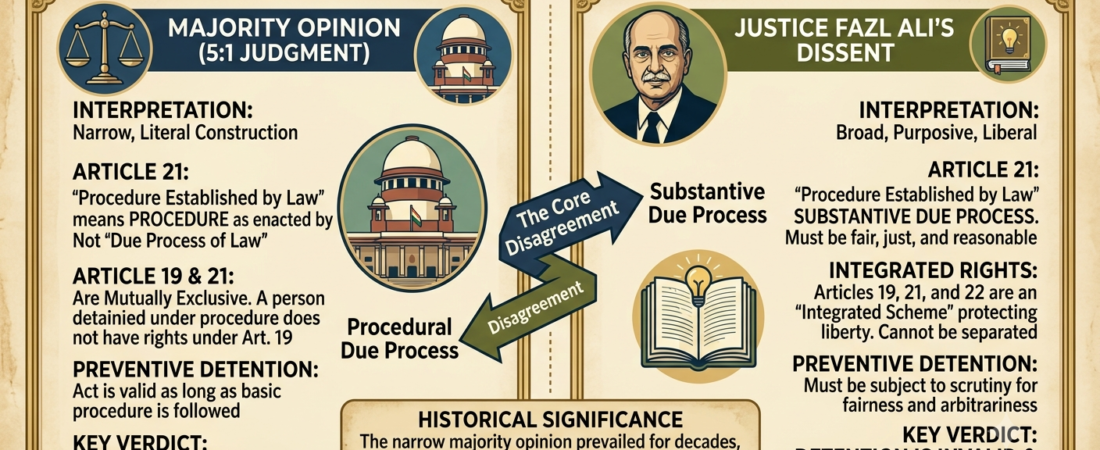
In our analysis of early constitutional jurisprudence, this judgment established the “silos doctrine” or the theory of mutually exclusive Fundamental Rights. The majority held that Part III contains distinct categories of rights that do not overlap.
The Interpretation of Article 21: “Procedure Established by Law”
Chief Justice H.J. Kania and the majority justices interpreted the word “law” in Article 21 strictly as State-made statutory law, not natural law or abstract principles of justice. Furthermore, they held that “procedure established by law” simply meant procedure prescribed by a competent legislature.
The Court explicitly noted that the Constituent Assembly intentionally dropped the phrase “due process of law” from the drafting stage. Therefore, Indian courts could not review the substantive reasonableness of a legislative act under Article 21.
Key Takeaway: In 1950, the Supreme Court ruled that “procedure established by law” meant any valid statutory procedure enacted by Parliament, leaving the judicial branch powerless to strike down harsh laws as long as legislative competence existed.
The Relationship Between Article 19 and Article 21
The petitioner argued that detaining a citizen directly restricts their right to move freely throughout India under Article 19(1)(d). Consequently, the law should pass the “reasonable restriction” test under Article 19(5).
However, the Court rejected this argument. Chief Justice Kania held that Article 19 applies only to free citizens who are in full possession of their personal liberty. Thus, when a person is deprived of personal liberty under a valid law, rights under Article 19 automatically cease to apply.
The Validity of the Preventive Detention Act, 1950
The Supreme Court evaluated various sections of the challenged Act:
- Section 3 (Executive Discretion): Upheld. The Court held that subjective satisfaction of executive officers is permissible for preventive detention.
- Section 7 & 11 (Representation & Duration): Upheld. The lack of oral hearing or indefinite detention periods did not violate constitutional protections.
- Section 12 (Bypassing Advisory Board): Upheld by the majority.
- Section 14 (Secrecy of Grounds): Struck Down. The Court unanimously invalidated Section 14 because it barred detenu persons from revealing detention grounds to courts, directly undermining Article 22(5) and judicial oversight.
Dissenting Opinion: Justice Fazl Ali’s Vision
Justice Saiyid Fazl Ali delivered a historic dissenting judgment that proved remarkably prophetic. He argued against reading fundamental rights in isolation.
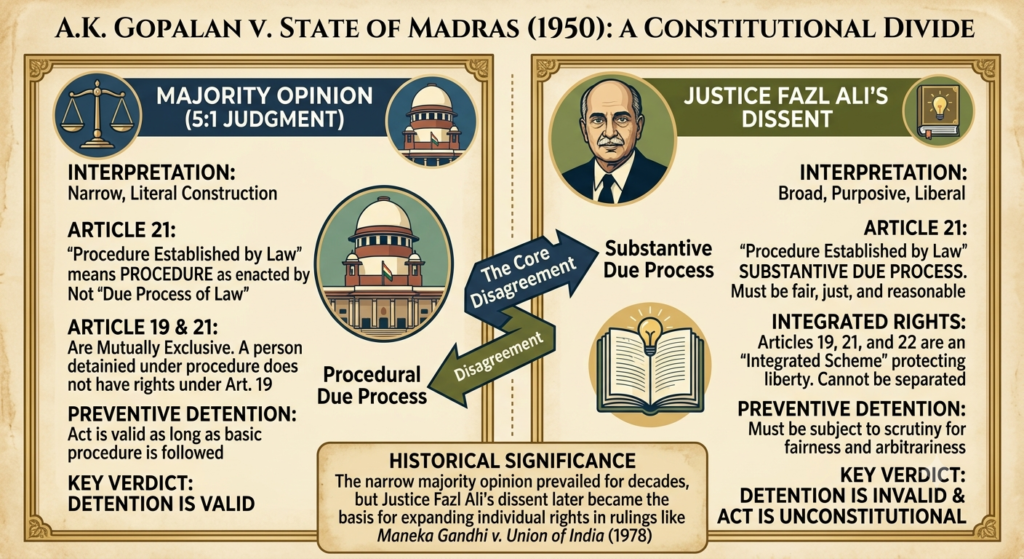
Justice Fazl Ali asserted that preventive detention directly impairs the freedom of movement guaranteed by Article 19(1)(d). Furthermore, he maintained that “procedure established by law” must inherently include essential principles of natural justice, such as:
- Proper notice of charges or grounds.
- Opportunity to be heard before an impartial tribunal.
- Orderly procedure according to civilized legal standards.
Evolution: Overruling Gopalan in Bank Nationalization and Maneka Gandhi
The narrow interpretation established in A.K. Gopalan dominated Indian jurisprudence for nearly three decades. However, the legal architecture underwent a dramatic shift in subsequent cases.
The Overruling Timeline
- R.C. Cooper v. Union of India (1970): Also known as the Bank Nationalization case, the Supreme Court abandoned the mutually exclusive doctrine, ruling that fundamental rights overlap.
- Maneka Gandhi v. Union of India (1978): The Supreme Court formally overruled the A.K. Gopalan interpretation of Article 21. The Court adopted Justice Fazl Ali’s dissenting view, holding that procedure under Article 21 must be “just, fair, and reasonable,” effectively introducing procedural due process into Indian Constitutional Law.
Key Takeaway: The restrictive view in A.K. Gopalan was overturned by Maneka Gandhi v. Union of India (1978), which established that procedure under Article 21 cannot be arbitrary and must satisfy the requirements of Articles 14 and 19.
Legal Analysis & Practical Recommendations
When evaluating constitutional challenges involving preventive detention or fundamental rights today, legal researchers and practitioners should follow a structured approach:
Step-by-Step Analytical Framework for Article 21 Challenges
- Identify the Source of Restraint: Determine whether the deprivation of personal liberty stems from executive discretion or statutory enactment.
- Check Statutory Compliance: Verify if all mandatory procedural safeguards listed in Article 22 (such as timely communication of grounds and advisory board review) were strictly followed.
- Apply the Golden Triangle Test: Assess whether the challenged law satisfies Article 14 (non-arbitrariness), Article 19 (reasonable restrictions), and Article 21 (just, fair, and reasonable procedure).
- Evaluate Judicial Oversight: Ensure the law does not restrict judicial review or access to constitutional remedies under Articles 32 and 226.
If you are analyzing administrative detentions or drafting constitutional writs, always cite the overruling precedents alongside A.K. Gopalan to contextualize how procedural safeguards have expanded over time.
Frequently Asked Questions
What was the main ruling in A.K. Gopalan v. State of Madras?
The Supreme Court ruled that “procedure established by law” under Article 21 meant procedural law enacted by Parliament. It held that courts could not evaluate the substantive reasonableness of such laws under Article 19, thereby upholding the Preventive Detention Act, 1950 (except Section 14).
Why was Section 14 of the Preventive Detention Act struck down?
Section 14 prevented detenu persons from disclosing their grounds of detention or representations to any court. The Supreme Court held this unconstitutional because it prevented courts from determining whether the detention violated Article 22(5) guarantees.
Is the A.K. Gopalan case still valid law in India?
No, the core principle of A.K. Gopalan—that fundamental rights operate in isolated silos—was dismantled in R.C. Cooper (1970) and definitively overruled in Maneka Gandhi v. Union of India (1978).
Conclusion
The decision in A.K. Gopalan v. State of Madras remains a vital chapter in Indian legal history. Although its narrow reading of personal liberty was eventually discarded, the case laid the groundwork for modern constitutional law by sparking decades of judicial deliberation on due process and fundamental rights.