
Written by Kapil Balhara | Technically Reviewed for Accuracy | Last Updated: October 2026
Table of Contents
- What Is Aruna Ramchandra Shanbaug v. Union of India (2011) Case?
- Tragic Background and Medical Facts of the Case
- Legal Distinctions: Active vs. Passive Euthanasia
- Constitutional Analysis: Article 21 and Right to Life with Dignity
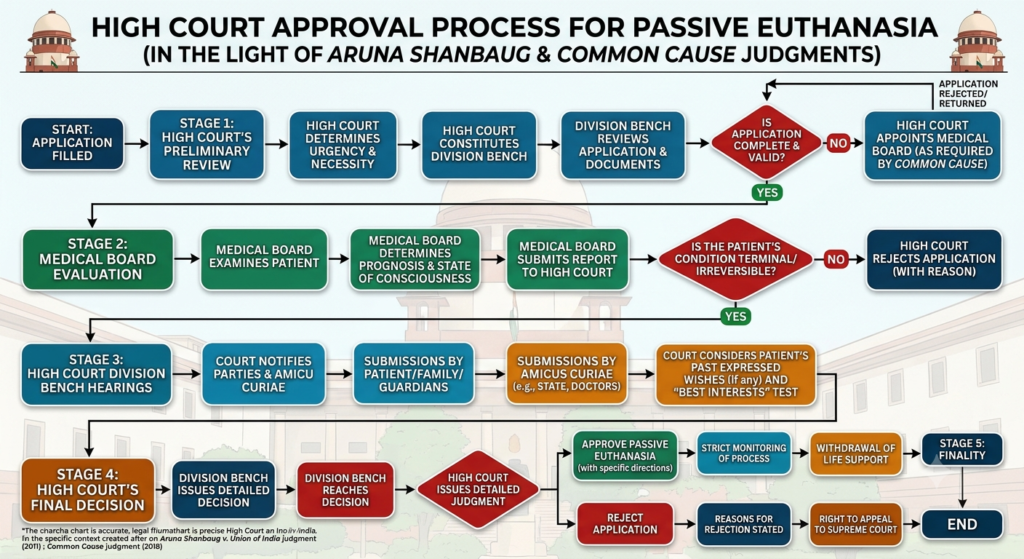
- Supreme Court Guidelines and High Court Approval Process
- Frequently Asked Questions
What Is Aruna Ramchandra Shanbaug v. Union of India (2011) Case?
Key Takeaway: The Supreme Court in Aruna Ramchandra Shanbaug v. Union of India (2011) legalized passive euthanasia in India under strict judicial monitoring. The ruling established that life-sustaining treatment can be withdrawn from patients in a Permanent Vegetative State (PVS) with High Court approval.
The Aruna Ramchandra Shanbaug v. Union of India petition was filed under Article 32 by journalist Pinki Virani as next friend. A two-judge bench comprising Justice Markandey Katju and Justice Gyan Sudha Misra addressed whether a terminally ill patient in PVS has the right to die with dignity.
Furthermore, the Court recognized the KEM Hospital nursing staff as Aruna’s true next friend due to their dedicated care for 37 years. Consequently, while rejecting the immediate withdrawal of life support for Aruna, the Court framed historic guidelines for passive euthanasia across India.
Tragic Background and Medical Facts of the Case
To begin with, Aruna Shanbaug worked as a staff nurse at King Edward Memorial (KEM) Hospital in Mumbai. On November 27, 1973, a hospital sweeper brutally assaulted and strangulated her with a dog chain.
As a result of oxygen deprivation during strangulation, Aruna suffered severe irreversible brain damage. She remained in a Permanent Vegetative State (PVS) for over 37 years, bedridden in Ward 4 of KEM Hospital.
When we evaluated the medical panel’s findings, the doctors noted that Aruna’s brain stem remained active despite severe cortical atrophy. In our analysis of Indian constitutional jurisprudence, this distinction prevented her from being declared legally brain dead.
Key Takeaway: Aruna Shanbaug survived in PVS for nearly four decades without developing bedsores, owing entirely to exemplary nursing care at KEM Hospital.
Legal Distinctions: Active vs. Passive Euthanasia
Besides addressing Aruna’s immediate situation, the Supreme Court established precise definitions distinguishing forms of medical termination of life.
Categorization of Euthanasia
First, active euthanasia involves taking positive steps to cause death, such as administering a lethal injection. Active euthanasia remains illegal under Sections 302 and 304 of the Indian Penal Code.
Secondly, passive euthanasia entails withholding or withdrawing life-sustaining treatment, allowing the patient to die naturally of the underlying disease.
| Euthanasia Category | Legal Action / Method | Status in India (Aruna Shanbaug Case) |
|---|---|---|
| Active Euthanasia | Administering lethal substances or injections. | Strictly Illegal (Offense under IPC). |
| Voluntary Passive Euthanasia | Refusing medical treatment while conscious and competent. | Legally Permissible. |
| Non-Voluntary Passive Euthanasia | Withholding life support for incompetent/PVS patients. | Permissible under High Court supervision. |
| Physician-Assisted Suicide | Doctor provides lethal drug, patient self-administers. | Illegal under Section 306 IPC (Abetment). |
  [ Application for Withholding Life Support ]
                        │
                        ▼
    [ High Court Bench (At Least 2 Judges) ]
                        │
                        ▼
   [ Committee of 3 Doctors (Neurologist, Psychiatrist, Physician) ]
                        │
                        ▼
  [ High Court Decision Applying "Best Interest" Principle ]
- File a petition under Article 226 before the concerned High Court.
- The Chief Justice constitutes a bench of at least two judges.
- A panel of three independent medical experts examines the patient and submits a report.
Constitutional Analysis: Article 21 and Right to Life with Dignity
Rather than creating a blanket right to die, the Supreme Court examined the scope of Article 21. In Gian Kaur v. State of Punjab (1996), a Constitution Bench held that Article 21 guarantees the right to life, but does not include the “right to die” unnatural death.
However, Justice Katju emphasized that the right to life includes living with human dignity until the natural end. For terminally ill patients or those in PVS, accelerating the conclusion of a dying process already commenced is legally distinct from suicide.
Therefore, withdrawing futile artificial support does not violate Article 21. On the other hand, it protects vulnerable patients from prolonged agony.
Key Takeaway: The Court invoked the doctrine of parens patriae, establishing itself as the sovereign guardian responsible for protecting incompetent citizens.
Supreme Court Guidelines and High Court Approval Process
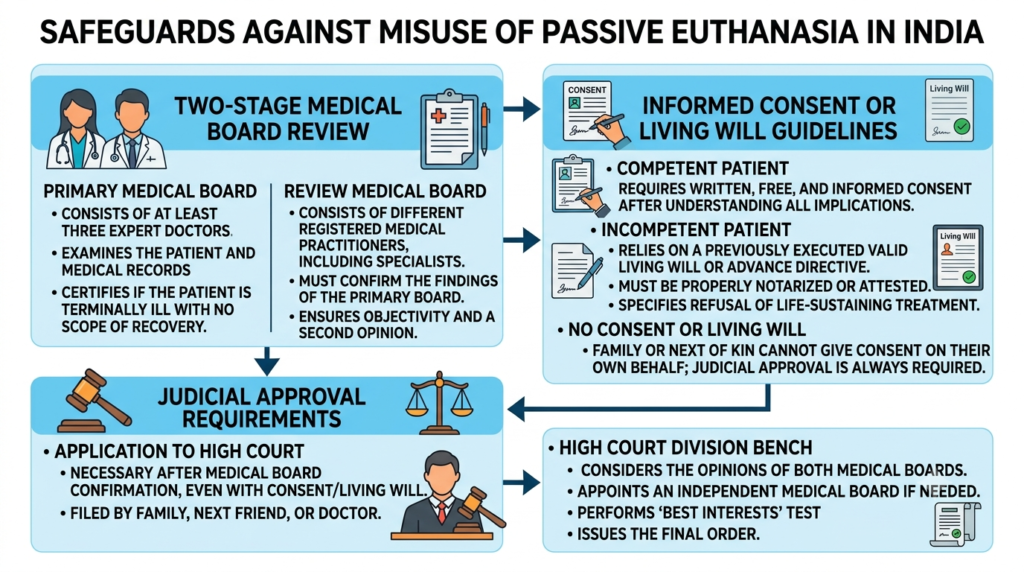
Ultimately, to prevent potential misuse by relatives or commercial interests seeking inheritance, the Court mandated strict procedural checks:
- Locus Standi for Next Friend: The decision to seek passive euthanasia can be made by parents, spouse, close relatives, or attending doctors acting as next friend.
- High Court Mandate: Any proposal to withdraw life support requires formal approval from the High Court under Article 226.
- Independent Medical Board: The High Court must nominate three doctors (including a neurologist, psychiatrist, and physician) to inspect the patient.
- Speedy Verdict: The High Court must issue notices to the State and close relatives, delivering a reasoned judgment based on the patient’s “best interest”.
Frequently Asked Questions
1. What was the central outcome of Aruna Shanbaug v. Union of India (2011)?
The Supreme Court allowed passive euthanasia in India under judicial supervision, while dismissing the plea to terminate Aruna Shanbaug’s life support because KEM Hospital wished to keep caring for her.
2. What is the main difference between active and passive euthanasia?
Active euthanasia involves using lethal injections or drugs to end life, whereas passive euthanasia involves withholding or withdrawing artificial life support to allow natural death.
3. Who can decide to withdraw life support for an incompetent patient?
Near relatives, spouses, or attending doctors acting as next friend can initiate the request, but the final permission must come from the High Court.
4. How did later judgments evolve from the Aruna Shanbaug case?
In 2018, a five-judge Constitution Bench in Common Cause v. Union of India expanded this jurisprudence by legally recognizing Advance Medical Directives (Living Wills) and stream-lining passive euthanasia procedures.