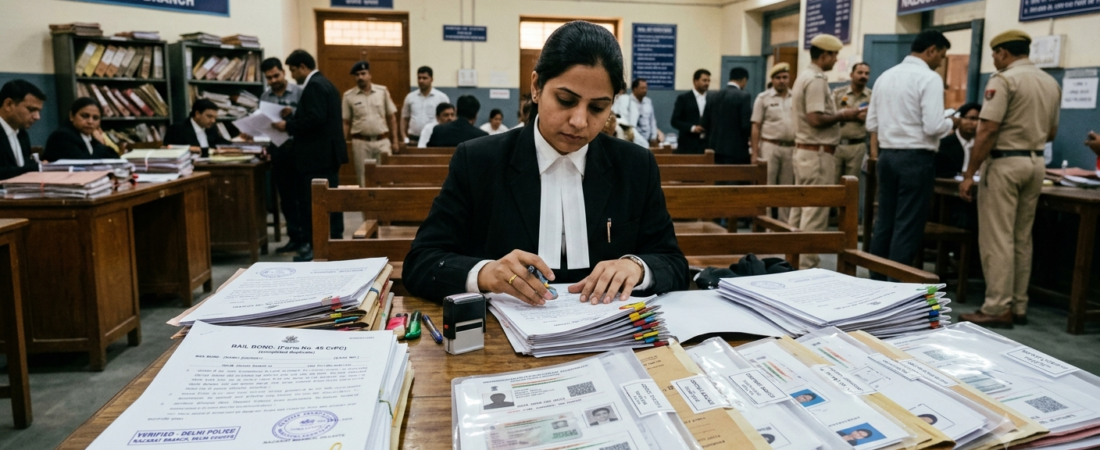
Securing a favorable court order granting relief to an arrested family member brings immense psychological relief. However, an accused individual remains confined inside jail until the trial court receives and approves the physical bail bond paperwork.
In Delhi District Courts, simple clerical mistakes or incomplete financial records frequently trigger extended detention in prison. Therefore, understanding exact documentation requirements accelerates court processing and prevents unnecessary procedural delays.
Written by Kapil Balhara / Placitum Advocates | Technically Reviewed for Legal Accuracy | Last Updated: September 2026
Table of Contents
- Understanding the Bail Bond Framework in Delhi Courts
- Mandatory ID Proofs and Solvency Papers Required
- Personal Bond vs. Surety Bond: Key Structural Differences
- Step-by-Step Surety Verification Process in District Courts
- Landmark Judgments on Bail and Local Surety Restrictions
- Frequently Asked Questions
Understanding the Bail Bond Framework in Delhi Courts
In Indian criminal jurisprudence, a bail bond serves as a legal contract executed between the accused, their guarantor, and the court. Specifically, this legal instrument ensures that the accused promises to attend all future trial proceedings in exchange for immediate release from judicial custody.
A bail bond in Delhi district courts is a binding legal undertaking, accompanied by financial security or a third-party guarantor, submitted under Form 45 of the criminal procedure framework. It guarantees that an accused person will strictly adhere to court attendance conditions upon release from judicial detention.
The primary legal statutory provisions governing bail procedures reside within the Bharatiya Nagarik Suraksha Sanhita, 2023 (BNSS), which superseded the legacy Code of Criminal Procedure, 1973 (CrPC).
- Bailable Offence Provisions: Under Section 478 BNSS (formerly Section 436 CrPC), granting release remains a mandatory statutory right upon furnishing required undertakings.
- Non-Bailable Offence Provisions: Under Section 480 and Section 483 BNSS (formerly Sections 437 and 439 CrPC), granting release depends entirely upon judicial discretion.
- Anticipatory Relief Provisions: Section 482 BNSS (formerly Section 438 CrPC) provides pre-arrest protection against pending law enforcement action.
- Default Bail Mandates: Section 187 BNSS (formerly Section 167(2) CrPC) mandates release when law enforcement agencies fail to submit formal charge sheets within statutory timeframes.
In our legal practice, we observe that courts consistently demand strict documentary proof to prevent financial fraud or fugitive evasion during ongoing trials.

Mandatory ID Proofs and Solvency Papers Required
When presenting a guarantor before the magistrate, defense lawyers must submit authentic government credentials along with verifiable financial proofs.
Category 1: Accused Documentation
- Certified Court Order: The official judicial order explicitly granting release on specific monetary terms.
- Government Identification: Self-attested copies of Aadhaar Card, Passport, or Voter Registration Card establishing permanent identity.
- Recent Photographs: Four recent passport-size photographs showing clear facial profile.
Category 2: Surety (Guarantor) Identification
A guarantor acts as a custodian who assumes direct responsibility for the accused’s court attendance.
- Primary ID Proofs: Aadhaar Card (mandatory for real-time UIDAI verification) alongside Voter ID or Passport.
- Residential Proofs: Latest electricity bills, piped gas bills, or registered lease agreements proving continuous residence in the Delhi-NCR region.
- Occupational Proofs: Official employee identity cards, Form 16 certificates, or registered trade licenses for self-employed individuals.
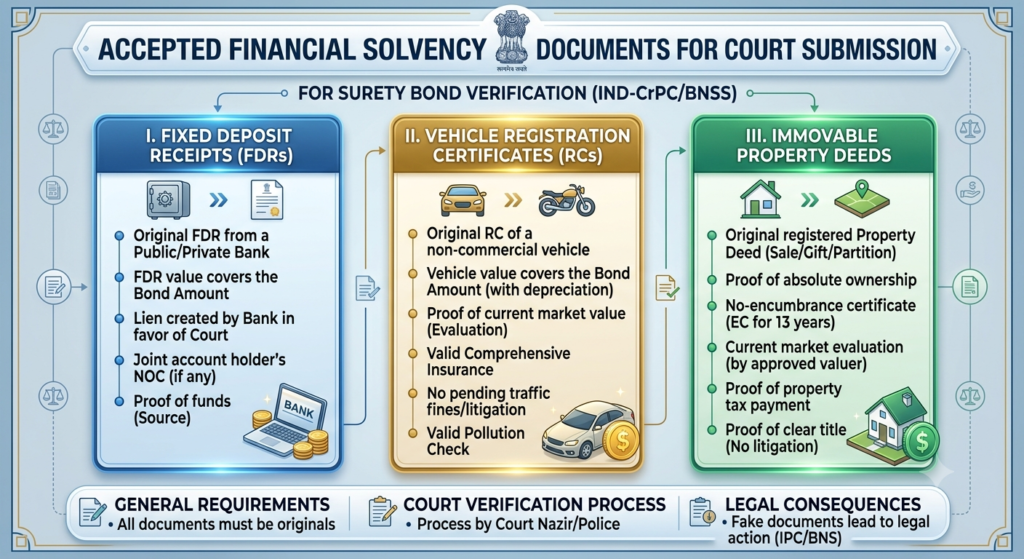
Category 3: Financial Solvency Proofs
To fulfill the financial conditions stipulated by the judge, the guarantor must prove financial capability equal to or exceeding the specified bond value.
Personal Bond vs. Surety Bond: Key Structural Differences
Understanding the operational differences between various bond formats simplifies the submission strategy before the court reader.
Key Takeaway: Courts require a personal bond directly from the accused, whereas a surety bond requires a third-party guarantor who pledges personal assets as financial security against non-appearance.
The comparison table below details how various solvency documents perform during real-world court evaluations across Delhi tribunals:
| Solvency Document | Financial Evaluation Method | Average Approval Speed | Risk of Court Rejection |
|---|---|---|---|
| Fixed Deposit Receipt (FDR) | Original bank receipt marked with court lien | Fast (Same Day) | Extremely Low |
| Vehicle Registration (RC) | Valuated against current commercial unencumbered value | Fast (Same Day) | Low |
| Property Sale Deed / Registry | Verified through physical municipal land records | Slow (2–4 Days) | Moderate (If title lacks clarity) |
| Salary Slips / Form 16 | Cross-checked against active employer records | Moderate (1–2 Days) | Low (For government employees) |
For families seeking immediate release, utilizing Fixed Deposit Receipts or Vehicle Registration Certificates consistently reduces administrative processing delays compared to land title deeds.
Furthermore, if you require direct legal support regarding complex court filings, consider scheduling an expert consultation.
Step-by-Step Surety Verification Process in District Courts
Executing a surety bond requires navigating a strict procedural workflow across court departments.
- Drafting Form 45: The defense lawyer drafts the statutory undertaking specifying the FIR number, police station, offense sections, and guarantor particulars.
- Document Compilation: Counsel attaches original solvency proofs, certified court order copies, and verified id proofs into a single court folder.
- Clerical Scrutiny: The court clerk (Ahlmad) reviews the application to ensure that monetary values match judicial directions precisely.
- Judicial Examination: The guarantor appears physically before the magistrate. The judge conducts a brief examination under oath to confirm that the guarantor is not acting as a paid proxy.
- Police Verification Process: If the court suspects document fraud, or if the guarantor resides outside Delhi, the magistrate directs the local Station House Officer (SHO) to complete a physical verification process.
- Dispatch of Release Warrant: Upon judicial approval, the court generates a formal release warrant. Subsequently, court staff transmit the warrant electronically or via physical messenger directly to Tihar, Mandoli, or Rohini Jail facilities.
In our analysis of recent cases, completing these administrative steps systematically prevents last-minute document rejections by the duty magistrate.
Landmark Judgments on Bail and Local Surety Restrictions
Historically, trial courts routinely insisted on local Delhi residents as guarantors. However, binding judgments on bail passed by the Supreme Court of India have declared unreasoned local restrictions unconstitutional.
Key Takeaway: The Supreme Court has repeatedly established that demanding local sureties or excessive financial property deeds deprives marginalized citizens of their fundamental liberty under Article 21.
Key Judicial Precedents
- Moti Ram & Ors. v. State of Madhya Pradesh (1978): The Supreme Court held that demanding exorbitant financial values or insisting exclusively upon local guarantors violates equal protection principles, confirming that personal credibility outweighs geographic residence.
- Satender Kumar Antil v. Central Bureau of Investigation (2022): The Apex Court issued sweeping procedural guidelines instructing lower courts to avoid imposing oppressive, impossible conditions when accepting sureties.
- In Re Policy Strategy for Grant of Bail (2023): The Supreme Court mandated the implementation of digital transmission systems to deliver court release orders to prison authorities instantly, eliminating unnecessary days in confinement.
Consequently, trial courts must evaluate guarantors based on genuine reliability rather than rigid geographic borders.
Frequently Asked Questions
What documents are mandatory for a surety bond in Delhi courts?
A guarantor must submit an Aadhaar Card, secondary ID proof (Voter ID/Passport), proof of local residence (utility bill/rent deed), financial solvency proofs (FDR, Vehicle RC, or Property Deed), and passport-size photographs.
Can an outstation relative act as a guarantor in a Delhi court?
Yes, an outstation relative can legally act as a guarantor. However, the trial court may order police verification of their outstation residential address, which can add two to three days to the release timeline.
Is an original land registry essential for executing a bail bond?
No, a land registry is not mandatory. Guarantors can submit alternative solvency proofs, including bank Fixed Deposits (FDRs), Vehicle Registration Certificates (RCs), or official salary certificates depending on the amount ordered by the court.
How long does police verification of a surety take in Delhi?
When ordered by the magistrate, local police verification typically takes between 24 and 72 hours. The local police officer visits the guarantor’s address, verifies original credentials, and submits a confirmation report to the court clerk.
Standard Legal Disclaimer: The legal information provided in this article is intended strictly for educational and informational purposes. It does not constitute formal legal advice, nor does reading this content establish an attorney-client relationship. Statutory provisions, court rules, and administrative practices in Delhi District Courts remain subject to amendment. Litigants must consult an experienced criminal lawyer for professional legal representation regarding specific cases.