Table of Contents
- Introduction to Berubari Union Case (In Re)
- Historical Context and the Radcliffe Award
- Key Constitutional Issues Raised in Berubari Case
- Supreme Court Judgment and Nehru-Noon Agreement
- Impact on Constitutional Law and Later Amendments
- Comparative Breakdown: Sovereign Powers vs. Article 3
- Frequently Asked Questions
Introduction to Berubari Union Case (In Re)
National sovereignty often depends on clear territorial boundaries. However, boundary disputes can create intense political and constitutional friction.
The Berubari Union Case (In Re) remains a monumental landmark in Indian legal history. It directly addressed whether the Indian Parliament could cede national territory to another country.
Written by Kapil Balhara | Technically Reviewed for Accuracy | Last Updated: October 2026
Furthermore, this judicial reference questioned the very nature of the Preamble. Legal scholars and students still study this precedent to understand executive power limits.
In our analysis of early constitutional litigation, few disputes highlight border management challenges so clearly. Therefore, understanding this ruling is crucial for legal researchers and associates alike.
Historical Context and the Radcliffe Award
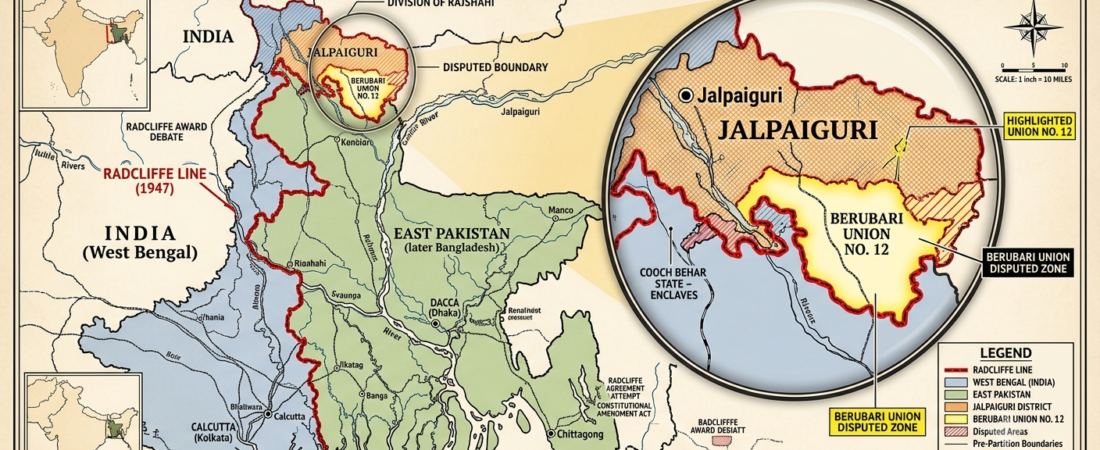
In 1947, Sir Cyril Radcliffe received the task of partitioning Bengal and Punjab. Consequently, he drew boundary lines between India and Pakistan under severe time constraints.
Unfortunately, the Radcliffe Award contained loose descriptions for several geographical areas. Specifically, it omitted a explicit text mention of Berubari Union No. 12 in Jalpaiguri.
Consequently, Pakistan claimed ownership over this territory. India maintained administrative control and possession of the area throughout this timeframe.
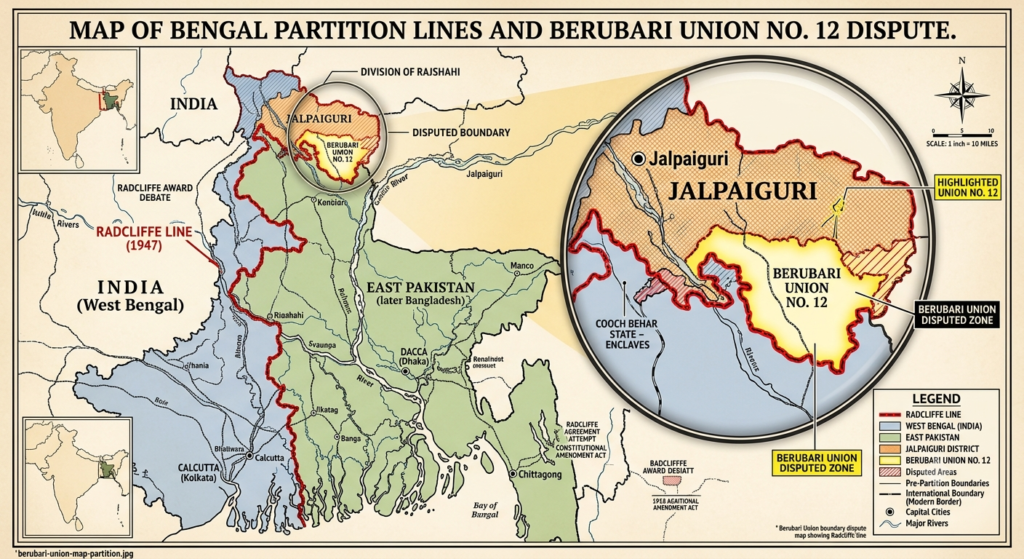
To resolve ongoing border friction, Prime Minister Jawaharlal Nehru met Prime Minister Feroz Khan Noon. Subsequently, both leaders signed the Nehru-Noon Agreement in 1958.
This treaty divided the Berubari Union territory between India and East Pakistan. However, local residents protested fiercely against the proposed territorial transfer.
Key Takeaway: The Nehru-Noon Agreement sought a diplomatic solution to boundary ambiguities. Yet, it triggered a major debate regarding constitutional power over national boundaries.
Key Constitutional Issues Raised in Berubari Case
President Rajendra Prasad submitted a reference to the Supreme Court under Article 143. Thus, the court evaluated the constitutional validity of the treaty enforcement.
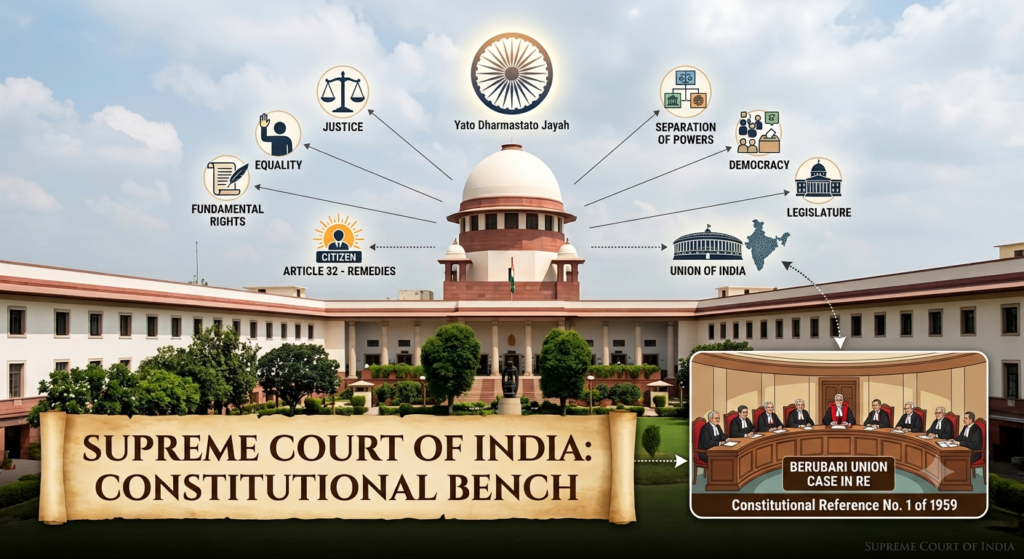
The executive branch had attempted to transfer territory without parliamentary legislation. Therefore, critical legal questions demanded immediate clarification from the apex court.
Role of the Preamble in Constitutional Interpretation
The government argued that the Preamble highlights a sovereign nation’s power. Consequently, executives asserted that ceding territory is an inherent attribute of national sovereignty.
However, the Supreme Court declared that the Preamble is not an operational source of power. In contrast, it acts merely as a key to open the minds of framers.
Key Takeaway: The Berubari ruling established that the Preamble cannot grant substantive power to the executive or legislature.
Article 3 vs. Executive Power in Cession of Territory
The government also relied on Article 3 of the Indian Constitution. Specifically, Article 3 allows Parliament to alter state boundaries or diminish state areas.
Nevertheless, the court analyzed whether diminishing an area includes ceding it to a foreign state. Ultimately, the judges concluded that internal reorganization differs entirely from foreign territorial cession.
- Article 3 governs internal adjustments among Indian states.
- Cession of territory requires surrendering Indian sovereignty to a foreign nation.
- Executive agreements cannot bypass legislative constitutional requirements.
Supreme Court Judgment and Nehru-Noon Agreement
The Supreme Court delivered its unanimous advisory opinion in March 1960. Chief Justice B.P. Sinha authored the comprehensive judgment for the bench.
First, the court held that Article 3 does not cover Cession of Territory. Therefore, Parliament cannot use simple statutory legislation under Article 3 to cede land.
Second, the court stated that transferring land requires a formal constitutional amendment. Specifically, Parliament must invoke its amendment powers under Article 368.
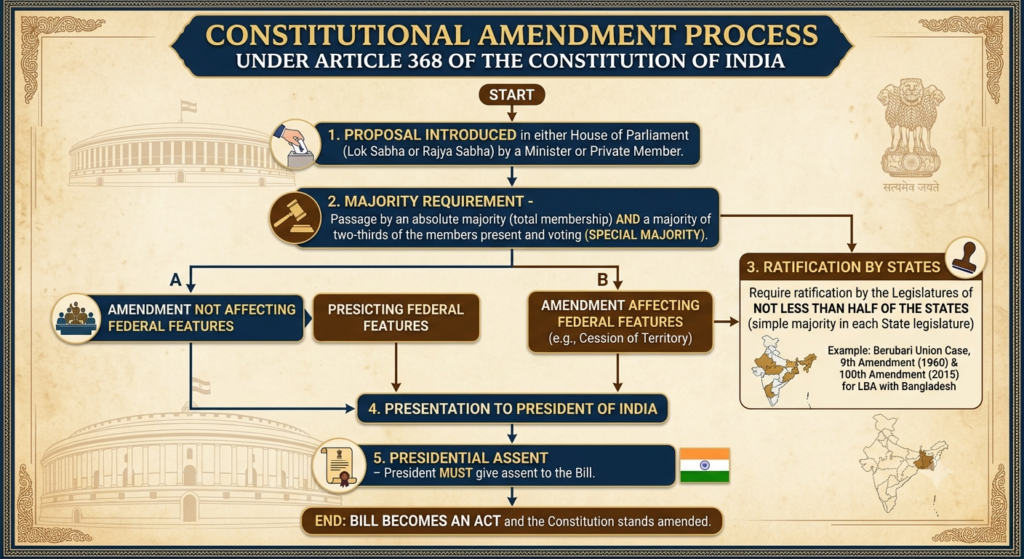
- Identify boundary disputes requiring treaty enforcement.
- Determine if the action constitutes administrative boundary settlement or actual land transfer.
- If cession occurs, draft a Constitutional Amendment Bill under Article 368.
- Pass the bill through both Houses of Parliament with required special majorities.
- Amend Schedule 1 of the Constitution to reflect altered borders.
Consequently, Parliament enacted the 9th Constitutional Amendment Act in 1960. This amendment formally authorized the transfer of the specified Berubari territory.
Impact on Constitutional Law and Later Amendments
The ruling in Berubari Union Case (In Re) set a vital precedent for future boundary treaties. For instance, the landmark Kesavananda Bharati case later modified the view on the Preamble.
In Kesavananda Bharati (1973), the Supreme Court recognized the Preamble as part of the Constitution. Nevertheless, the ruling on territorial cession remained entirely intact and authoritative.
Later, in Maganbhai Ishwarbhai Patel v. Union of India (1969), the court clarified another rule. Specifically, settling a disputed border does not always equal ceding territory.
If a treaty simply demarcates an uncertain border, executive action may suffice. Conversely, transferring undisputed Indian land always demands a constitutional amendment under Article 368.
Key Takeaway: The Berubari decision preserves democratic oversight. Executives cannot rewrite national geography without legislative sanction under Article 368.
When we evaluated recent international agreements, such as the 2015 India-Bangladesh Land Boundary Agreement, this framework held firm. The 100th Constitutional Amendment was enacted to execute that swap legally.
Comparative Breakdown: Sovereign Powers vs. Article 3
To understand these distinction clearly, review the structural differences below.
| Constitutional Parameter | Article 3 (Internal Reorganization) | Article 368 (Cession of Territory) |
|---|---|---|
| Scope of Application | Adjusts boundaries between internal Indian States | Transfers Indian territory to a foreign sovereign state |
| Legislative Majority | Simple majority in both parliamentary houses | Special majority under constitutional amendment rules |
| Sovereignty Impact | Maintains full Indian national sovereignty | Relinquishes sovereign control over specific territory |
| Preamble Connection | Guided by unity and administrative integrity | Restricted by constitutional sovereignty requirements |
Furthermore, this distinction guarantees that executive power remains accountable to Parliament. As a result, arbitrary land swaps remain impossible under Indian jurisprudence.
If you need deeper legal analysis on constitutional precedents, reach out to our legal research team today for structured case notes!
Frequently Asked Questions
Is the Preamble considered part of the Indian Constitution today?
Yes, the Supreme Court overruled its earlier Berubari stance in the 1973 Kesavananda Bharati decision. The court held that the Preamble is an integral part of the Constitution. However, it remains non-justiciable and does not grant substantive executive power.
Why was Article 3 deemed insufficient for ceding territory?
Article 3 only allows Parliament to alter internal state borders or names. Because ceding territory surrenders national sovereignty to a foreign nation, the court ruled it exceeds internal reorganization powers. Thus, an amendment under Article 368 is mandatory.
What was the immediate result of the Berubari Union Case ruling?
The ruling forced Parliament to pass the 9th Constitutional Amendment Act in 1960. This action amended Schedule 1 of the Constitution, legally permitting the government to complete the intended territorial transfer to Pakistan.
To sum up, the Berubari Union Case (In Re) remains a foundational constitutional pillar. It secures parliament’s authority, establishes limits on executive treaties, and safeguards national territory through rigorous constitutional procedures.