Discovering that swindlers drained your savings through a financial scam triggers intense panic, confusion, and deep emotional shock. Therefore, knowing How to File a Cyber Crime FIR for Online Fraud & Scams allows you to act fast, freeze beneficiary accounts, and maximize your money recovery chances.
Written by Kapil Balhara | Technically Reviewed for Accuracy | Last Updated: October 2026
Table of Contents
- Understanding Cyber Crime FIRs and Emergency Actions
- Step-by-Step Reporting via National Portals and Helpline 1930
- Documenting Digital Evidence and Registering Physical FIRs
- Freezing Fraudulent Accounts and Coordinating with Nodal Officers
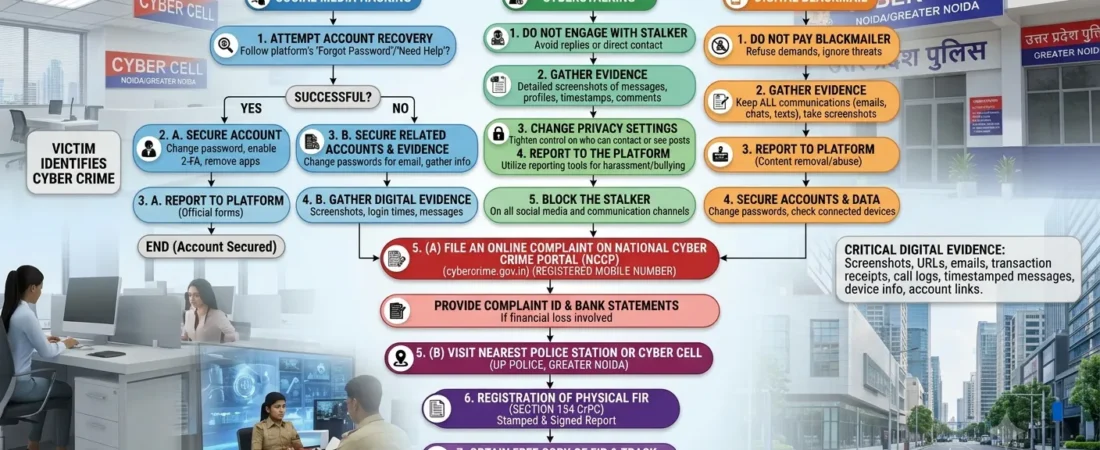
- Specialized Cyber Crimes: Identity Theft, Hacking, and Extortion
- Legal Framework, Landmark Judgments, and Unfreezing Accounts
- Frequently Asked Questions
Understanding Cyber Crime FIRs and Emergency Actions
Online fraud techniques evolve rapidly across digital payment networks, instant messaging apps, and deceptive websites. Consequently, navigating police procedures quickly protects your digital identity while creating immutable electronic evidence trails.
Section 173 of the Bharatiya Nagarik Suraksha Sanhita (BNSS) read alongside the Information Technology (IT) Act, 2000 governs digital crime disclosures. This statutory framework mandates police officers to record cyber offences and initiate immediate digital tracing.
Key Takeaway: The first two hours following financial fraud represent the critical “Golden Hours.” Reporting incidents within this window increases the likelihood of freezing stolen funds inside suspect beneficiary accounts.
Definition and Summary Block
Learning how to file a cyber crime FIR for online fraud & scams enables victims to report digital financial crimes, identity theft, and online extortion. You can register complaints by dialing national helpline 1930, submitting complaints on cybercrime.gov.in, filing physical complaints at local cyber cells, and obtaining court orders to freeze fraudulent bank accounts.
In our legal practice, we frequently guide victims through complex digital banking frauds. Therefore, review the comparative table below to select the appropriate reporting channel based on incident urgency.
| Reporting Channel | Primary Forum / Portal | Response Speed | Primary Legal Objective |
|---|---|---|---|
| National Helpline 1930 | Financial Fraud Management System (Citizen Financial Cyber Fraud Reporting) | Instant (Real-time call response) | Triggers immediate holding alerts across destination bank servers |
| National Cyber Portal | cybercrime.gov.in | 1 to 24 Hours | Generates official ACK complaint number and routes file to state cyber cell |
| Physical Cyber Cell FIR | District Cyber Crime Police Station / Local Thana | Same Day | Logs formal FIR under IT Act and BNSS, assigning Investigating Officer |
| Bank Nodal Escalation | Designated Bank Cyber Cell / Ombudsman | 24 to 48 Hours | Secures transaction logs, reverses unauthorized debits, and prevents further charges |
| Magistrate Application | Section 175(3) BNSS / Judicial Magistrate Court | 7 to 21 Days | Issues court directions compelling banks to release frozen funds to victims |
Step-by-Step Reporting via National Portals and Helpline 1930
When financial fraud occurs, taking immediate digital action stops illicit money transfers across multi-layered banking channels.
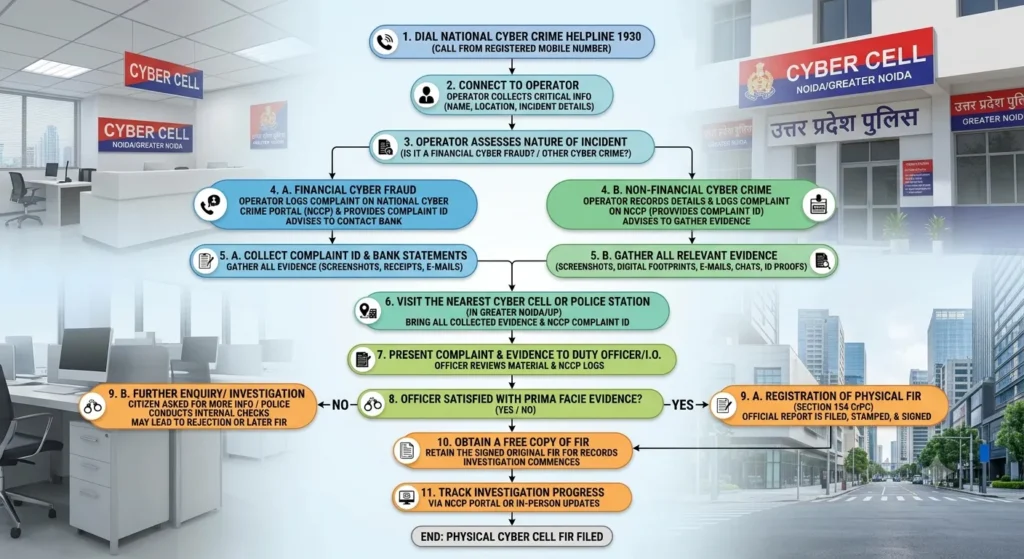
Contacting the 1930 Cyber Crime Helpline Immediately
Dial national helpline 1930 (formerly 155260) immediately from your registered mobile number upon noticing unauthorized bank debits.
The helpline operator records key details, including your full name, mobile number, bank account details, transaction timestamp, and destination UPI ID or account number.
The system dispatches real-time automated alerts through the Citizen Financial Cyber Fraud Reporting and Management System (CFCFRMS). Consequently, beneficiary banks block funds inside scammer accounts before perpetrators withdraw cash at ATMs.
Submitting Complaints on the National Cyber Crime Portal
Following your emergency phone call, navigate to the official National Cyber Crime Reporting Portal at cybercrime.gov.in.
Select “Report Other Cyber Crime” or “Report Financial Fraud” based on your incident category. Register an account using your mobile number and authenticated OTP.
Enter comprehensive factual details regarding the incident, including website links, phone numbers used by fraudsters, fake app downloads, and communication logs.
NATIONAL CYBER CRIME PORTAL SUBMISSION WORKFLOW

[Step 1: Dial Helpline 1930 & Secure Temporary Reference ID]
      │
      ▼
[Step 2: Access cybercrime.gov.in & Complete Mobile OTP Login]
      │
      ▼
[Step 3: Enter Transaction Details, Beneficiary UPI/Bank Accounts]
      │
      ▼
[Step 4: Upload PDF Evidence (Bank Statements, Chat Logs, Screenshots)]
      │
      ▼
[Step 5: System Generates Acknowledgement Number & Assigns District Cyber Cell]
Key Takeaway: Always link your helpline 1930 reference ID when completing your online portal filing. This links your initial emergency phone alert with your detailed written complaint file.
Documenting Digital Evidence and Registering Physical FIRs
Electronic evidence requires careful preservation to withstand strict scrutiny during court proceedings. Consequently, compile complete digital documentation before visiting police authorities.
Gathering Bank Receipts UPI Transaction IDs and Screenshots
Collect every transaction record associated with the fraudulent incident immediately. Specifically, download official bank statements displaying debited amounts, beneficiary account names, IFSC codes, and Unique Transaction Reference (UTR) numbers.
In addition, capture clear high-resolution screenshots of UPI payment confirmation screens, wallet debit logs, and SMS transaction alerts received from your bank.
Furthermore, preserve complete chat logs from WhatsApp, Telegram, Instagram, or email exchanges. Do not delete message threads, as timestamps prove suspect identity.
Protecting Evidence and Avoiding File Tampering
Preserving digital chain of custody remains essential for evidentiary admissibility under Section 63 of the Bharatiya Sakshya Adhiniyam (BSA) (formerly Section 65B Indian Evidence Act).
Export original chat files directly as text backups rather than relying solely on cropped image snapshots. Keep original mobile devices, SIM cards, and hard drives untouched to allow forensic examination by police tech units.
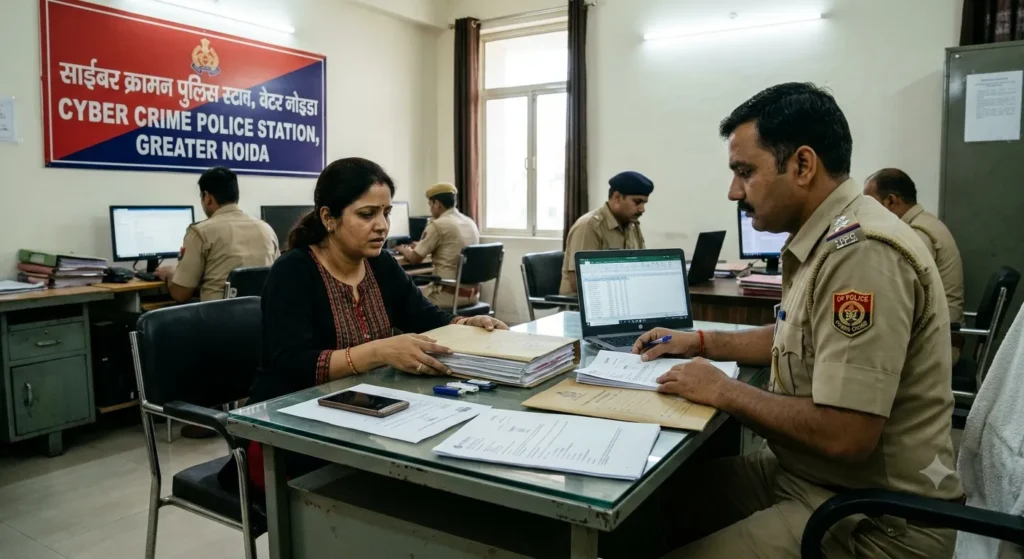
Registering Physical FIR at Local Cyber Cells
While online portal complaints initiate digital tracing, visiting a physical cyber cell converts your digital filing into a formal First Information Report.
Approach your district Cyber Crime Police Station or local police station with a printed copy of your national portal complaint.
Submit a detailed written application addressed to the Station House Officer (SHO), attaching all bank statements, screenshots, and identity proofs. Ensure the duty officer affixes an official station receiving stamp and date on your duplicate copy.
Freezing Fraudulent Accounts and Coordinating with Nodal Officers
Stopping scam proceeds requires fast coordination between investigating police officers and banking institution nodal representatives.
Freezing Fraudulent Accounts to Recover Lost Money
Once police register your complaint, the Investigating Officer (IO) issues formal statutory notices under Section 94 BNSS (formerly Section 91 CrPC) to destination banks.
These legal notices instruct bank managers to freeze suspect accounts immediately. Banks freeze both primary recipient accounts and secondary “mule” accounts used to disperse stolen funds.
In our analysis of financial recovery workflows, quick issuance of Section 94 BNSS notices prevents scammers from transferring stolen balances into cryptocurrency exchanges or international payment gateways.
Following Up with Nodal Bank Officers and Police
Maintain continuous communication with the assigned police Investigating Officer and designated bank nodal officers.
Obtain the specific acknowledgement receipts issued by recipient banks confirming account freezes and current held balances.
Provide supplementary representations to the police IO if you uncover additional suspect numbers, social media handles, or fraudulent websites tied to the scam network.
Key Takeaway: Request written confirmation from the IO regarding the exact frozen amount across beneficiary bank accounts. This frozen amount represents the maximum balance you can reclaim through court release orders.
Specialized Cyber Crimes: Identity Theft, Hacking, and Extortion
Cyber threats extend beyond financial scams, incorporating personal extortion, account takeover, and deepfake harassment.
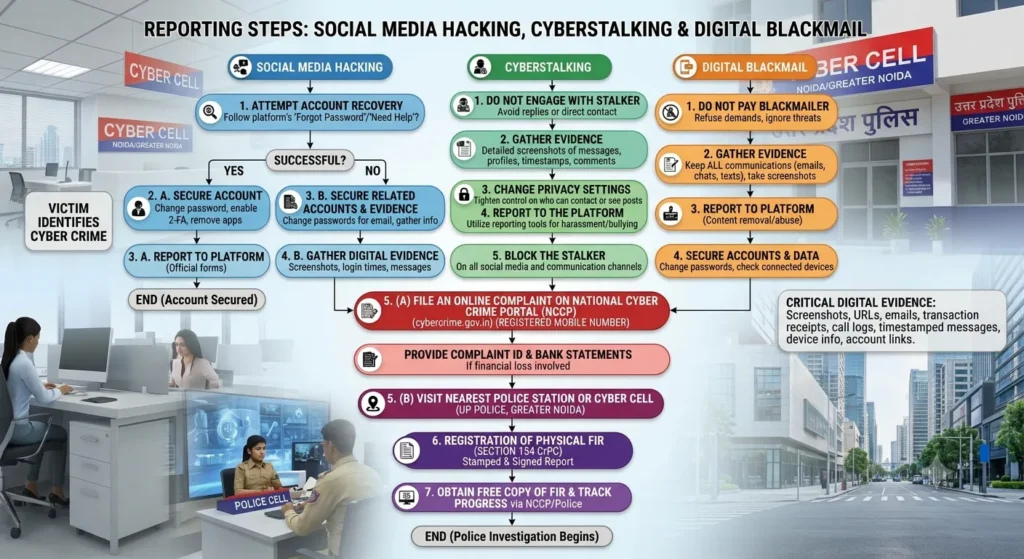
Reporting Social Media Account Hacking and Identity Theft
If perpetrators hack your Instagram, Facebook, or WhatsApp accounts, secure technical log records immediately.
Capture screenshots showing unauthorized password reset alerts, modified recovery email notifications, and IP login logs.
Report account takeovers directly to platform trust and safety teams while filing a formal complaint on the National Cyber Crime Portal under Section 66 (Hacking) and Section 66C (Identity Theft) of the IT Act.
Dealing with Cyberstalking Online Harassment and Blackmail
Online blackmail schemes, including loan app scams and morphing extortion, require immediate law enforcement intervention.
Never pay blackmailers or transfer funds under pressure, as extortion demands escalate continuously.
Block communication channels, download full conversation histories, and file an urgent complaint under Section 67 IT Act (Publishing Obscene Material) and Section 308 BNS (Extortion) at your local cyber cell.
Legal Framework, Landmark Judgments, and Unfreezing Accounts
Navigating cyber laws requires deep familiarity with statutory provisions and judicial precedents governing digital investigations.
Legal Framework and Statutory Provisions
Cyber offences fall under compound statutory framework combining the Information Technology Act, 2000 and the Bharatiya Nyaya Sanhita (BNS), 2023:
- Section 66D IT Act: Cheating by personation by using computer resource (up to 3 years imprisonment).
- Section 66C IT Act: Identity theft and fraudulent utilization of electronic signatures or passwords.
- Section 318 BNS: Cheating and dishonestly inducing delivery of property (formerly Section 420 IPC).
- Section 319 BNS: Cheating by personation during digital communications.
Landmark Judicial Rulings on Cyber Crime Investigations
In our legal analysis, relying on binding precedents strengthens victim applications during court proceedings:
- Shriji Concrete Pvt. Ltd. v. State of Gujarat (2022): The Gujarat High Court held that bank accounts of innocent third parties cannot remain indefinitely frozen without proving direct nexus to cyber crime proceeds.
- Teesta Atul Setalvad v. State of Gujarat (2018) 2 SCC 372: The Supreme Court affirmed police powers under Section 102 CrPC (now Section 106 BNSS) to seize property and freeze bank accounts linked to criminal investigations.
- State of Maharashtra v. Tapas D. Neogy (1999) 7 SCC 685: The Supreme Court held that “property” under criminal procedure includes bank accounts, authorizing police to freeze accounts during theft inquiries.
Steps to Unfreeze Bank Accounts Blocked During Investigations
Occasionally, police freeze bank accounts belonging to innocent business owners or merchants because stolen funds passed through their accounts during secondary transactions.
If police freeze your account unintentionally during a cyber fraud investigation, follow these legal unfreezing steps:
- Obtain Freeze Details: Request your bank manager to provide the specific police station name, FIR/complaint number, and IO contact details.
- Submit Business Proofs: Draft a formal representation to the IO presenting GST returns, tax filings, invoices, and trade contracts proving legitimate business origin for all incoming transactions.
- Approach Judicial Magistrate: If police delay unfreezing, file an application under Section 497/503 BNSS (formerly Section 451/457 CrPC) before the local Magistrate Court seeking account unfreezing.
- File High Court Petition: File a Writ Petition under Article 226 of the Constitution before the High Court to lift arbitrary account freezes affecting your fundamental right to livelihood under Article 19(1)(g).
MAGISTRATE PETITION FOR RELEASE OF FROZEN FUNDS / UNFREEZING ACCOUNT

IN THE COURT OF THE CHIEF JUDICIAL MAGISTRATE AT [CITY NAME]
MISC. CRIMINAL APPLICATION NO. _____ OF 2026

IN THE MATTER OF:
[Your Name / Business Name]                     ... APPLICANT
                  VERSUS
State (Cyber Crime Police Station)               ... RESPONDENT

APPLICATION UNDER SECTION 497/503 BNSS FOR RELEASE OF FROZEN BANK FUNDS

MOST RESPECTFULLY SHOWETH:

1. The Applicant is a victim of online fraud / legitimate business owner whose account No. [Account No.] at [Bank Name] was frozen pursuant to directions issued in Cyber Crime FIR No. [___/2026].

2. The Applicant has fully cooperated with the Investigating Officer and submitted all transaction receipts, GST invoices, and identity proofs.

3. The held amount of Rs. [Amount] is currently frozen inside Account No. [Account No.] at [Beneficiary Bank Name].

PRAYER:
It is respectfully prayed that this Hon'ble Court may direct the Respondent Police / Bank to unfreeze the Applicant's bank account and release held funds.
Key Takeaway: Acting quickly through Magistrate applications under Section 497 BNSS remains the fastest legal route to secure court orders directing banks to return frozen funds to fraud victims.
Need expert legal assistance recovering stolen cyber funds or unfreezing a blocked business account? Contact our specialized legal team today for immediate consultation.
Frequently Asked Questions
What is the deadline to report online financial fraud on helpline 1930?
You should dial 1930 within the “Golden Hours” (ideally within 2 to 24 hours of the fraudulent debit). Reporting quickly increases the probability that beneficiary banks freeze stolen funds before scammers complete cash withdrawals.
Can I file a cyber crime FIR if the fraudster operates from another state?
Yes, you can file a cyber crime FIR at your local police station or district cyber cell regardless of where the fraudster is located. Cyber crime police stations possess pan-India jurisdiction to investigate electronic crimes across state lines.
How long does it take to recover money after police freeze a scammer’s bank account?
Recovering frozen money typically takes between two to six months. You must obtain a formal indemnity bond or refund order from the local Magistrate Court directing the bank to release held funds back to your account.
Will police charge any fee for investigating cyber crime complaints?
No, police charge no fees for registering cyber crime complaints, issuing account freeze notices, or conducting digital investigations. Filing complaints on national portals and at local cyber cells remains completely free of cost across India.
Reclaim Your Digital Security Today
Falling victim to online scams is distressing, but taking rapid legal action empowers you to fight back effectively. By leveraging helpline 1930, preserving digital evidence, and following up at local cyber cells, you can stop scammers and recover your hard-earned money.
Do not let cyber criminals get away with fraud. Compile your bank receipts, file your online portal complaint today, and assert your legal rights to secure complete justice.