How to File an FIR for Vehicle Theft and Claim Insurance
Discovering that someone stole your car or bike triggers overwhelming shock, anger, and deep financial dread. Therefore, understanding FIR for Vehicle Theft (Car / Bike) & Insurance Claims ensures you protect your legal rights, fulfill statutory timelines, and secure full insurance reimbursement.
Written by Kapil Balhara | Technically Reviewed for Accuracy | October 2026
Understanding Vehicle Theft FIRs and Statutory Mandates
Vehicle theft represents a serious cognizable offence across all Indian jurisdictions. Consequently, navigating police procedures quickly protects your property rights while establishing an immutable timeline for insurance claims.
Section 173 of the Bharatiya Nagarik Suraksha Sanhita (BNSS) governs the registration of First Information Reports for property theft. This statutory provision mandates police officers to record vehicle theft complaints without delay.
Key Takeaway: Filing an FIR immediately is the foundational legal requirement for motor insurance payouts. Insurers reject claims if policyholders fail to report thefts to police promptly.
Definition and Summary Block
Filing an FIR for vehicle theft (car / bike) & insurance claims enables owners to initiate criminal investigations and claim insurance compensation. You must call 112 immediately, lodge an FIR under Section 173 BNSS, notify your insurer within policy deadlines, inform the RTO, and obtain a court-accepted Untraced Final Report.
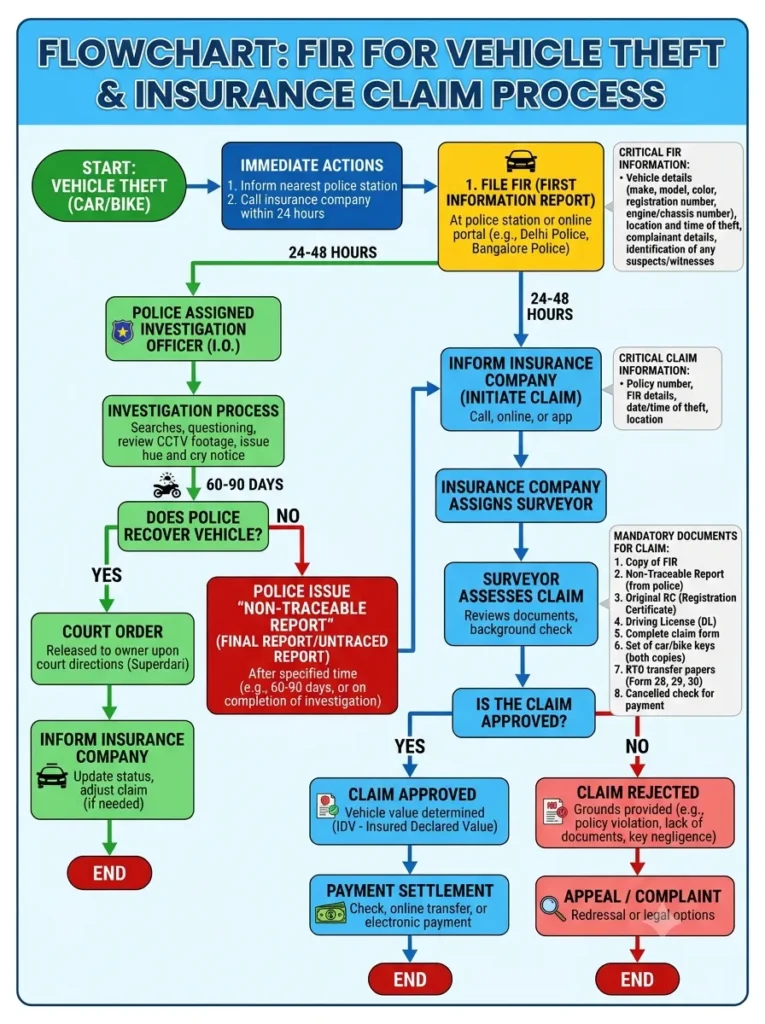
Flowchart outlining FIR for vehicle theft car bike and insurance claims step by step
In our legal practice, we routinely assist vehicle owners navigating complex insurance disputes following theft incidents. Therefore, review the comparative breakdown below to understand the distinct responsibilities of police authorities and insurance providers.
Entity / Authority
Primary Statutory / Policy Role
Mandatory Reporting Timeline
Key Document Produced
Local Police Station
Registers FIR under Section 173 BNSS and conducts search
Immediate (Call 112 / Visit station within hours)
Stamped FIR Copy & Untraced Final Report
Insurance Company
Assesses claim eligibility under Insured Declared Value (IDV)
Within 24 to 48 hours of theft discovery
Claim Form & Settlement Voucher
Regional Transport Office (RTO)
Records theft alert on VAHAN database to block transfer
Accepts police investigation report and certifies theft
Post-investigation (30 to 90 days)
Certified Untraced Report Order
Immediate Action Steps After Discovering Vehicle Theft
Taking fast, structured steps during the initial hours following vehicle theft prevents evidence loss and strengthens your insurance standing.
Calling Emergency Helpline 112 and Station Visit
First, dial emergency helpline 112 immediately upon noticing your vehicle is missing from its parked location.
The emergency operator records your call timestamp, location, vehicle registration number, and make. This recorded phone call creates immediate contemporary proof of theft.
Next, visit the local police station holding jurisdiction over the theft scene. Do not delay your visit, as immediate reporting eliminates insurer allegations of gross negligence.
Vehicle Information Needed for Theft FIR Draft
When drafting your written complaint for the duty officer, compile complete vehicle specifics beforehand.
Incident Particulars: Exact date, time window, street address, and landmarks where you parked the vehicle.
Key Particulars: Number of original vehicle keys in your physical possession (insurers demand both original keys).
Valuables Particulars: List any original documents or personal belongings kept inside the stolen vehicle.
In State of Haryana v. Bhajan Lal (1992), the Supreme Court held that police officers possess no legal discretion to refuse recording disclosures regarding cognizable offences like theft.
Key Takeaway: Always confirm that both original factory keys remain in your physical possession. Insurers inspect original keys to verify that policyholders did not leave keys inside unlocked vehicles.
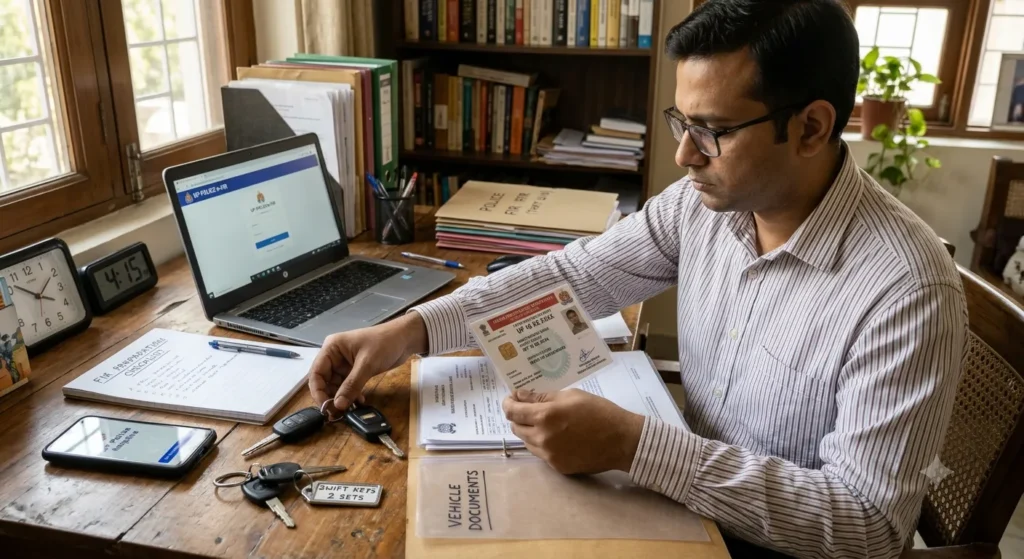
Vehicle owner organizing RC documents and keys to file an FIR for vehicle theft
Vehicle Information Needed for Theft FIR Draft
Providing detailed information in your initial police complaint ensures that investigating officers issue accurate automated alerts across border check-posts.
Drafting a Flawless Theft Complaint
Structure your written application clearly, addressing the Station House Officer (SHO) of the jurisdictional police station.
State whether you noticed suspicious individuals lingering near your parking spot earlier. If nearby commercial shops or residential buildings possess CCTV cameras, mention their availability in your application.
Furthermore, state whether your vehicle contained GPS tracking hardware, steering locks, or anti-theft gear. Mentioning anti-theft devices proves that you took reasonable care to safeguard your property.
FORMAL COMPLAINT FOR VEHICLE THEFT UNDER SECTION 173 BNSS

To,
The Station House Officer (SHO),
[Police Station Name], [District Name]

SUBJECT: Application for registration of FIR regarding theft of [Car / Bike Make & Model], Registration No: [Vehicle Registration No]

Respected Sir/Madam,

I, [Your Full Name], R/o [Complete Address], Contact No: [Phone Number], respectfully submit that I am the registered owner of [Car / Bike Make & Model], bearing Registration No: [Registration No], Chassis No: [Chassis No], and Engine No: [Engine No].

Incident Details:
1. Date and Time of Parking: [Date] at approximately [Time]
2. Theft Location: [Exact Address / Parking Landmark]
3. Discovery of Theft: [Date] at approximately [Time]

I parked my vehicle securely and locked it properly. On [Discovery Date/Time], I returned to the spot and found my vehicle missing. Despite searching nearby areas, I could not locate it.

I request your good office to register an FIR under Section 173 BNSS, issue automated alerts, and initiate an immediate investigation. Both original keys remain in my safe possession.

Sincerely,

[Your Signature]
[Your Full Name]
Notifying Insurance Companies and the RTO Within Required Timelines
While police handle the criminal investigation, you must simultaneously execute mandatory administrative notices to your insurer and motor vehicle authorities.
Notifying Insurance Companies Within Required Timelines
Contact your insurance company’s customer care helpline or access their mobile portal within 24 to 48 hours of theft discovery.
Provide your policy number, vehicle registration number, and the police station name where you lodged your complaint.
The insurer registers a formal theft claim and assigns an independent surveyor to inspect the theft scene and collect initial documents.
In Gurshinder Singh v. Shriram General Insurance Co. Ltd. (2020), a three-judge Bench of the Supreme Court held that a delay in informing the insurance company is not fatal to a genuine theft claim if the policyholder reported the theft to the police immediately.
Informing the Regional Transport Office RTO
Notify the Regional Transport Office (RTO) where your vehicle was originally registered within 7 to 14 days.
Submit a formal written letter attached with a copy of your FIR, requesting the RTO to mark the vehicle as “Stolen” in the central VAHAN database.
Marking the vehicle as stolen prevents thieves or black-market syndicates from forging duplicate RC books or transferring ownership to unsuspecting buyers.
Key Takeaway: The Supreme Court judgment in Gurshinder Singh v. Shriram General Insurance protects policyholders from arbitrary claim rejections based solely on minor delays in notifying insurance companies, provided police were informed promptly.
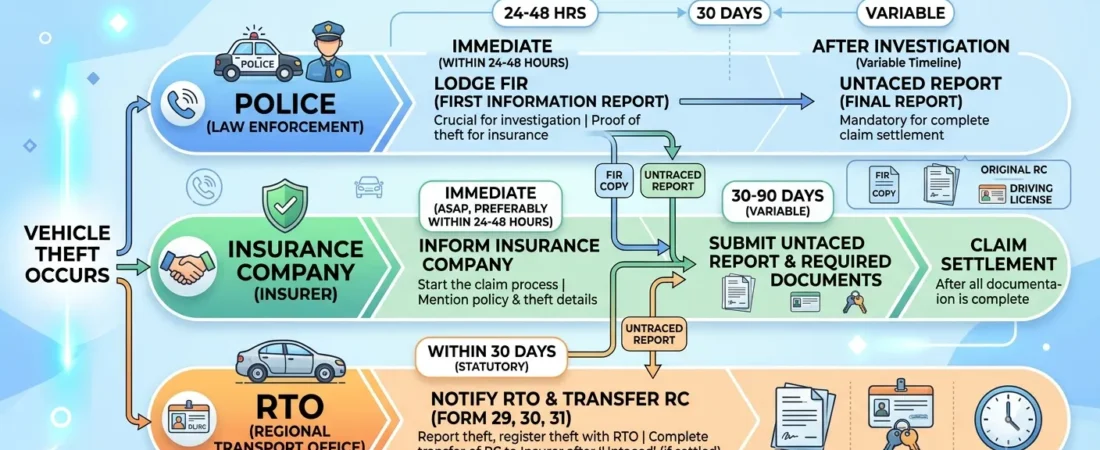
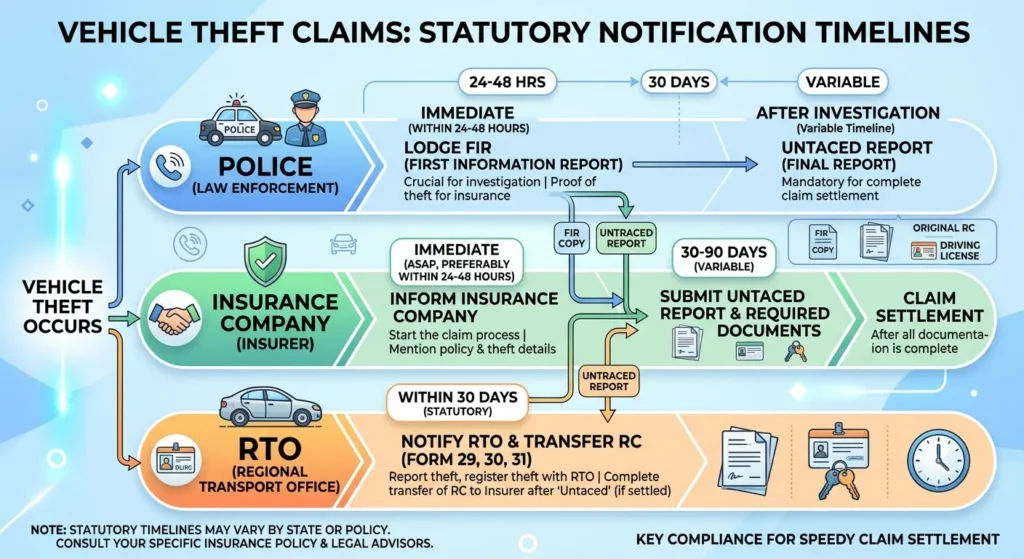
Infographic displaying notification timelines for FIR for vehicle theft car bike and insurance claims
Police Search Process, Location Alerts, and Untraced Final Reports
Following FIR registration, police execute investigative steps to locate the stolen vehicle and catch perpetrators.
Police Search Process and Vehicle Location Alerts
The assigned Investigating Officer (IO) uploads your vehicle’s registration, chassis, and engine numbers onto the automated CCTNS network.
This digital entry triggers alerts across regional police check-posts, toll plazas, and automated number plate recognition (ANPR) camera networks.
Furthermore, the IO visits the theft scene, inspects nearby CCTV camera footage, records witness statements under Section 180 BNSS, and verifies local parking logs.
Obtaining Court-Issued Untraced Final Investigation Reports
If police cannot recover the vehicle within 30 to 90 days, the IO prepares a formal investigation summary termed an “Untraced Final Report” (or “FR Untraced”).
The IO submits this Untraced Report under Section 193 BNSS to the competent Judicial Magistrate Court.
The Judicial Magistrate reviews the investigation file, verifies that police executed reasonable search measures, and passes a formal judicial order accepting the Untraced Final Report.
POLICE INVESTIGATION & UNTRACED REPORT WORKFLOW

[Vehicle Theft Occurs & FIR Registered]
      │
      ▼
[IO Issues CCTNS Alerts & Inspects CCTV / Toll Logs]
      │
      ▼
[30 to 90 Days Search Period Yields No Vehicle Recovery]
      │
      ▼
[IO Prepares Untraced Final Report under Section 193 BNSS]
      │
      ▼
[Judicial Magistrate Accepts Report & Issues Certified Order Copy]
      │
      ▼
[Policyholder Submits Court Order to Insurer for Claim Final Settlement]
Key Takeaway: Insurance companies require a certified copy of the Magistrate’s order accepting the Untraced Final Report before releasing final claim payout checks.
Insurance Settlement Workflows, Financed Vehicles, and Vehicle Recovery
Navigating the final insurance settlement requires compiling specific legal, vehicle, and financial document annexures.
Submitting FIR Copies for Insurance Claim Approval
Provide the following document dossier to your assigned insurance surveyor:
Certified FIR Copy: Official police station stamped printout of the registered FIR.
Magistrate’s Untraced Order: Certified copy of the court order accepting the police Untraced Report.
Original Keys & RC: Both original vehicle keys alongside the original Registration Certificate (RC) book.
Insurance Policy Copy: Valid comprehensive insurance policy document displaying the Insured Declared Value (IDV).
RTO Theft Endorsement: Official acknowledgement from the RTO confirming the stolen status entry in VAHAN records.
Form 28, 29, 30 & Subrogation Letter: Signed RTO transfer forms and letter of subrogation transferring vehicle rights to the insurer upon claim payout.
Claims Settlement Process for Financed Vehicles
If you purchased the stolen vehicle through an active auto loan, the insurance policy carries a financier hypothecation clause.
Consequently, the insurance company dispatches the claim payout amount directly to the bank or financial institution financing the loan.
If the settled Insured Declared Value (IDV) exceeds the outstanding loan balance, the bank deducts remaining dues and transfers the surplus funds back to your savings account.
Conversely, if the IDV falls short of the total outstanding loan balance, you remain responsible for paying the remaining deficit to close the loan account.
What to Do If Stolen Vehicle Is Recovered Later
Occasionally, police recover a stolen vehicle after the insurance company has already settled the claim and disbursed payment.
Because you executed a formal Letter of Subrogation during claim settlement, the insurance company holds legal ownership of the recovered vehicle.
The insurer takes possession of the recovered vehicle through court release applications under Section 497 BNSS (formerly Section 451 CrPC) and auctions it to recover claim costs.
Need legal guidance obtaining your Untraced Report or settling a delayed insurance claim? Contact our specialized legal team today for immediate consultation and assistance.
Frequently Asked Questions
How long does an insurance company take to settle a vehicle theft claim?
Insurance companies typically settle vehicle theft claims within 30 to 90 days. The processing time depends on how fast the local police station submits its Untraced Final Report and how quickly the Judicial Magistrate court passes the acceptance order.
Can an insurance company reject my claim if I lose one original key?
If you lose one original key, you must explain the loss in your written complaint and insurance claim form. While insurers scrutinize missing keys strictly, judgments like National Insurance Co. Ltd. v. Nitin Khandelwal protect policyholders from arbitrary rejections if theft is proven.
What is Insured Declared Value (IDV) in vehicle theft insurance claims?
Insured Declared Value (IDV) is the maximum fixed sum insured payable by the insurance company in the event of total loss or theft of the vehicle. It represents the manufacturer’s listed selling price adjusted for annual depreciation based on vehicle age.
What should I do if the police refuse to register an FIR for vehicle theft?
If local police refuse to register your theft FIR, send your complaint to the Superintendent of Police (SP) via Registered Post under Section 173(4) BNSS, or file a petition before the Judicial Magistrate under Section 175(3) BNSS seeking court directions.
Secure Your Financial and Legal Safety Today
Facing vehicle theft is deeply distressing, but taking rapid, structured legal action protects your financial investment. By lodging an immediate FIR, notifying your insurer promptly, and securing your court Untraced Report, you ensure a smooth claim payout.
Do not let procedural delays jeopardize your insurance entitlement. File your police complaint today, notify your RTO, and assert your legal rights to recover your full claim settlement.