
Written by Kapil Balhara | Technically Reviewed for Accuracy | Last Updated: October 2026
Table of Contents
- What Is Githa Hariharan v. Reserve Bank of India Case?
- Factual Background and the Statutory Barrier
- Constitutional Challenge to Section 6(a) of HMGA
- Supreme Court Interpretation of the Word “After”
- Impact on Mothers’ Guardianship Rights and Gender Equality
- Frequently Asked Questions
What Is Githa Hariharan v. Reserve Bank of India Case?
Key Takeaway: The Supreme Court ruling in Githa Hariharan v. Reserve Bank of India (1999) held that both father and mother possess equal status as natural guardians of a minor child. The judgment re-interpreted Section 6(a) of the Hindu Minority and Guardianship Act, 1956 to protect constitutional gender equality.
The Githa Hariharan v. Reserve Bank of India case arose when author Githa Hariharan applied to invest in RBI Relief Bonds for her minor son. The Reserve Bank refused her application because she signed as the natural guardian while the father was alive.
Consequently, the petitioner challenged Section 6(a) of the Hindu Minority and Guardianship Act (HMGA), 1956 under Article 32 of the Constitution. A Supreme Court bench comprising Justice Umesh C. Banerjee and Chief Justice A.S. Anand ruled that a mother can act as a natural guardian even during the father’s lifetime under specific circumstances.
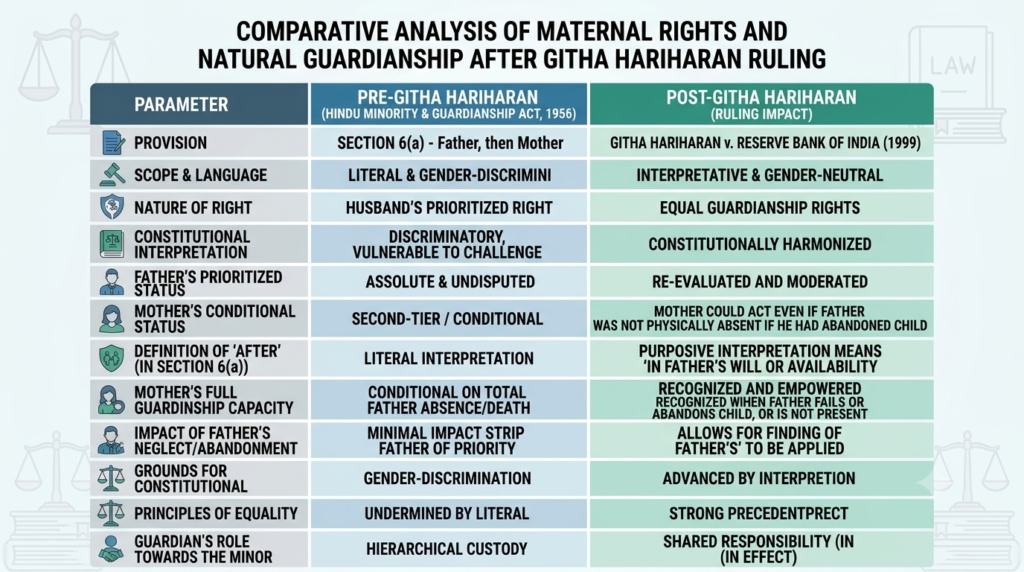
Factual Background and the Statutory Barrier
To begin with, Githa Hariharan married Dr. Mohan Ram in 1982, and their son Rishab Bailey was born in July 1984. In December 1984, Githa Hariharan submitted an application to the Reserve Bank of India for 9% Relief Bonds in her minor son’s name.
However, the Reserve Bank returned the application form. The bank instructed her to either provide the father’s signature or produce a guardianship certificate from a competent court. The RBI relied strictly on Section 6(a) of the Hindu Minority and Guardianship Act, 1956.

Simultaneously, another writ petition involving Dr. Vandana Shiva was tagged with this case. In that proceeding, the father asserted sole natural guardianship despite displaying complete apathy toward the child’s welfare.
Key Takeaway: Banks and public institutions routinely rejected maternal signatures based on a literal reading of personal law, forcing mothers into unnecessary court litigation.
Constitutional Challenge to Section 6(a) of HMGA
Besides administrative obstacles, the legal core of the case targeted Section 6(a) of the HMGA, 1956. The provision stated that the natural guardian of a Hindu minor boy or unmarried girl is “the father, and after him, the mother”.
Senior advocate Indira Jaising argued that this provision established an explicit gender bias. Specifically, treating the mother’s rights as secondary violated fundamental rights under the Constitution:
- Article 14: Guarantees equality before the law and equal protection of laws.
- Article 15: Prohibits discrimination by the State on grounds of sex.
- CEDAW Commitments: Violates international conventions ratified by India in June 1993.
| Parameter | Literal Statutory View (Pre-1999) | Constitutional Interpretation (Githa Hariharan) |
|---|---|---|
| Primary Natural Guardian | Father exclusively during his lifetime. | Both father and mother enjoy equal guardianship status. |
| Meaning of “After” | “After the death of the father”. | “In the absence of the father” (temporary or permanent). |
| Trigger Conditions | Death of father or complete renunciation. | Father’s apathy, physical absence, or incapacity. |
| Governing Standard | Paternal priority under patriarchal customs. | Child welfare paramountcy and Article 14 gender equality. |
In our analysis of personal law jurisprudence, this petition exposed how traditional statutory wording clashed directly with India’s constitutional equality code.
Supreme Court Interpretation of the Word “After”
Rather than striking down Section 6(a) as unconstitutional, the Supreme Court adopted the principle of harmonious construction. The Court held that courts must retain statutory provisions whenever possible by aligning them with constitutional mandates.
     [ Section 6(a) Literal Text: "Father, and after him, Mother" ]
                                 │
                                 ▼
       [ Challenge under Article 14 & Article 15 Gender Code ]
                                 │
                                 ▼
   [ Harmonious Construction Applied by Supreme Court Bench ]
                                 │
                                 ▼
[ "After" = In the absence / apathy / incapacity of the Father ]
- Examine the legislative intent focused on protecting the welfare of the minor child.
- Reject narrow pedantic interpretations that violate constitutional equality guarantees.
- Expand the term “after” to cover circumstances where the father is absent or indifferent.
Therefore, Justice Banerjee clarified that “after” does not mean “after the death of the father”. Instead, the word signifies “in the absence of” the father. For instance, if the father is indifferent, physically away, incapable due to illness, or consents to the mother’s management, the mother acts as the legal natural guardian.
Key Takeaway: The Supreme Court expanded the word “after” to mean “in the absence of,” ensuring mothers can exercise legal guardianship without awaiting the father’s death.
Impact on Mothers’ Guardianship Rights and Gender Equality
Consequently, the ruling revolutionized administrative procedures across Indian banking, educational, and public institutions.
Directive to Reserve Bank of India
First, the Supreme Court directed the RBI to formulate new operational guidelines allowing mothers to sign bank applications and manage investments independently.
Secondly, the decision removed institutional hurdles for single mothers, divorced women, and separated parents handling passport applications and school admissions.
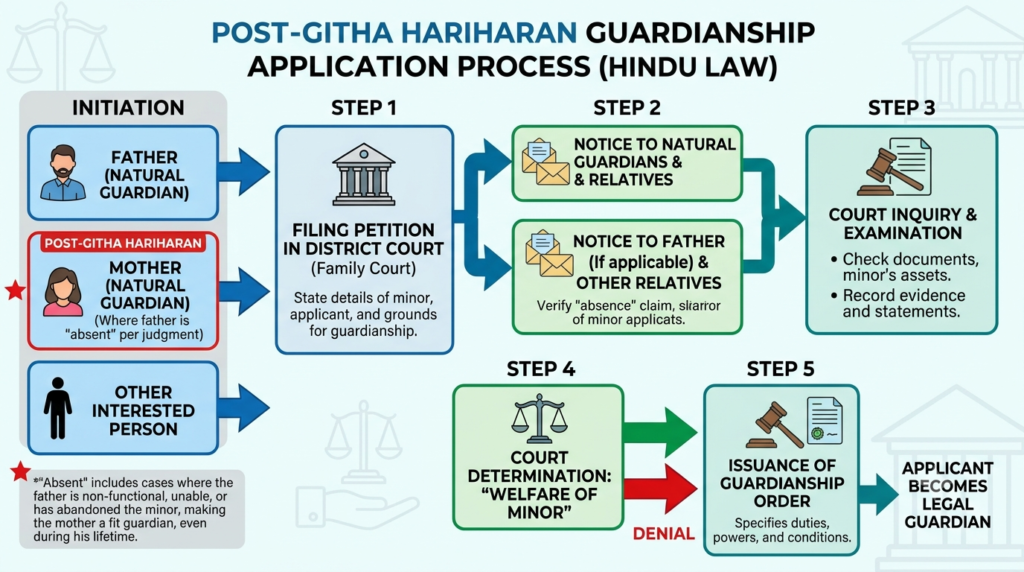
Ultimately, the judgment established that child welfare serves as the supreme consideration in all guardianship disputes. Personal laws must remain subordinate to fundamental human rights and constitutional gender justice.
Frequently Asked Questions
1. What was the central legal issue in Githa Hariharan v. Reserve Bank of India?
The primary issue was whether Section 6(a) of the Hindu Minority and Guardianship Act, 1956 violated Articles 14 and 15 by giving the father primary natural guardianship over the mother.
2. How did the Supreme Court interpret the word “after” in Section 6(a)?
The Supreme Court held that “after” does not mean after the father’s death, but rather “in the absence of” the father due to apathy, physical separation, or incapacity.
3. Can a Hindu mother act as a natural guardian during the father’s lifetime?
Yes. Under the Githa Hariharan ruling, a mother can act as a natural guardian whenever the father is absent, indifferent, or incapable of taking care of the child.
4. Which fundamental rights were protected by this judgment?
The Supreme Court protected the right to gender equality under Article 14, non-discrimination under Article 15, and the right to dignity under Article 21.