In 1967, the Supreme Court of India rendered a monumental judgment in I.C. Golaknath v. State of Punjab that permanently reshaped Indian constitutional law. This landmark ruling established that Parliament could not curtail fundamental rights through constitutional amendments.
Written by Kapil Balhara | Technically Reviewed for Accuracy | Last Updated: October 2026
Table of Contents
- What is I.C. Golaknath v. State of Punjab Case?
- Background and Key Legal Issues
- The Core Arguments and Constitutional Conflict
- The Landmark 6:5 Supreme Court Verdict
- Doctrine of Prospective Overruling Explained
- Impact and Subsequent Constitutional Evolution
- Frequently Asked Questions
What is I.C. Golaknath v. State of Punjab Case?
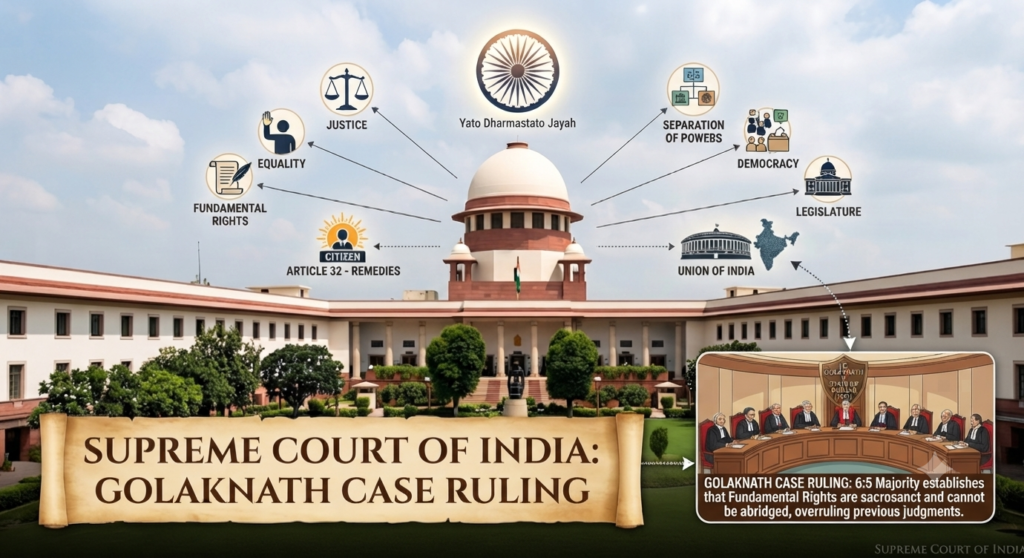
I.C. Golaknath v. State of Punjab (1967) is a landmark Supreme Court of India decision where an 11-judge bench ruled 6:5 that Parliament cannot abridge Fundamental Rights under Part III using Article 368. The Court declared that constitutional amendments qualify as “law” under Article 13(2).
Background and Key Legal Issues
The dispute originated when the Punjab government placed 418 acres of land owned by the family of Henry Golaknath under the Punjab Security of Land Tenures Act, 1953, declaring it surplus. The petitioners challenged this action under Article 32. They asserted that the state action infringed their fundamental rights to equality and property.
The state relied on the Constitution (Seventeenth Amendment) Act, 1964, which added the state law to the Ninth Schedule. Inclusion in the Ninth Schedule shielded statutes from judicial scrutiny. Consequently, the petitioners directly challenged the constitutional validity of the First, Fourth, and Seventeenth Amendments.
Our legal research team analyzed the core legal questions presented to the 11-judge bench:
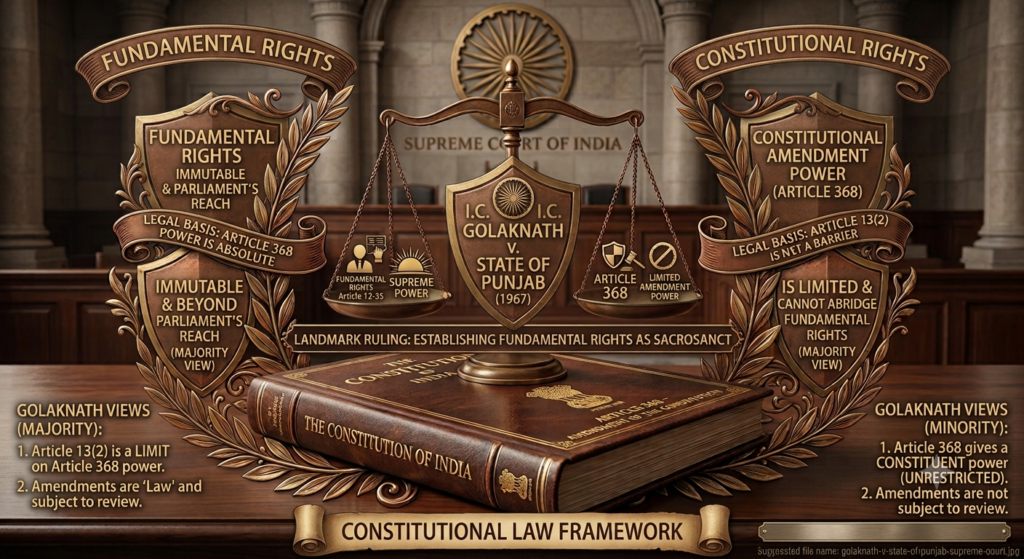
- Does Parliament possess absolute power under Article 368 to amend Fundamental Rights?
- Does a constitutional amendment constitute “law” within the meaning of Article 13(2)?
- Are Fundamental Rights immutable and beyond parliamentary reach?
The Core Arguments and Constitutional Conflict
The petitioners argued that Fundamental Rights represent natural rights reserved by the people. In contrast, the State argued that Article 368 contains an unrestricted sovereign power to amend any constitutional provision.
Furthermore, the Union government contended that social reform and agrarian restructuring required flexibility. However, counsel for the petitioners argued that allowing Parliament unchecked authority creates a pathway to authoritarianism.
| Parameter / Aspect | Petitioner’s Argument | Respondent’s (State) Argument |
|---|---|---|
| Source of Amending Power | Derived from residuary legislative powers (Article 248). | Explicitly contained within Article 368 itself. |
| Status of Article 13(2) | Applies to all laws, including constitutional amendments. | Applies only to ordinary legislative enactments. |
| Nature of Rights | Transcendent, sacrosanct, and unamendable. | Subject to state modification for public interest. |
Key Takeaway: The fundamental dispute pitted parliamentary sovereignty against the inviolable nature of individual freedoms guaranteed by Part III.
The Landmark 6:5 Supreme Court Verdict
Chief Justice K. Subba Rao delivered the majority decision for six judges. In our analysis of the judgment, the majority established several foundational rules:
- Constitutional Amendments are “Law”: An amendment passed under Article 368 is a legislative process and qualifies as “law” under Article 13(2).
- Primacy of Fundamental Rights: Parliament cannot enact amendments that abridge or take away Part III rights.
- Source of Power: The authority to amend the Constitution resides in residuary powers under Article 248 read with Entry 97 of List I, not Article 368.
Moreover, the five dissenting judges—led by Justice Wanchoo—argued that Article 368 conveys explicit power to amend every constitutional provision.
Doctrine of Prospective Overruling Explained
To prevent widespread legal turmoil, CJI Subba Rao introduced the American legal concept of Prospective Overruling to Indian jurisprudence.
[Past Enactments Invalidated?] ---> NO (Protected by Prospective Overruling)
[Current Amendments Valid?]   ---> YES (First, Fourth, Seventeenth remain effective)
[Future Power to Abridge?]    ---> NO (Parliament restrained moving forward)
- Preservation of Past Actions: Previous constitutional amendments (First, Fourth, and Seventeenth) remained valid.
- Future Restraint: Parliament was prohibited from taking away fundamental rights in any future amendment.
- Prevention of Chaos: The Court avoided invalidating prior land reform legislation that had already restructured property ownership across India.
Key Takeaway: Prospective Overruling allowed the Supreme Court to correct legal precedent without causing retrospective administrative chaos.
If you are evaluating complex constitutional matters, review the primary judgment text carefully.
Impact and Subsequent Constitutional Evolution
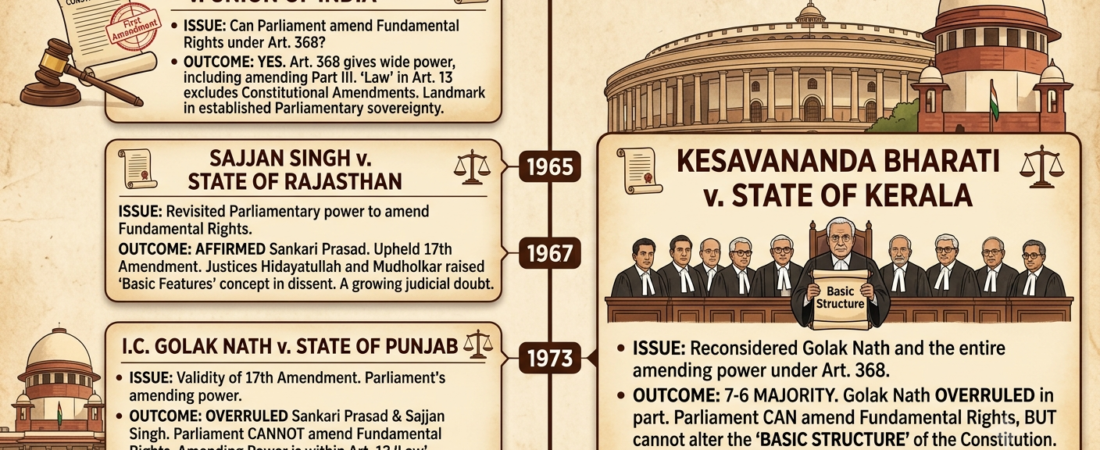
The decision in I.C. Golaknath created an immediate confrontation between the judiciary and Parliament. Consequently, Parliament enacted the 24th Constitutional Amendment Act in 1971 to neutralize the ruling.
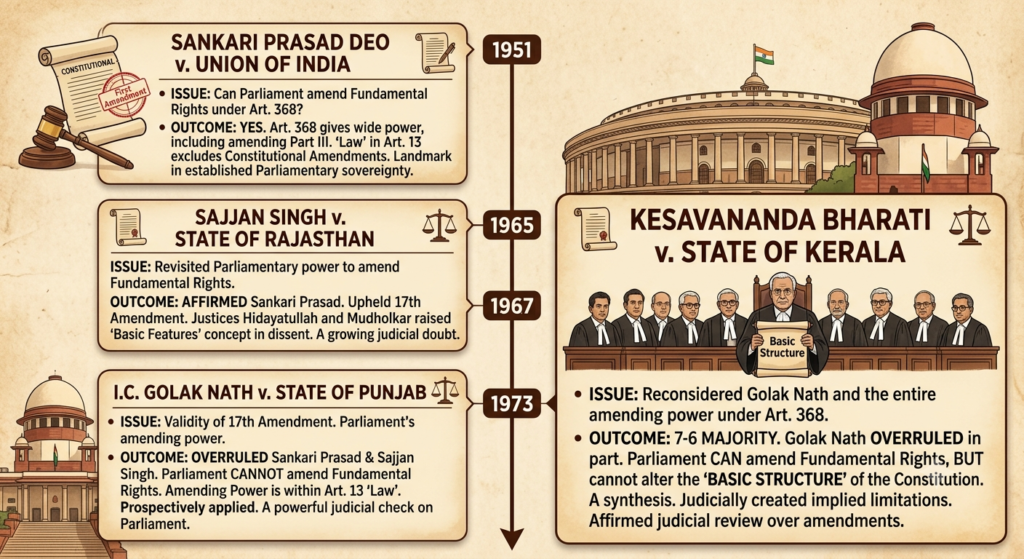
The evolutionary sequence unfolded as follows:
- Sankari Prasad (1951) & Sajjan Singh (1965): Upheld Parliament’s power to amend Part III.
- I.C. Golaknath (1967): Reversed prior rulings and barred Parliament from abridging Fundamental Rights.
- 24th Amendment (1971): Expressly stated that Article 13(2) does not apply to Article 368 amendments.
- Kesavananda Bharati (1973): Overruled Golaknath partially, establishing the Basic Structure Doctrine.
Ultimately, while the Kesavananda Bharati ruling restored Parliament’s power to amend Fundamental Rights, it imposed the constraint that no amendment may alter the basic structure of the Constitution.
Frequently Asked Questions
What was the main ratio decidendi of I.C. Golaknath v. State of Punjab?
The main ratio was that constitutional amendments under Article 368 constitute “law” under Article 13(2), and Parliament cannot amend the Constitution to abridge Fundamental Rights.
Which case overruled the Golaknath verdict?
The 13-judge bench in Kesavananda Bharati v. State of Kerala (1973) overruled the Golaknath verdict. It permitted the amendment of Fundamental Rights provided the basic structure remains intact.
What is the significance of Article 368 in this case?
The Court held that Article 368 merely outlines the procedural steps for an amendment, whereas the actual power to amend stems from residuary legislative powers under Article 248.
Did the Golaknath case strike down the 17th Amendment?
No, because the Supreme Court applied the doctrine of prospective overruling, the 17th Amendment remained valid for past actions, but Parliament was barred from enacting similar curtailments in the future.
Did this comprehensive legal breakdown help you understand the doctrine of prospective overruling and amendment limits? Connect with our team today for deeper legal research assistance!