Written by Kapil Balhara | Technically Reviewed for Accuracy | Last Updated: August 2026
Introduction
Depriving a citizen of personal liberty without a final conviction strikes at the core of human rights. Consequently, the power to grant or refuse bail remains a pivotal test of a civilized legal framework. When courts treat pre-trial detention as a routine exercise, constitutional guarantees risk becoming illusory. The landmark Supreme Court decision in Gudikanti Narasimhulu vs Public Prosecutor transformed Indian bail jurisprudence by subjecting judicial discretion to constitutional accountability.
This comprehensive analysis examines Justice V.R. Krishna Iyer’s seminal ruling. Furthermore, our review explores how Article 21 of the Constitution regulates judicial discretion, restricts arbitrary pre-trial detention, and balances personal liberty with public justice.
Table of Contents
- Understanding Gudikanti Narasimhulu vs Public Prosecutor case
- Factual Matrix of the Case
- Judicial Discretion and Article 21 Framework
- Core Guidelines for Bail Jurisprudence
- Comparison of Key Bail Precedents
- Key Takeaways for Legal Practitioners
- Frequently Asked Questions
Understanding Gudikanti Narasimhulu vs Public Prosecutor Case
Gudikanti Narasimhulu vs Public Prosecutor is a landmark 1977 Supreme Court judgment delivered by Justice V.R. Krishna Iyer. The ruling established that judicial discretion in granting bail is governed by Article 21. It affirmed that bail refusal must be non-punitive, reasonable, and primarily aimed at securing attendance.
Historically, courts often treated bail applications through impressionistic or uncanalized bench orders. Therefore, understanding this judgment enables legal researchers and practitioners to enforce structured constitutional standards during bail hearings.
Factual Matrix of the Case
The case involved petitioners who had been tried for grave offences under Sections 148, 302, and 302 read with Section 149 of the Indian Penal Code. Initially, the trial court acquitted the accused. However, the State appealed, and the Andhra Pradesh High Court reversed the acquittal, convicting the petitioners.
Pursuant to Order XXI of the Supreme Court Rules 1966, the petitioners surrendered to curial custody before preferring their statutory appeal under Section 2(c) of the Supreme Court (Enlargement of Criminal Appellate Jurisdiction) Act, 1970, read with Section 379 of the CrPC.
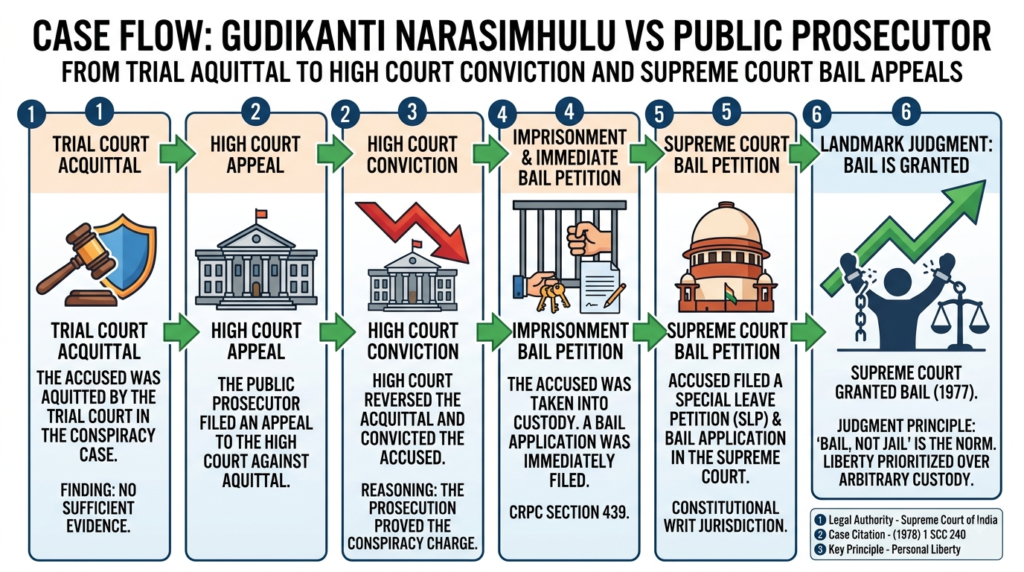
Significantly, the petitioners had remained on bail during both the trial and appellate stages. Additionally, the State had temporarily released them on parole following their surrender, during which no misconduct was reported. Four co-accused had already been enlarged on bail by the Supreme Court.
The petitioners subsequently moved a bail application (Criminal Misc. Petition No. 1443 of 1977) before the Supreme Court pending their final appeal. By that point, they had served nearly a year in prison, while the final disposal of the appeal was anticipated to take several years.
Addressing the petition as a Chamber Judge, Justice V.R. Krishna Iyer allowed the bail plea, imposing reasonable protective conditions.
Key Takeaway: An intermediate acquittal by a trial court significantly weakens the grounds for denying provisional release during a pending appeal, as the accused has already enjoyed the confidence of a judicial acquittal once.
Judicial Discretion and Article 21 Framework
In evaluating the petition, Justice Krishna Iyer addressed the fundamental question: “Bail or jail?” He noted that the Code of Criminal Procedure remained cryptic on the exact parameters, often leaving decisions to the uncanalized “hunch of the bench”.
1. The Nature of Judicial Discretion
Relying on classical juristic thoughts from Benjamin Cardozo, Lord Mansfield, and Lord Camden, the Court held that judicial discretion is not arbitrary caprice. Discretion must be guided by established legal principles, Tradition, and system. It represents an appeal to judicial conscience, executed in accordance with law rather than personal humor.
2. The Article 21 Constitutional Mandate
The Court underscored that personal liberty is a fundamental right under Article 21. It can suffer eclipse only through a “procedure established by law”. The Court ruled that any deprivation of freedom—whether brief or enduring—must meet the test of reasonableness under Article 19 and Article 21.
In our analysis, the judgment firmly rejected the practice of using pre-trial detention as a punitive measure. Depriving liberty is reasonable only when necessary for the bifocal interests of justice: protecting society and ensuring the accused faces judgment.
Core Guidelines for Bail Jurisprudence
Justice Krishna Iyer laid down specific, structured criteria to guide courts in deciding bail matters:
Primary Objective: Securing Attendance
The paramount consideration in bail applications is ensuring the applicant appears to receive judgment and serve the sentence if convicted. All secondary factors must relate back to this primary rule.
Key Factors Identified by the Court
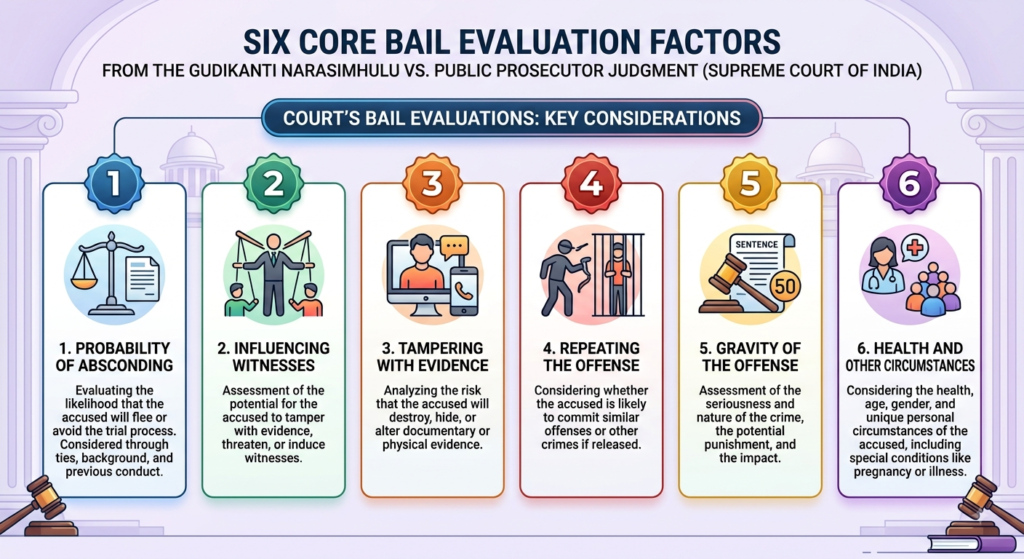
- Gravity of Offence and Severity of Punishment: When the crime carries extreme penalties, courts may presume a heightened risk of flight.
- Nature of Supporting Evidence: Strong evidence supporting grave charges increases the likelihood of absconsion.
- Course of Justice and Witness Tampering: Courts must evaluate whether the applicant is likely to pollute justice, intimidate witnesses, or commit further crimes.
- Impact of Prior Acquittal: A prior finding of innocence by a trial court lowers the presumption of flight risk during appeal.
- Period Spent in Custody and Trial Delays: Protracted incarceration coupled with docket congestion weighs heavily in favor of granting provisional release.
- Deplorable Sub-Jail Conditions: Public expense and the harsh, unrewarding environment of sub-jails render avoidable incarceration unreasonable.
Key Takeaway: Refusal of bail should never be stampeded by police exaggerations. Courts must soberly size up predictions of criminal prospects against tangible evidence.
Comparison of Key Bail Precedents
The following comparison illustrates how Gudikanti Narasimhulu synthesized domestic and international legal principles to structure judicial discretion:
| Authority / Precedent | Core Legal Focus | Application in Gudikanti Case |
|---|---|---|
| Lord Russel C.J. (R. v. Rose, 1898) | Bail is not to be withheld as a punishment. | Adopted to affirm that detention serves only to secure attendance, not to punish. |
| Archbold Criminal Practice Test | Evaluates charge, evidence, severity, and independent sureties. | Refined by adding Article 21 constitutional reasonableness tests. |
| Cardozo Judicial Discretion Doctrine | Discretion must be methodized, disciplined, and subordinated to social order. | Used to restrict arbitrary bench hunches in bail matters. |
| Vera Foundation (Manhattan Project) | Emphasizes community roots over heavy monetary suretyship. | Cited to discourage excessive financial bail demands on poor applicants. |
Key Takeaways for Legal Practitioners
When drafting or arguing bail petitions before appellate courts, legal associates should implement the following steps:
- Establish Attendance Reliability: Highlight deep community roots, local employment, or past compliance with bail conditions.
- Demonstrate Absence of Misconduct: Present documented proof of good conduct during previous bail or parole periods.
- Quantify Custody vs Appeal Delays: Highlight total duration in detention alongside the estimated timeline for appeal disposal.
- Propose Restorative Bail Conditions: Offer workable, non-oppressive conditions (such as periodic police check-ins) to satisfy societal safety concerns.
In applying these principles to Gudikanti Narasimhulu, the Supreme Court granted bail. The Court required personal bonds and directed the petitioners to visit their village only once a week after reporting to the local police station. It also suggested voluntary participation in therapeutic or meditation centers for psychic reformation.
Link to Download Gudikanti Narasimhulu vs Public Prosecutor Judgement
Frequently Asked Questions
Q1. What is the central legal holding of Gudikanti Narasimhulu vs Public Prosecutor?
The Supreme Court held that judicial discretion in bail matters must be guided by sound legal principles and Article 21. Bail is primarily meant to secure the presence of the accused at trial, not to inflict pre-trial punishment.
Q2. How did Justice Krishna Iyer define “Judicial Discretion” in this case?
Justice Krishna Iyer emphasized that discretion is not arbitrary humor or caprice. Guided by Cardozo’s principles, he ruled that judicial discretion must be informed by tradition, disciplined by system, and subordinated to social order.
Q3. Does an intermediate acquittal affect a bail plea during an appeal?
Yes. The Court ruled that when a trial court records a finding of innocence, the panic that might prompt an accused to flee decreases, making the grounds for denying bail weaker during an appeal.
Q4. Why is setting excessive monetary bail improper according to the Court?
The Supreme Court observed that imposing heavy bail on poor individuals is fundamentally wrong. Poverty is a social malady requiring judicial sympathy rather than sternness, and community ties should carry greater weight than financial suretyship.
Conclusion
The judgment in Gudikanti Narasimhulu vs Public Prosecutor remains a cornerstone of Indian bail jurisprudence. By anchoring judicial discretion within the constitutional guarantees of Article 21, the Supreme Court ensured that personal freedom remains the rule and pre-trial detention the exception.
If you require expert assistance with appellate bail petitions, constitutional writs, or criminal litigation, contact Placitum Advocates to consult our legal team.