Table of Contents
- What is Gurbaksh Singh Sibbia vs State of Punjab?
- Factual Background and Procedural History
- Key Legal Issues Before the Supreme Court
- High Court’s Restrictive View vs. Supreme Court’s Verdict
- Core Principles Governing Section 438 CrPC
- Frequently Asked Questions
The legal landscape surrounding Gurbaksh Singh Sibbia vs State of Punjab represents a monumental shift in Indian criminal jurisprudence. Personal liberty often hangs in the balance during intense political rivalries or criminal investigations. Understanding this ruling helps legal researchers, lawyers, and legal associates navigate the complexities of pre-arrest bail.
Written by Kapil Balhara / Placitum Advocates | Technically Reviewed for Accuracy | Last Updated: August 2026
What is Gurbaksh Singh Sibbia vs State of Punjab?
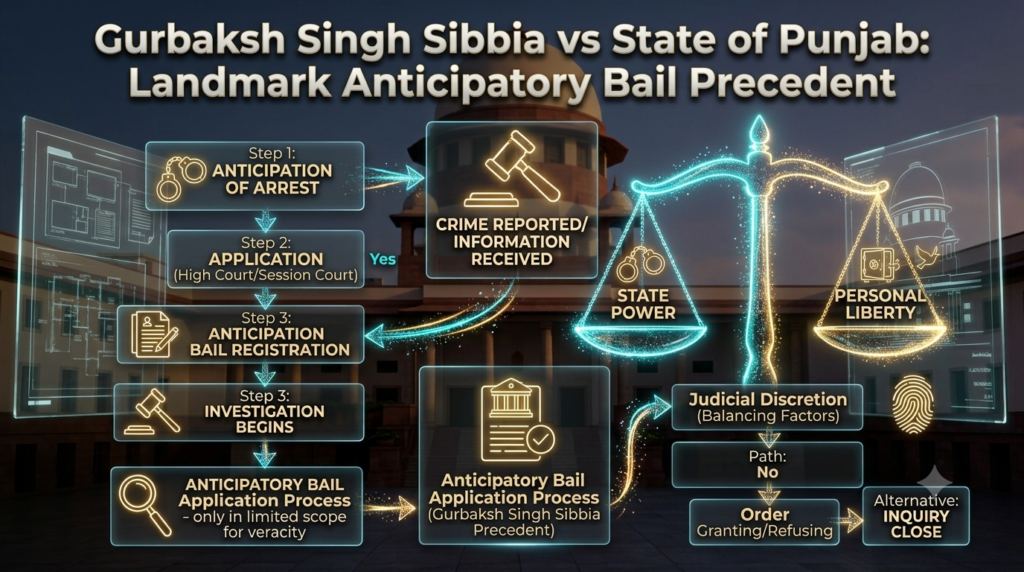
The landmark ruling in Gurbaksh Singh Sibbia vs State of Punjab is a Constitution Bench decision of the Supreme Court of India that defined the scope of anticipatory bail under Section 438 CrPC. The Court established that judicial discretion must remain unfettered by rigid, self-imposed judicial limitations.
Key Takeaway: The Constitution Bench in Gurbaksh Singh Sibbia affirmed that anticipatory bail protects personal liberty under Article 21, ensuring courts retain broad judicial discretion without imposing cast-iron restrictions.
Factual Background and Procedural History
The petitioner, Gurbaksh Singh Sibbia, served as a Minister in the Government of Punjab. Serious political corruption allegations were raised against him. Fearing arrest, he moved the High Court under for pre-arrest relief.
The High Court of Punjab and Haryana referred the matter to a Full Bench. However, the Full Bench dismissed the petitions. It formulated a restrictive eight-point code limiting the grant of bail.
Consequently, the appellants approached the Supreme Court via special leave. The Chief Justice Y.V. Chandrachud headed a five-judge Constitution Bench to examine the issue.
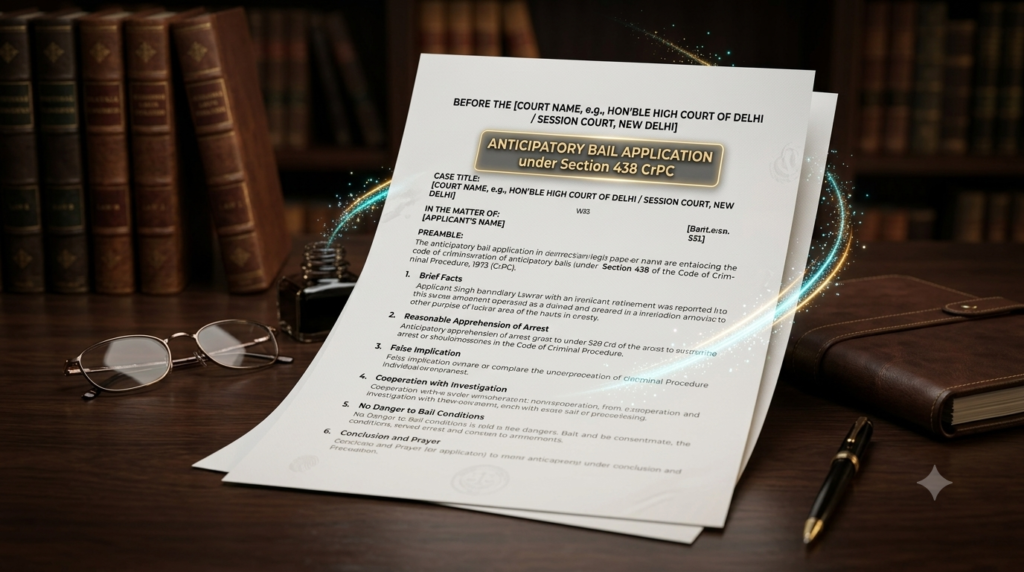
The Historical Need for Section 438
Under the Code of Criminal Procedure 1898, no explicit statutory provision existed for pre-arrest relief. High Courts differed on whether inherent powers allowed such protection. The Law Commission of India recognized this gap in its 41st Report.
Specifically, the Law Commission noted that influential adversaries often misuse police machinery. False allegations stem from political antagonism to humiliate rivals. Therefore, Parliament enacted Section 438 in the 1973 Code to safeguard personal liberty.
Key Legal Issues Before the Supreme Court
The Supreme Court faced the delicate task of balancing competing societal interests. On one hand stood individual freedom protected by Article 21. On the other lay the legitimate investigational powers of the police.
The court needed to answer several key questions:
- Should conditions under Section 437 be automatically read into Section 438?
- Must an applicant show a “special case” or prove mala fide intent to obtain relief?
- Can courts issue a blanket bail order covering all future crimes?
Key Takeaway: The apex court emphasized that discretion entrusted by Parliament to superior courts must not be stultified through judicially created limitations.
High Court’s Restrictive View vs. Supreme Court’s Verdict
The High Court attempted to lay down rigid principles for governing pre-arrest bail. However, the Supreme Court rejected this restrictive approach.
| High Court’s Eight-Point Code | Supreme Court’s Clarification |
|---|---|
| Power must be exercised sparingly in exceptional cases. | Discretion must remain broad; “exceptional cases” test is invalid. |
| Section 437 restrictions are implicit in Section 438. | Section 438 is distinct and contains no statutory restrictions. |
| Applicant must establish a “special case”. | Requiring a “special case” reduces the provision to a dead letter. |
| No pre-arrest bail for life-imprisonment offences unless false. | Bail can be granted even in serious cases if facts warrant it. |
| Blanket bail can be issued for any future accusation. | Blanket bail orders should not be passed. |
Furthermore, the Supreme Court highlighted the distinction between post-arrest and pre-arrest procedures. In our analysis of criminal jurisprudence, pre-arrest relief operates as insurance against police custody.
When we evaluated the judgment, the Supreme Court clearly stated that filing an FIR is not a mandatory prerequisite for seeking relief. A reasonable apprehension of arrest suffices.
Core Principles Governing Section 438 CrPC
The landmark judgment laid down practical guidelines to govern judicial discretion. These guidelines ensure a fair balance between personal freedom and effective investigation.
Essential Conditions for Granting Relief
To secure protection under Section 438, specific criteria must be fulfilled:
- Reasonable Belief: The applicant must show tangible facts causing a genuine apprehension of arrest for a non-bailable offence.
- No Blanket Orders: The order must specify the particular offences or accusations.
- Specific Conditions: Courts may require the applicant to join interrogation, avoid tampering with evidence, or remain in India.
Key Takeaway: Pre-arrest protection is a device to secure individual liberty; it is neither a passport to crime nor a shield against legitimate investigation.
Procedural Step-by-Step Flow for Applicants
- Identify specific facts giving rise to a reasonable belief of impending arrest.
- File an application under Section 438 before the Sessions Court or High Court.
- Seek interim protection while notice issues to the Public Prosecutor.
- Comply with all conditions imposed under Section 438(2), including police interrogation.
If you need professional assistance regarding bail applications, Placitum Advocates can assist your legal team.
Link to Download Gurbaksh Singh Sibbia vs Govt of Punjab Judgement
Frequently Asked Questions
Is filing an FIR mandatory before applying for anticipatory bail?
No, filing an FIR is not a condition precedent under Section 438 CrPC. The applicant only needs to establish a reasonable belief of an impending arrest based on tangible facts.
Can a court grant a blanket bail order under Section 438?
No, the Supreme Court explicitly barred blanket orders. The order must identify specific offences so it does not impede lawful police investigations.
Does anticipatory bail prevent police from investigating?
No, pre-arrest bail does not hamper police investigation rights. Courts routinely impose conditions requiring the applicant to co-operate with investigating officers as needed.