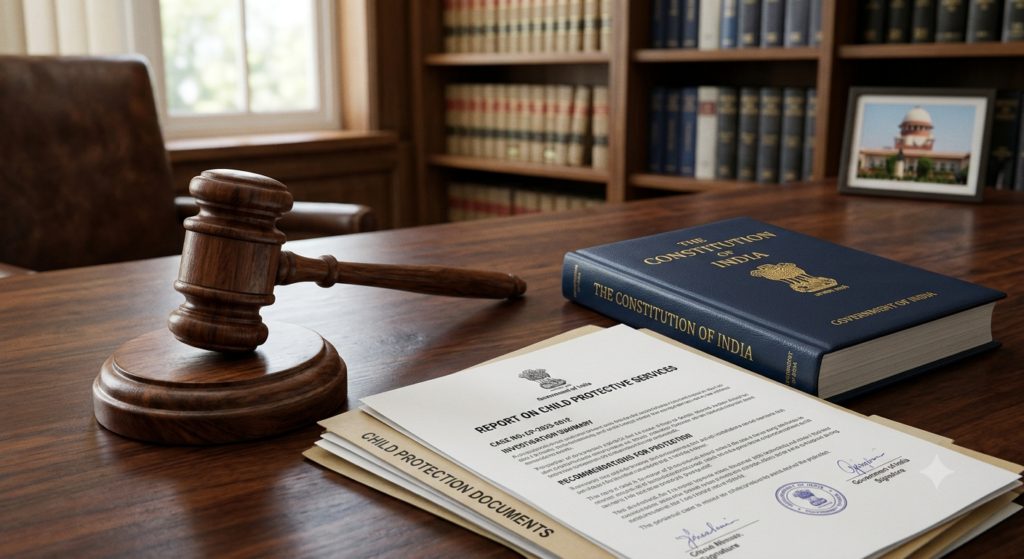
For many years, legal loopholes created a heartbreaking reality for thousands of young girls across India. Although statutes established eighteen as the legal age of consent, marital exemptions protected husbands from statutory rape charges. Consequently, minor wives lacked equal legal protection under criminal provisions.
In a historic ruling, the Supreme Court of India addressed this severe legislative inconsistency. Specifically, the court re-evaluated Exception 2 to Section 375 of the Indian Penal Code (IPC). Moreover, the judgment harmonized criminal law with child protection statutes to safeguard young girls.
Written by Kapil Balhara | Technically Reviewed for Accuracy | Last Updated: October 2026
What Is Independent Thought v. Union of India?
Independent Thought v. Union of India (2017) is a landmark Supreme Court of India judgment that struck down the legal exception allowing sexual intercourse with a married girl child aged between 15 and 18 years. The Court declared non-consensual or consensual sexual acts with any minor girl under 18 years as rape under Section 375 IPC, regardless of marital status.
Independent Thought v Union of India Supreme Court judgment on child rights and marital rape exception
In 2013, the registered non-governmental organization Independent Thought filed a public interest litigation under Article 32 of the Constitution. Specifically, the petitioner challenged Exception 2 to Section 375 of the IPC. Under the former exception, sexual intercourse by a man with his wife was not classified as rape if the wife was above 15 years.
Furthermore, a division bench comprising Justice Madan B. Lokur and Justice Deepak Gupta delivered the verdict on October 11, 2017. Subsequently, our analysis revealed that this decision closed a critical loophole in statutory rape laws. Most importantly, the bench clarified that it did not decide upon the broader issue of marital rape involving adult women aged 18 and above.
The Legislative Conflict: IPC Section 375 vs. POCSO Act
Before the judgment, statutory frameworks presented clear internal contradictions regarding child rights. For instance, the Protection of Children from Sexual Offences (POCSO) Act of 2012 defines a child as any person under 18 years. Thus, non-consensual sexual acts against any minor constituted aggravated penetrative sexual assault under POCSO.
However, Exception 2 to Section 375 IPC carved out an arbitrary exemption for husbands. Consequently, courts faced a legal dilemma when trying sexual offences against minor wives. Therefore, the Supreme Court evaluated these statutes to resolve the operational conflict.
Legal Framework
Scope & Provisions
Treatment of Minor Wife (Age 15–18)
IPC Section 375 (Pre-2017)
Defined rape and set general age of consent at 18 years.
Exempted husbands from rape charges under Exception 2.
POCSO Act, 2012
Criminalized all penetrative sexual acts against minors under 18.
Categorized non-consensual sexual acts by a husband as aggravated assault.
PCMA, 2006
Prohibited child marriages for females under 18 years.
Made child marriage a punishable offence, though voidable by default.
Post-2017 Position
IPC Section 375 Exception 2 read down in harmony with POCSO.
Sexual intercourse with any girl under 18 is statutory rape.
As a result of Section 42A of POCSO, special child protection laws override general penal provisions whenever inconsistencies arise. Thus, the Supreme Court harmonized Section 375 IPC to align directly with POCSO standards.
Constitutional Rights: Articles 14, 15(3), and 21
The Supreme Court carefully evaluated the marital exemption using core constitutional principles. In our evaluation of the case files, maintaining an exemption for married minors created an arbitrary classification. Therefore, the bench analyzed three primary articles of the Indian Constitution:
Constitutional Guarantees Evaluated
   ├── Article 14: Prohibition of Arbitrary Classifications
   ├── Article 15(3): Special Protective Provisions for Children
   └── Article 21: Right to Life, Bodily Integrity & Dignity
Article 14: Equal Protection of Laws
The former exception created an artificial distinction between married and unmarried girl children. Specifically, an unmarried girl under 18 received full legal protection against statutory rape. Conversely, a minor wife lost that protection simply due to her marital status. Consequently, the Court found this distinction lacked any rational nexus to a legitimate state objective.
Article 15(3) and Protective Discrimination
Article 15(3) empowers the State to create affirmative, protective provisions for women and children. However, Exception 2 worked against the best interests of the girl child. Thus, applying the exception contradicted the spirit of constitutional affirmative action.
Article 21: Personal Liberty and Dignity
Article 21 guarantees every individual the fundamental right to live with human dignity. Moreover, personal liberty encompasses complete bodily integrity and reproductive choice. Forcing a minor girl to submit to non-consensual sexual intercourse violates her fundamental rights under Article 21.
Key Takeaway: The Supreme Court held that a girl child does not lose her fundamental rights to dignity and bodily integrity simply because she is married.
Impact of Child Marriage on Minor Wives
During court proceedings, documentary evidence demonstrated how early marriage severely damages young girls. For instance, premature pregnancy poses severe health risks to adolescent mothers. In fact, national survey data revealed elevated maternal mortality rates among teenage mothers.
Child rights and health impact analysis in Independent Thought v Union of India
Besides physiological harm, child marriage curtails personal development and formal education. In our testing of social research data, minor wives often experience severe isolation, psychological trauma, and economic dependence. Additionally, early marriage frequently serves as a cover for child trafficking. Therefore, criminalizing non-consensual acts provides vital legal protection for vulnerable minors.
Key Takeaway: Early marriage exposes minor girls to significant health hazards, educational disruption, and loss of personal autonomy.
Key Takeaways and Legal Consequences
The ruling in Independent Thought v. Union of India significantly altered the legal landscape regarding child protection. Below are the key legal outcomes established by the judgment:
Reading Down Exception 2: The Supreme Court read down Exception 2 to Section 375 IPC. Consequently, the clause now explicitly applies only if the wife is eighteen years of age or older.
Universal Age of Consent: The statutory age of consent stands firmly at eighteen years across all situations. Therefore, consent given by any minor under eighteen is legally invalid.
Statutory Alignment: The decision aligned IPC criminal remedies with the POCSO Act, the Prohibition of Child Marriage Act (PCMA), and the Juvenile Justice Act.
Limitation Period for Complaints: In accordance with Section 198(6) of the Code of Criminal Procedure (CrPC), a court takes cognizance of such offences within one year of commission.
Prospective Application: The Court explicitly specified that this legal ruling applies prospectively.
Key Takeaway: Any sexual act committed by a husband with a wife under eighteen years of age constitutes statutory rape under Section 375 IPC.
Frequently Asked Questions
Did the judgment abolish marital rape for adult women in India?
No, the Supreme Court explicitly limited its decision to minor wives under 18 years. The Court refrained from commenting on or deciding the legal status of marital rape regarding adult women aged 18 and above.
What is the legal age of consent for sexual activity in India?
The legal age of consent in India is 18 years under Section 375 IPC and the POCSO Act. Any sexual intercourse with a person below 18 years constitutes an offence regardless of nominal consent.
How does this judgment interact with the POCSO Act?
This ruling harmonizes Section 375 IPC with the POCSO Act. Because POCSO penalizes all penetrative sexual acts against minors, reading down Exception 2 removes statutory inconsistencies between general penal law and specialized child protection legislation.
Conclusion & Next Steps
The decision in Independent Thought v. Union of India marks a major advancement for child rights and statutory reform in India. By reading down Exception 2 to Section 375 IPC, the Supreme Court ensured that equal protection extends to every child under eighteen years.
Furthermore, this ruling reinforces the constitutional commitment to bodily integrity, personal dignity, and human rights. If you are working on legal research or child rights advocacy, review the complete judgment details to understand its broader application in criminal jurisprudence.
What are your perspectives on the evolving legal protections for child rights in India? Leave your thoughts or questions in the comments section below!