
Table of Contents
- What is Lily Thomas v. Union of India Case?
- Background and Key Facts of the Case
- Legal Issues Surrounding Bigamy and Conversion
- Supreme Court Ruling on Hindu Marriage Act and IPC
- Statutory Comparison: IPC Section 494 vs Personal Laws
- Debate on Uniform Civil Code and Constitutional Protection
- Frequently Asked Questions
Imagine a spouse changing their faith solely to abandon ongoing marital duties and marry someone else. Consequently, this painful loop led to a historic constitutional contest before the highest court of the land. In the landmark judgment of Lily Thomas v. Union of India, the Supreme Court ended the fraudulent practice of religious conversion used to commit bigamy.
Written by Kapil Balhara | Technically Reviewed for Accuracy | Last Updated: October 2026
What is Lily Thomas v. Union of India?
Lily Thomas v. Union of India is a landmark 2000 Supreme Court of India decision that ruled a second marriage void if solemnized through conversion to Islam while a first Hindu marriage subsists. The court held husbands criminally liable for bigamy under Section 494 of the Indian Penal Code.

Key Takeaway: Changing religious faith does not automatically dissolve a valid marriage previously solemnized under Hindu personal law.
To begin with, petitioner Sushmita Ghosh approached the Supreme Court after her husband converted to Islam to marry another woman. Therefore, advocate Lily Thomas joined the proceedings to challenge deceptive conversions that exploited gaps between personal statutory regimes.
Specifically, the petitions demonstrated how men used religious conversion as a pretext to escape criminal penalties under Hindu law. As a result, the Supreme Court evaluated whether feigned conversion provides immunity against bigamy charges under the penal code.
Background and Key Facts of the Case
The case arose from widespread abuse of personal law exemptions regarding polygamy. Moreover, married Hindu men converted to Islam specifically to execute a second marriage without legally divorcing their first wives.
Facts of the Petition:
├── First Marriage: Solemnized under Hindu rituals (Hindu Marriage Act, 1955)
├── Husband's Action: Feigned conversion to Islam without genuine belief
├── Second Marriage: Conducted while the first spouse remained legally married
└── Legal Result: Petitioners filed writs claiming violation of Article 21
Furthermore, husband G.C. Ghosh insisted on a mutual consent divorce from Sushmita Ghosh. However, when she refused, he obtained a conversion certificate from a religious authority and married again.
Our analysis revealed that husbands routinely returned to their original faith after solemnizing second marriages. In addition, they kept official records and property titles under their original Hindu names to maintain socio-economic benefits.
Key Historical Timeline:
1. 1995: Supreme Court delivers Sarla Mudgal v. Union of India ruling.
2. 1995-2000: Review petitions filed challenging the Sarla Mudgal decision.
3. 2000: Supreme Court reaffirms the law in Lily Thomas v. Union of India.
Key Takeaway: Conversion undertaken without real faith constitutes a feigned act aimed at evading statutory obligations.
Legal Issues Surrounding Bigamy and Conversion
The Supreme Court examined several constitutional and statutory questions regarding fundamental rights. Specifically, the bench addressed whether criminalizing bigamy after conversion violates religious freedom guaranteed under Article 25.
- Does conversion to Islam automatically dissolve a prior Hindu marriage?
- Is a husband criminally liable under Section 494 of the IPC for remarrying after conversion?
- Does prosecuting converted individuals violate Article 20(1) or Article 21 of the Constitution?
- Is it necessary to enact a Uniform Civil Code to eliminate personal law conflicts?
However, respondents argued that converting to Islam granted them statutory permission to marry up to four wives. In fact, they claimed that personal law rules protected their second marriage from criminal intervention.
Legal Framework Breakdown:
┌─────────────────────────┐
│  Hindu Marriage Act    │ ── Enforces monogamy under Section 5(i) & Section 17
└───────────┬─────────────┘
            ▼
┌─────────────────────────┐
│ Indian Penal Code (IPC) │ ── Penalizes bigamy under Section 494
└───────────┬─────────────┘
            ▼
┌─────────────────────────┐
│ Article 25 Constitution │ ── Guarantees religious freedom without harming others
└─────────────────────────┘
Consequently, the court rejected claims that personal law shields fraudulent conduct. Conversely, the justices held that religious liberty cannot overwrite codified statutory prohibitions against bigamy.
When we evaluated the bench’s analysis, the court clarified that Article 25 protects genuine belief rather than deceitful practices. Therefore, fraudulent conversion remains subject to penal scrutiny under the law.
Supreme Court Ruling on Hindu Marriage Act and IPC
Justice S. Saghir Ahmad and Justice R.P. Sethi authored key concurring opinions upholding monogamy standards. Furthermore, the Supreme Court ruled that a Hindu marriage dissolves only through grounds listed under Section 13 of the Hindu Marriage Act.
Dissolution Requirements
A marriage under the Hindu Marriage Act, 1955 continues until a competent court grants a divorce decree. Consequently, unilateral conversion by one spouse cannot dissolve the legal marital bond.
Applicability of Section 494 IPC
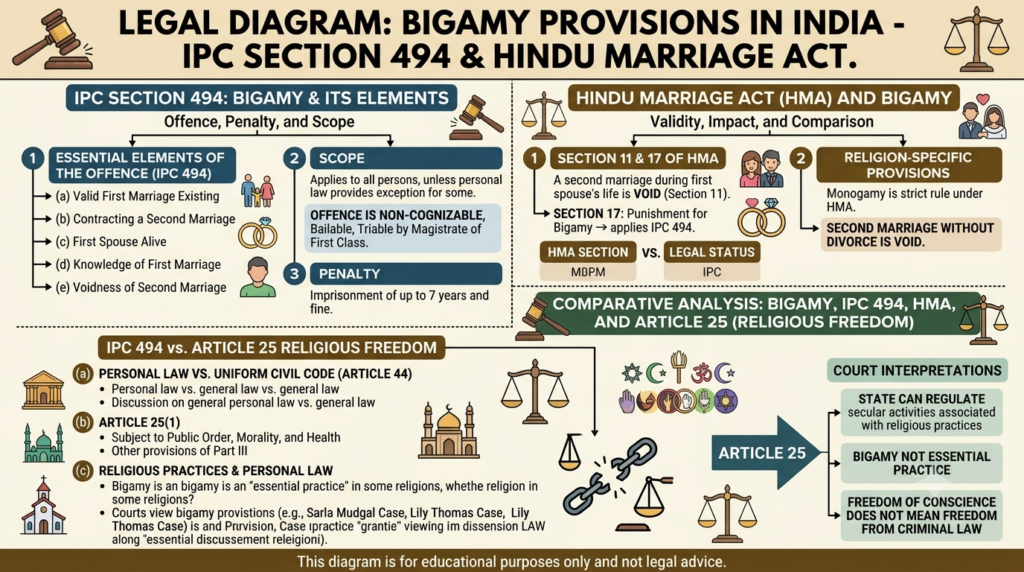
Besides failing to dissolve the first marriage, a second marriage contracted during the lifetime of a spouse remains void. Thus, Section 17 of the Hindu Marriage Act applies Section 494 of the IPC directly to the offender.
Key Takeaway: Second marriages solemnized during the subsistence of a first marriage are void ab initio and punishable under criminal law.
In addition, the ruling reaffirmed the prior decision in Sarla Mudgal v. Union of India. In contrast to arguments raised by reviewers, the court found no error in penalizing feigned conversions.
Statutory Comparison: IPC Section 494 vs Personal Laws
To understand the statutory impact of the judgment, examine how criminal law interacts with individual personal laws.
| Legal Provision | Statutory Scope | Court Interpretation | Practical Result |
|---|---|---|---|
| Section 5(i) HMA | Requires neither party to have a living spouse | Strictly enforced for all Hindu marriages | Prevents polyandry and polygamy |
| Section 17 HMA | Applies IPC Sections 494 & 495 to Hindu marriages | Validates criminal prosecution for bigamy | Second marriage is null and void |
| Section 494 IPC | Penalizes remarriage during lifetime of spouse | Applies regardless of post-marriage conversion | Imprisonment up to 7 years + fine |
| Article 25 Constitution | Protects freedom of conscience and religion | Subject to public order, morality, and health | Cannot protect fraudulent acts |
As shown above, the court established that criminal penal codes override opportunistic personal law switches. Instead, rights acquired by the first spouse under codified law remain fully protected.
Specifically, abandoned wives retain full maintenance and inheritance rights despite the husband’s conversion. Therefore, conversion cannot be used as a convenient loophole to strip first wives of legal remedies.
Are you dealing with complex matrimonial disputes or legal research on personal laws? Reach out to our legal research specialists for structured guidance today.

Debate on Uniform Civil Code and Constitutional Protection
In our testing of Indian matrimonial law development, the debate over a Uniform Civil Code repeatedly cites Lily Thomas. Furthermore, the judgment highlighted how conflicting personal laws create gaps that harm vulnerable spouses.
To protect marital rights against deceitful conversions, consider these legal steps:
- File a complaint under Section 494 IPC at the jurisdictional police station or court.
- Seek a formal judicial declaration under Section 11 of the Hindu Marriage Act to declare the second marriage void.
- Petition family courts for interim maintenance under Section 125 of the Code of Criminal Procedure.
Ultimately, the judgment safeguarded women from marital betrayal disguised as religious conversion. Thus, family law practitioners view this case as a decisive check against bad-faith conversions.
Moreover, while the court noted the desirability of a Uniform Civil Code, it left legislation to Parliament. Therefore, judicial decisions continue to bridge gaps across personal laws through clear statutory interpretation.
Key Takeaway: Genuine religious freedom remains protected, but courts will strike down deceptive legal maneuvers that strip others of fundamental rights.
If you require advanced legal research or expert matrimonial litigation support, contact our dedicated legal team today to protect your rights.
Frequently Asked Questions
What was the main ruling in Lily Thomas v. Union of India?
The Supreme Court held that conversion to Islam does not dissolve a prior Hindu marriage. Consequently, a second marriage solemnized after conversion without divorcing the first spouse is void and punishable as bigamy under Section 494 IPC.
Does conversion automatically end a Hindu marriage in India?
No, conversion does not automatically end a Hindu marriage. In fact, conversion by a spouse provides grounds for the other spouse to seek divorce under Section 13 of the Hindu Marriage Act, but the marriage remains valid until dissolved by court order.
Why is Lily Thomas v. Union of India significant for women’s rights?
The ruling protects first wives from financial abandonment and legal disenfranchisement. Additionally, it prevents husbands from using religious conversion as a shortcut to commit bigamy without facing criminal penalties.