
Table of Contents
- Introduction to the Landmark Ruling
- Background and Key Facts of the Case
- The Golden Triangle and Constitutional Intersection
- Due Process of Law vs Procedure Established by Law
- Principles of Natural Justice and Administrative Action
- Comparative Analysis of Key Issues
- Frequently Asked Questions
Introduction to the Landmark Ruling
Written by Kapil Balhara | Technically Reviewed for Accuracy | Last Updated: October 2026
The case of Maneka Gandhi v. Union of India stands as a pivotal milestone in Indian constitutional jurisprudence. It fundamentally reshaped how courts interpret fundamental rights, executive power, and personal liberty.
In this landmark 1978 decision, the Supreme Court of India expanded the horizon of individual freedoms under Article 21. Furthermore, it established that state actions impinging on personal liberty must be just, fair, and reasonable rather than arbitrary.
Key Takeaway: Maneka Gandhi v. Union of India transformed Article 21 from a passive protection against executive overreach into a vibrant guarantee of substantive due process and procedural fairness.
Background and Key Facts of the Case
To understand this landmark ruling, one must examine the event that triggered the legal battle. In June 1976, the petitioner received an official passport issued under the Passports Act of 1967.
However, in July 1977, the Regional Passport Office in New Delhi ordered the immediate impounding of her passport under Section 10(3)(c) of the Act, citing the “interests of the general public.”
Maneka Gandhi v. Union of India (1978) is a landmark Supreme Court case that ruled the right to travel abroad is part of personal liberty under Article 21. The Court held that statutory procedures restricting liberty must be fair, just, and reasonable, incorporating natural justice into administrative actions.
When the petitioner requested a formal statement of reasons for this administrative action, the authorities refused to comply. Consequently, she filed a writ petition under Article 32 of the Constitution, challenging the validity of the impounding order and the statutory provision itself.

The Golden Triangle and Constitutional Intersection
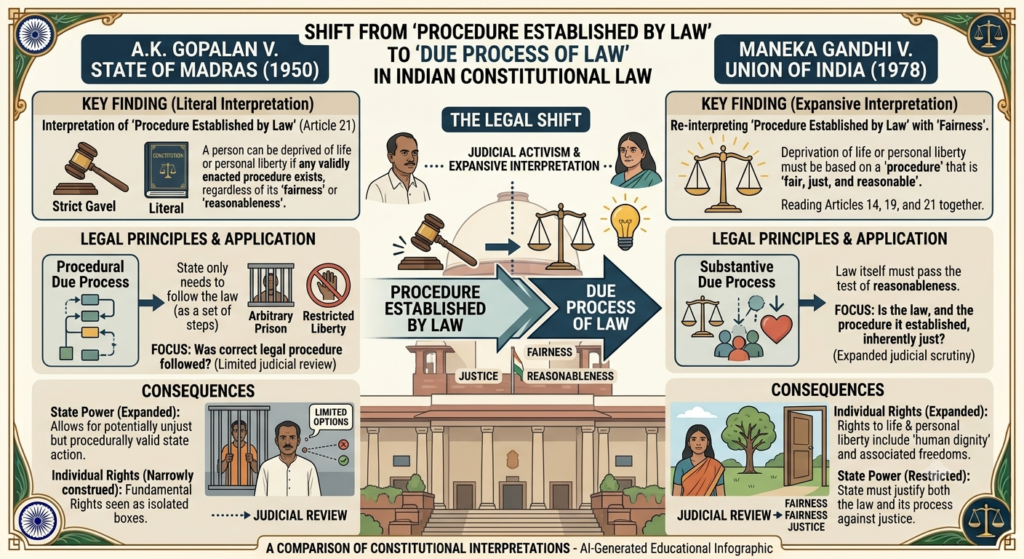
Before this judgment, constitutional jurisprudence largely viewed fundamental rights as separate, watertight compartments following the early precedent set in A.K. Gopalan v. State of Madras.
However, our analysis reveals that the Supreme Court discarded this narrow approach in favor of an integrated scheme. Specifically, the Court established that Articles 14, 19, and 21 form an interconnected framework often referred to as the “Golden Triangle.”
- Article 14: Ensures equality before law and strikes against state arbitrariness.
- Article 19: Guarantees fundamental freedoms, including free speech and expression.
- Article 21: Protects the right to life and personal liberty.
Additionally, the Court affirmed that any law depriving a person of personal liberty must satisfy the tests of reasonableness under Article 14 and fundamental freedoms under Article 19 simultaneously.
Key Takeaway: The “Golden Triangle” doctrine ensures that state actions affecting personal freedom under Article 21 must pass the scrutiny of non-arbitrariness under Article 14 and reasonableness under Article 19.
Due Process of Law vs Procedure Established by Law
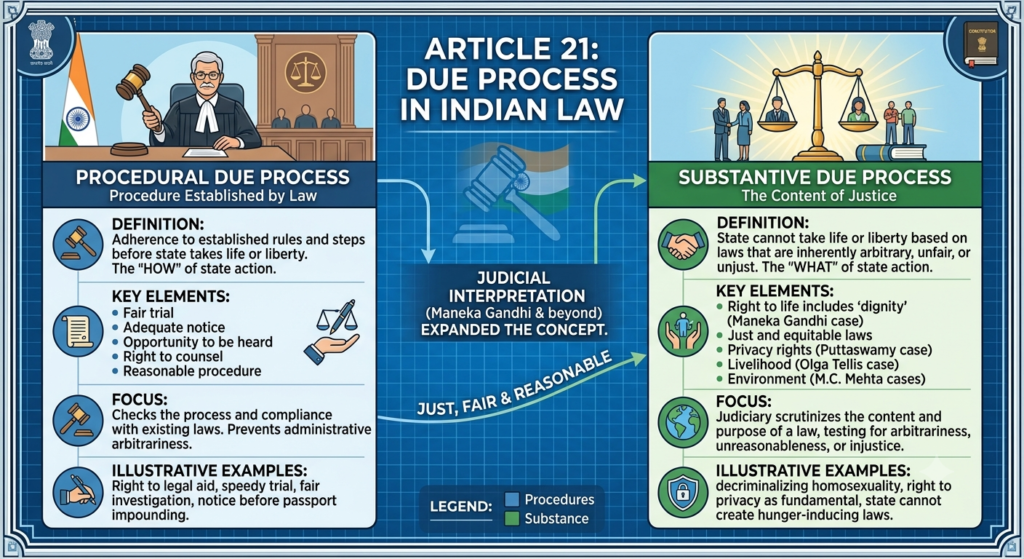
The Constituent Assembly explicitly chose the phrase “procedure established by law” in Article 21 instead of the American “due process of law.” Nevertheless, this ruling effectively imported substantive due process into Indian constitutional law.
In our evaluation of the ruling, the Court clarified that “procedure” cannot mean just any statutory sequence enacted by a legislature. On the contrary, the procedure must be fair, just, and non-arbitrary.
- Legislative Competence: The law must be enacted by a competent legislative body.
- Procedural Fairness: The process prescribed must conform to principles of justice and fairness.
- Substantive Reasonableness: The statutory restriction must not be oppressive, whimsical, or discriminatory.
Principles of Natural Justice and Administrative Action
Another profound outcome of this case is the expansion of natural justice principles across administrative functions. The Court held that the duty to act fairly applies to both quasi-judicial and purely administrative actions.
Furthermore, the Court addressed the doctrine of audi alteram partem (the right to a fair hearing). While emergency situations may warrant post-decisional hearings, the right to present one’s case cannot be denied altogether.
Besides expanding hearing rights, the Court emphasized that statutory authorities must record reasons when taking adverse actions against individuals. Thus, recording reasons acts as a vital safeguard against official bias and unchecked power.
Key Takeaway: Administrative orders affecting personal liberties must observe natural justice rules, including giving fair notice, offering an opportunity to be heard, and providing clear reasons.
Comparative Analysis of Key Issues
To better grasp the transformation brought about by this judgment, consider the structural shifts before and after the 1978 decision:
| Legal Metric | Pre-1978 Standard (A.K. Gopalan) | Post-1978 Standard (Maneka Gandhi) |
|---|---|---|
| Interpretation of Rights | Watertight, mutually exclusive compartments | Integrated “Golden Triangle” (Articles 14, 19, & 21) |
| Standard for Procedure | Any procedure enacted by formal statute | Procedure must be right, fair, just, and reasonable |
| Right to Travel Abroad | Restricted or treated as non-fundamental | Recognized as an intrinsic facet of Article 21 |
| Natural Justice Scope | Restricted primarily to quasi-judicial bodies | Extended universally to administrative actions |
Frequently Asked Questions
What is the main legal significance of Maneka Gandhi v. Union of India?
This decision established that any law depriving a person of personal liberty under Article 21 must prescribe a procedure that is fair, just, and reasonable. In addition, it linked Articles 14, 19, and 21 together into an integrated guarantee against state arbitrariness.
Is the right to travel abroad a fundamental right in India?
Yes. The Supreme Court ruled that the freedom to travel abroad is an essential attribute of “personal liberty” guaranteed under Article 21 of the Constitution of India.
How did this judgment affect the rule of natural justice?
The Court held that the principles of natural justice, particularly the right to a fair hearing (audi alteram partem), apply to administrative actions that entail adverse civil consequences, ensuring fair play in governance.