Written by Kapil Balhara | Technically Reviewed for Accuracy | Last Updated: October 2026
Table of Contents
- What Is M.C. Mehta v. Union of India (Oleum Gas Leak Case)?
- Factual Background and the Oleum Gas Leak Disaster
- Evolution of Absolute Liability vs. Strict Liability
- Constitutional Scope: Article 21 and Article 32 Analysis
- Key Holdings and Supreme Court Directives
- Impact on Modern Indian Environmental Law
- Frequently Asked Questions
What Is M.C. Mehta v. Union of India (Oleum Gas Leak Case)?
Key Takeaway: The M.C. Mehta v. Union of India (1987) judgment established the principle of absolute liability in Indian environmental law. The landmark decision held hazardous industries strictly accountable for industrial disasters without allowing traditional common-law exceptions.
The M.C. Mehta v. Union of India case arose after a dangerous oleum gas leak occurred at the Shriram Foods and Fertiliser Industries complex in Delhi in December 1985. A Five-Judge Constitution Bench of the Supreme Court, led by Chief Justice P.N. Bhagwati, formulated a new legal doctrine.
Furthermore, the Court replaced the nineteenth-century English rule from Rylands v. Fletcher with the absolute liability principle. Consequently, Indian courts gained expanded powers under Article 32 to enforce fundamental rights and grant monetary compensation directly to victims.
Factual Background and the Oleum Gas Leak Disaster
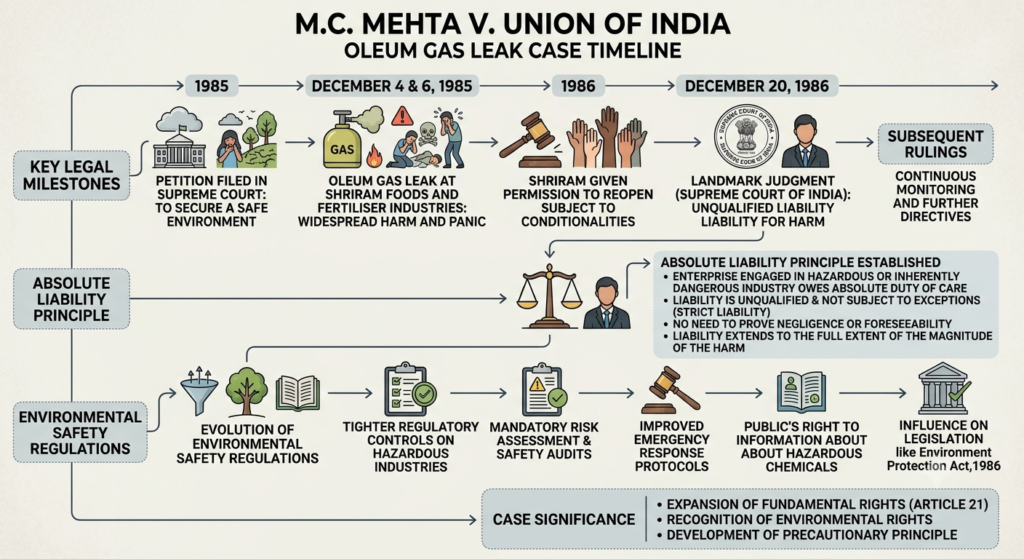
To begin with, public interest litigator M.C. Mehta filed a writ petition under Article 32 of the Constitution of India. He sought the immediate closure and relocation of caustic chlorine and fertilizer units operated by Shriram Foods and Fertiliser Industries. The plant sat in a densely populated area of New Delhi.
However, while the original writ petition remained pending, a disaster occurred on December 4 and December 6, 1985. Oleum gas escaped from one of the units, causing widespread panic, illness, and death.

Subsequently, legal bodies stepped in to protect affected citizens. For instance, the Delhi Legal Aid and Advice Board and the Delhi Bar Association filed applications claiming compensation for victims.
Because these applications raised complex constitutional questions under Article 21 and Article 32, a three-judge bench referred the matter to a larger five-judge bench.
Key Takeaway: The oleum gas escape transformed a basic relocation petition into a landmark constitutional trial on corporate accountability and human rights protection.
Evolution of Absolute Liability vs. Strict Liability
In evaluating corporate culpability, the Supreme Court re-examined the classic doctrine of strict liability established in Rylands v. Fletcher (1866). Under English common law, strict liability allowed several defenses. For example, hazardous enterprises could escape financial responsibility by proving:
- Act of God (unforeseeable natural events)
- Act of a third party or stranger
- Statutory authority or consent of the injured party
- Plaintiff’s own default or negligence
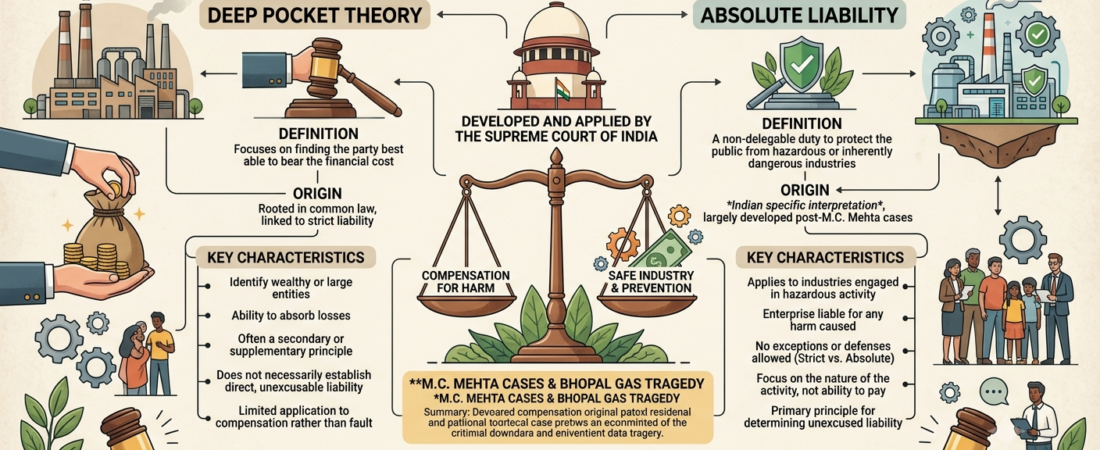
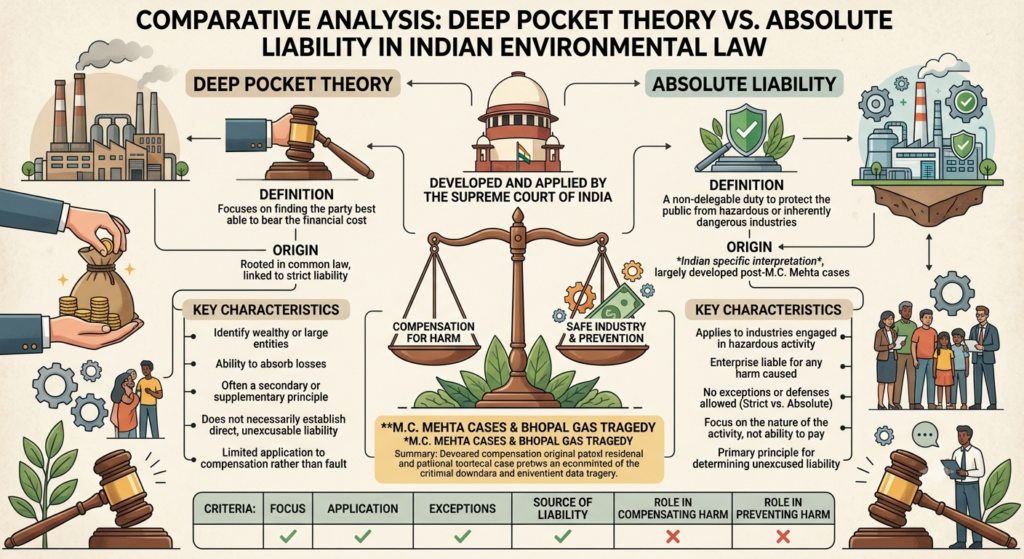
In contrast, Chief Justice P.N. Bhagwati stated that Indian jurisprudence must not rely on foreign legal crutches. Therefore, the Court constructed a new rule called Absolute Liability. Under this doctrine, an enterprise operating a hazardous industry owes an absolute, non-delegable duty to the public.
| Parameter | Strict Liability (Rylands v. Fletcher) | Absolute Liability (M.C. Mehta v. UOI) |
|---|---|---|
| Origin | 19th Century English Common Law | Indian Supreme Court (1986 Judgment) |
| Available Defenses | Act of God, third-party act, consent, statutory authority | Zero defenses permitted |
| Scope of Duty | Conditional duty based on non-natural land use | Absolute and non-delegable duty to community |
| Exceptions | Applies only if escape occurs without negligence | Applies even if all reasonable care was taken |
| Compensation Basis | Restitution for actual damages caused | Linked to enterprise size to ensure deterrent effect |
In addition, the Court formulated the “Deep Pocket Theory”. Consequently, the larger and more prosperous an enterprise is, the higher the compensation it must pay to achieve a deterrent effect.
Constitutional Scope: Article 21 and Article 32 Analysis
Besides developing tort law, the decision broadened constitutional protections under Article 21 (Right to Life and Personal Liberty) and Article 32 (Constitutional Remedies).
Epistolary Jurisdiction and Procedural Flexibility
First, the Court reinforced epistolary jurisdiction. Specifically, public-spirited citizens and social action groups can initiate public interest litigation simply by sending informal letters.
Secondly, the bench confirmed that technicalities must never obstruct access to justice. Thus, lack of supporting affidavits or formal writ formats cannot invalidate a legitimate legal action involving disadvantaged victims.
Remedial Powers and Compensation Under Article 32
Most importantly, the Supreme Court clarified that Article 32 goes beyond injunctive relief. Furthermore, the Court possesses implicit power to forge new remedies and grant monetary compensation when fundamental rights are violated.
  [ Fundamental Right Breach (Article 21) ]
                      │
                      ▼
   [ Epistolary Jurisdiction Ignited (PIL) ]
                      │
                      ▼
 [ Remedial Power via Article 32 Invoked ]
                      │
                      ▼
[ Award of Deterrent Monetary Compensation ]
- Identify the gross violation of Article 21 rights affecting public health.
- File a PIL or letter petition with the PIL Cell of the Supreme Court.
- Receive court-directed remedial action, independent commissions, and compensation orders.
Key Takeaway: Article 32 grants the Supreme Court full authority to enforce fundamental rights by fashioning financial remedies against hazardous private actors.
Key Holdings and Supreme Court Directives
Ultimately, the five-judge bench delivered several transformative holdings:
- Creation of Absolute Liability: Hazardous industries are fully liable for any harm caused by toxic escapes, irrespective of safety measures or absence of negligence.
- Application of Deep Pocket Rule: Quantum of compensation must correlate directly with the financial capacity and magnitude of the enterprise.
- Legal Aid and Special Courts: The Court directed the Delhi Legal Aid and Advice Board to file claims on behalf of all oleum gas victims before designated judges.
- Article 12 and Private Sector: While the bench discussed extending Article 12 accountability to private hazardous corporations under Article 21, it left the final ruling open for future consideration.
Impact on Modern Indian Environmental Law
Consequently, the ruling transformed environmental jurisprudence across India. For example, the Parliament incorporated absolute liability concepts when drafting the Public Liability Insurance Act, 1991, and establishing the National Green Tribunal (NGT).
Furthermore, the judgment established that industrial economic development cannot compromise citizen health or Article 21 rights. Therefore, corporate enterprises operating hazardous units must absorb environmental damages as operational overheads.
Frequently Asked Questions
1. What is the main principle laid down in M.C. Mehta v. Union of India (1987)?
The primary principle established in this case is the doctrine of Absolute Liability. It mandates that an enterprise engaged in a hazardous activity is completely liable for any harm caused by an accident, without any legal defenses.
2. How does absolute liability differ from the rule in Rylands v. Fletcher?
The rule in Rylands v. Fletcher (strict liability) permits several exceptions, such as acts of God or third-party interference. Conversely, absolute liability allows no exceptions whatsoever.
3. What is the Deep Pocket Theory in Indian environmental law?
The Deep Pocket Theory states that the financial capacity of a polluting enterprise determines the compensation amount. Larger and wealthier corporations must pay higher damages to ensure a strong deterrent effect.
4. Can compensation be awarded directly under Article 32 writ petitions?
Yes. The Supreme Court ruled that Article 32 gives courts the power to fashion new remedial measures, including awarding compensation for gross fundamental right violations.