Table of Contents
- Introduction to the Landmark Case
- Background and Key Legal Issues
- Supreme Court Ruling and Basic Structure Analysis
- Harmonious Construction: Fundamental Rights vs. Directive Principles
- Comparative Analysis of Constitutional Provisions
- Frequently Asked Questions
Introduction to the Landmark Case
In the pivotal landmark ruling of Minerva Mills Ltd. v. Union of India, the Supreme Court of India reinforced the core identity of the Indian Constitution. Furthermore, this decision firmly established that Parliament cannot claim unlimited power to alter the nation’s foundational framework.
Written by Kapil Balhara | Technically Reviewed for Accuracy | Last Updated: October 2026
Our legal analysis shows that this decision protected personal liberty. Specifically, the judgment prevented ordinary laws from bypassing constitutional scrutiny.
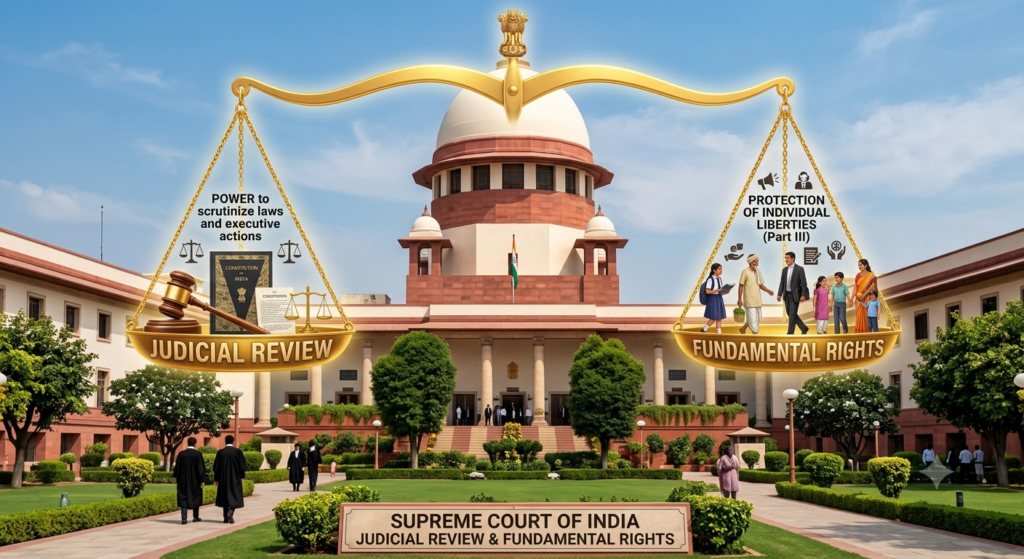
Key Takeaway: The Supreme Court ruled that a limited amending power is itself a basic feature of the Constitution, preventing Parliament from converting limited power into absolute authority.
Background and Key Legal Issues
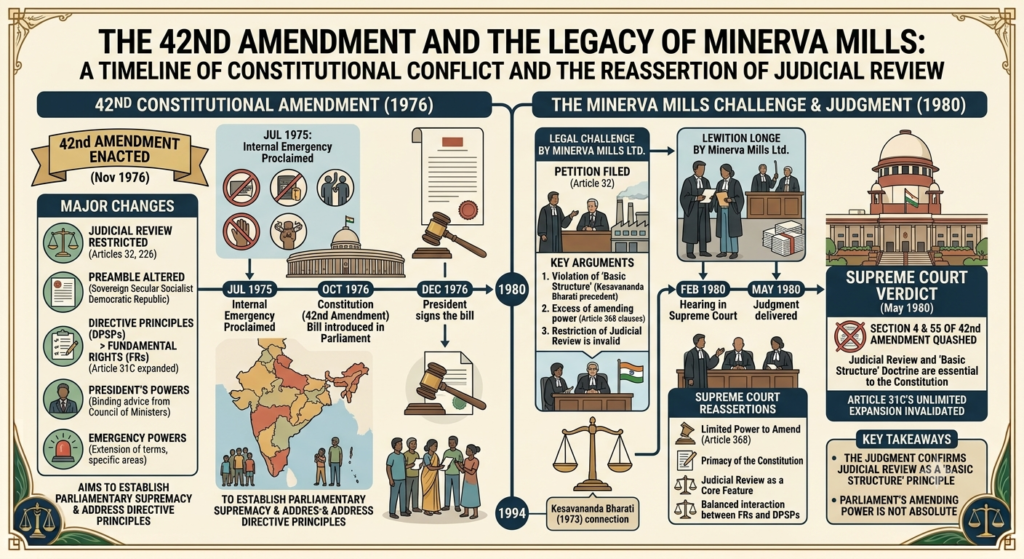
The controversy began when the Central Government appointed an investigation committee under Section 15 of the Industries (Development and Regulation) Act, 1951. Subsequently, the government passed an order in October 1971 under Section 18A to nationalize the textile undertaking.
Minerva Mills Ltd., a textile company located in Karnataka, faced nationalization under the Sick Textile Undertakings (Nationalisation) Act, 1974. Consequently, the company owners challenged the taking over of management.
Moreover, the petitioner challenged Sections 4 and 55 of the 42nd Constitutional Amendment Act, 1976. Section 55 had inserted Clauses (4) and (5) into Article 368. In addition, Section 4 had expanded Article 31C to give priority to all Directive Principles over Articles 14 and 19.
Supreme Court Ruling and Basic Structure Analysis
In our evaluation, the majority judgment delivered by Chief Justice Y.V. Chandrachud remains an absolute masterclass in constitutional law. Furthermore, the court held that clauses (4) and (5) of Article 368 were completely void and unconstitutional.
- Clause 5 Analysis: Clause (5) attempted to remove all limitations on parliamentary power to amend the Constitution. However, the Court ruled that Parliament cannot expand its limited power into an unlimited power.
- Clause 4 Analysis: Clause (4) attempted to deprive courts of their power of judicial review. Thus, the Court declared that rights without legal remedies are useless.
- Restoration of Balance: The court protected Article 32, ensuring that citizens can always approach the judiciary for redress.
Key Takeaway: Judicial review is a vital pillar of the Indian Constitution, ensuring that no organ of government exceeds its designated powers.
If you are analyzing legal precedents or researching constitutional law, feel free to bookmark our exhaustive case summaries for quick reference.
Harmonious Construction: Fundamental Rights vs. Directive Principles
The judgment stressed that Part III (Fundamental Rights) and Part IV (Directive Principles) are twin goals of social revolution. Consequently, giving absolute primacy to one over the other destroys the harmony of the Constitution.
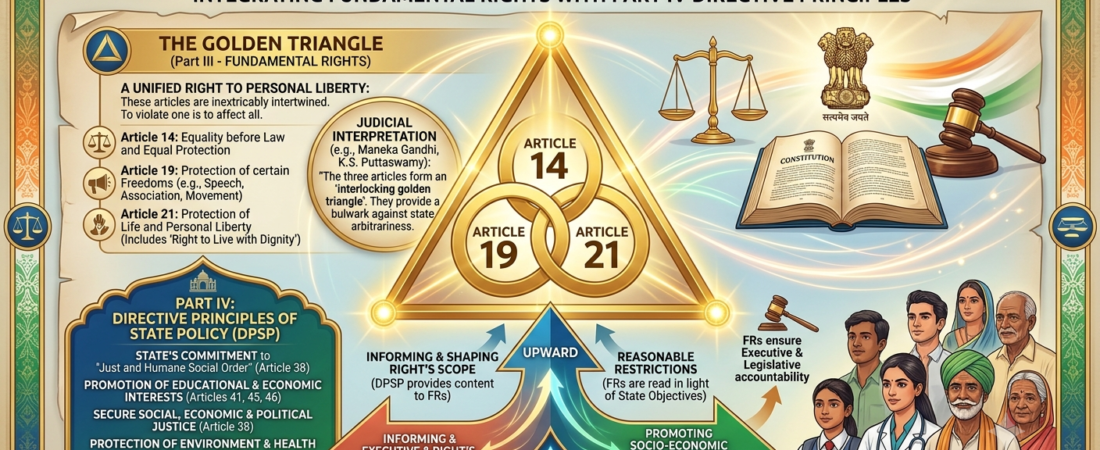
- Golden Triangle: The court identified Articles 14, 19, and 21 as the golden triangle protecting individual liberty.
- Chariot Wheels: Parts III and IV were described as two wheels of a chariot, where snapping one makes the other lose efficacy.
- Purity of Means: The objectives in Part IV must be achieved without destroying the core guarantees of Part III.
Additionally, Justice P.N. Bhagwati concurred that Clauses (4) and (5) of Article 368 were unconstitutional. However, he offered a distinct view on Article 31C’s scope regarding social justice laws.
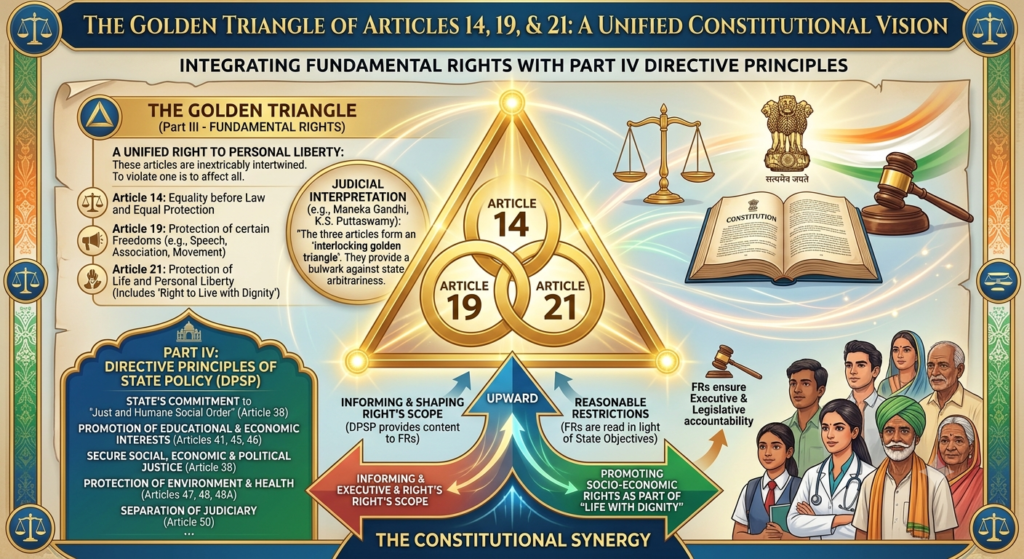
Key Takeaway: Sustainable socio-economic goals must never be achieved at the cost of total destruction of individual civil liberties.
Comparative Analysis of Constitutional Provisions
To understand the legal shifts brought by this case, we evaluated the statutory provisions before and after the judgment:
| Article / Provision | Position Under 42nd Amendment (1976) | Supreme Court Ruling in Minerva Mills (1980) |
|---|---|---|
| Article 368(4) | Barred courts from questioning any constitutional amendment on any ground. | Declared unconstitutional; preserved judicial review as a basic feature. |
| Article 368(5) | Granted unlimited constituent power to Parliament to amend or repeal provisions. | Declared unconstitutional; Parliament cannot expand its own limited power. |
| Article 31C | Immunized all laws implementing any Directive Principle from Articles 14 and 19. | Struck down the extension; restored protection of fundamental freedoms. |
Frequently Asked Questions
Q1. What was the main ratio decidendi of Minerva Mills Ltd. v. Union of India?
The main ratio decidendi is that Parliament has limited amending power under Article 368, which itself is a basic feature of the Constitution. Therefore, Parliament cannot use its amending power to destroy the basic structure or eliminate judicial review.
Q2. How did this judgment affect Article 31C?
The court struck down the amendment made to Article 31C by Section 4 of the 42nd Amendment Act. Consequently, Article 31C was restricted back to protecting only laws giving effect to Article 39(b) and (c).
Q3. Why is judicial review considered part of the Basic Structure?
Judicial review ensures checks and balances among the Executive, Legislature, and Judiciary. Without judicial review, fundamental rights would become useless parchment guarantees.
Conclusion
Ultimately, Minerva Mills Ltd. v. Union of India stands as a crucial protector of democratic governance. By striking down improper constitutional amendments, the Supreme Court ensured that individual freedom and social welfare remain harmoniously balanced under the Rule of Law.