Written by Kapil Balhara | Technically Reviewed for Accuracy | Last Updated: October 2026
Understanding Mohd. Ahmed Khan v. Shah Bano Begum
The landmark case of Mohd. Ahmed Khan v. Shah Bano Begum remains a pivotal judgment in Indian constitutional history. Decided by the Supreme Court of India in 1985, this case affirmed that secular maintenance laws apply to all citizens regardless of religion. Consequently, it sparked national debates on gender justice, personal laws, and the Uniform Civil Code.
Key Takeaway: The Supreme Court held that Section 125 of the Code of Criminal Procedure is a secular provision designed to prevent vagrancy, overriding personal law barriers whenever an indigent former wife cannot support herself.
Mohd. Ahmed Khan v. Shah Bano Begum Supreme Court ruling on maintenance rights
To begin with, the court evaluated whether a divorced Muslim woman could claim monthly support beyond the traditional iddat period. The five-judge Constitution Bench held that statutory rights under secular criminal law exist independently of personal religious texts. Therefore, the decision created a crucial precedent for gender equality and statutory protection across India.
Factual Matrix: The Long Legal Battle
In 1932, Shah Bano Begum married Mohd. Ahmed Khan, a practicing advocate in Indore. Five children were born from this long union. However, marital distress emerged decades later, leading to a bitter judicial fight.
First, in 1975, the husband drove Shah Bano out of the matrimonial home. Subsequently, in April 1978, she filed a petition under Section 125 of the Code of Criminal Procedure (CrPC). She requested a monthly allowance of Rs. 500 because her husband earned a substantial professional income.
In response, the husband divorced her by pronouncing an irrevocable talaq in November 1978. He argued that divorce severed all legal ties under Muslim Personal Law. Furthermore, he claimed he had already paid maintenance for two years alongside depositing Rs. 3,000 for Mahr during the iddat period.
Timeline of Key Events:
1932: Marriage between Shah Bano Begum and Mohd. Ahmed Khan
1975: Shah Bano is turned out of her matrimonial home
1978 (April): Shah Bano files for maintenance under Section 125 CrPC
1978 (Nov): Husband pronounces irrevocable talaq to evade statutory liability
1979 (Aug): Magistrate awards a maintenance allowance of Rs. 25 per month
1980 (July): High Court enhances maintenance allowance to Rs. 179.20 per month
1985 (April): Supreme Court dismisses husband's appeal and upholds maintenance rights
Later, the Judicial Magistrate directed the husband to pay a monthly maintenance of Rs. 25. Dissatisfied, Shah Bano approached the High Court of Madhya Pradesh for an enhancement. The High Court subsequently increased the amount to Rs. 179.20 per month. Consequently, the husband appealed to the Supreme Court of India.
The Core Legal Controversy: Section 125 CrPC vs. Personal Law
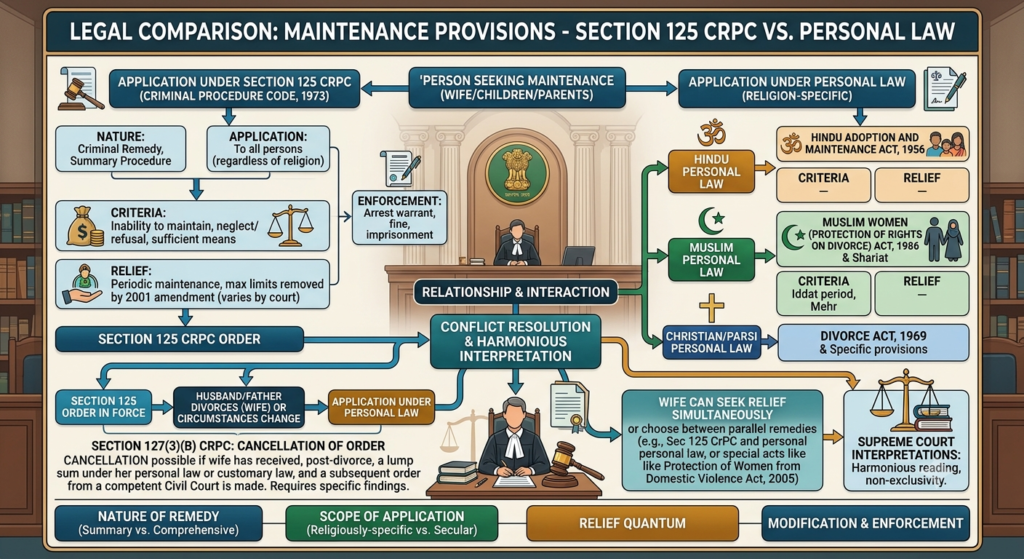
The central legal debate focused on whether secular statutory provisions take precedence over religious personal laws. Specifically, the defense argued that Section 127(3)(b) CrPC protected personal law practices by canceling maintenance orders once customary payments like Mahr were delivered.
Key Takeaway:Mahr is an obligation imposed on the husband as a mark of respect for the wife during marriage, not an amount paid in consideration of a divorce.
Our legal analysis shows how statutory definitions interact with customary practices:
Legal Provision
Scope and Application
Impact on Maintenance Rights
Section 125 CrPC
Secular, summary remedy for neglected wives, children, and parents.
Defines “wife” to include a divorced woman who has not remarried.
Section 127(3)(b) CrPC
Cancels maintenance if customary sums payable on divorce are received.
Does not exempt husbands if customary payments fail to prevent destitution.
Muslim Personal Law (Shariat)
Governs marital relations, dower obligations, and post-divorce duties.
Traditionally restricted post-divorce maintenance to the iddat period.
In our evaluation, the statutory scheme aims to prevent social destitution. Section 125 acts as a protective measure across all religions. Therefore, personal obligations cannot negate the social duty to prevent vagrancy.
Legal comparison between Section 125 CrPC and personal law maintenance provisions
Additionally, the defense insisted that the husband’s financial responsibility ended when iddat expired. However, the court examined religious texts to determine if any genuine conflict existed.
Supreme Court Verdict: Key Findings and Observations
Chief Justice Y.V. Chandrachud delivered the unanimous judgment for the five-judge bench. The Supreme Court ruled that Section 125 CrPC applies universally to every citizen regardless of faith.
Key Takeaway: When a divorced woman cannot support herself, her statutory right under Section 125 CrPC overrides restrictive personal law interpretations.
The court emphasized several key findings:
Secular Character of Section 125: The law serves a moral, social purpose designed to prevent destitution among vulnerable individuals.
Definition of “Wife”: The statutory definition explicitly includes divorced women who remain unmarried, without religious limitations.
Interpretation of Mahr: Dower is paid out of respect for marriage rather than as compensation for divorce.
Textual Harmony: Quranic verses obligate righteous husbands to provide fair maintenance to divorced wives.
Need expert legal counsel on maintenance claims or family law disputes? Contact Kapil Balhara’s legal practice today for clear, strategic guidance tailored to your rights.
Furthermore, the judgment affirmed earlier rulings in Bai Tahira and Fazlunbi. The court concluded that paying a small pittance during iddat does not relieve a financially capable husband from preventing his former spouse’s vagrancy.
The Uniform Civil Code and Constitutional Impact
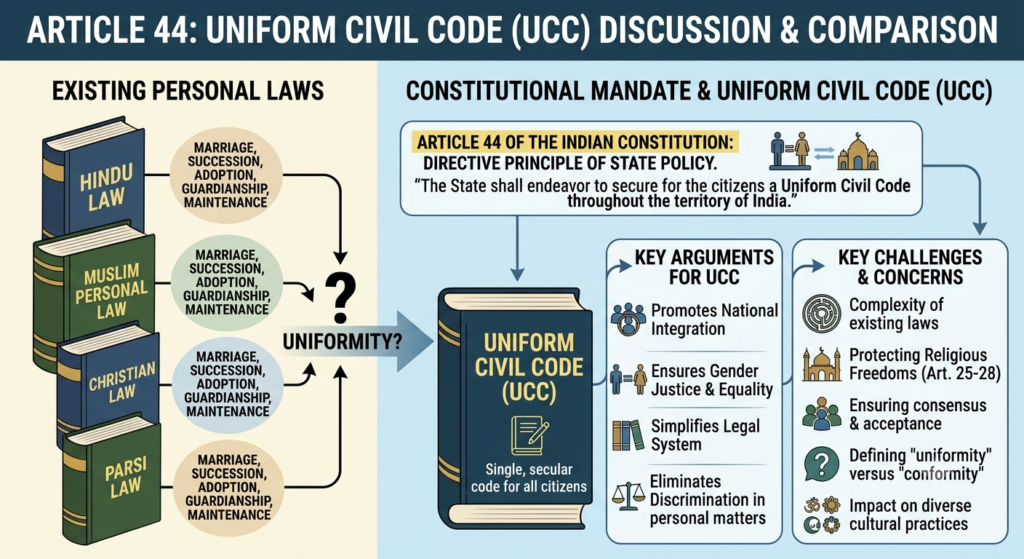
Beyond maintenance rights, the bench addressed Article 44 of the Constitution of India. Article 44 directs the state to secure a Uniform Civil Code for all citizens throughout the country.
Article 44 Indian Constitution Uniform Civil Code discussion in Shah Bano case
The court observed that Article 44 had largely remained unfulfilled. Chief Justice Chandrachud noted that a common civil code fosters national integration by reconciling conflicting legal ideologies. Moreover, the court stressed that legislative action must address systematic inequalities when personal laws fail to protect vulnerable individuals.
Key Takeaway: The Supreme Court highlighted that judicial interpretations cannot fully replace comprehensive legislative reform through a Uniform Civil Code.
Consequently, the decision created intense public discussion. While progressive reformers welcomed the emphasis on gender justice, conservative groups expressed strong reservations. Subsequently, Parliament enacted the Muslim Women (Protection of Rights on Divorce) Act, 1986, which altered the legal framework governing post-divorce liabilities.
Key Takeaways and Historical Significance
Ultimately, Mohd. Ahmed Khan v. Shah Bano Begum represents a monumental milestone in Indian jurisprudence. The ruling asserted that statutory remedies for basic human survival transcend personal legal codes.
Secular Primacy: Criminal procedure provisions on maintenance apply to all citizens irrespective of religion.
Gender Justice: Divorced women gain vital safeguards against sudden financial distress and vagrancy.
Statutory Harmony: The court harmonized constitutional principles with statutory provisions and religious teachings.
UCC Discourse: The ruling remains a foundational reference point for ongoing discussions on civil law uniformity.
In conclusion, this landmark decision strengthened rights for indigent women across India. It established that social justice mechanisms must protect individuals from hardship regardless of community affiliations.
Frequently Asked Questions
What was the main ruling in Mohd. Ahmed Khan v. Shah Bano Begum?
The Supreme Court ruled that Section 125 of the CrPC applies to all citizens regardless of religion. Therefore, a divorced Muslim woman who cannot maintain herself can claim maintenance from her former husband beyond the iddat period.
How did the Supreme Court interpret Mahr in this case?
The court held that Mahr (dower) is paid as a mark of respect for the wife during marriage. Because it is an obligation connected to marriage, it cannot be categorized as a sum payable “on divorce” under Section 127(3)(b) CrPC.
Does Section 125 CrPC override personal laws?
Yes, the Supreme Court clarified that Section 125 CrPC is a secular, prophylactic measure designed to prevent vagrancy. Consequently, its provisions take precedence over personal law limitations when a divorced spouse faces indigence.
What did the court say regarding the Uniform Civil Code?
The Supreme Court expressed regret that Article 44 of the Constitution had remained unfulfilled. It stated that a Uniform Civil Code would promote national integration by removing conflicting ideological loyalties in personal laws.