Table of Contents
- Introduction to the Landmark Case
- Background and Key Legal Issues
- Supreme Court Ruling on Article 21 and Right to Livelihood
- Due Process, Natural Justice, and Section 314 Analysis
- Comparative Analysis of Statutory and Rights Frameworks
- Frequently Asked Questions
Introduction to the Landmark Case
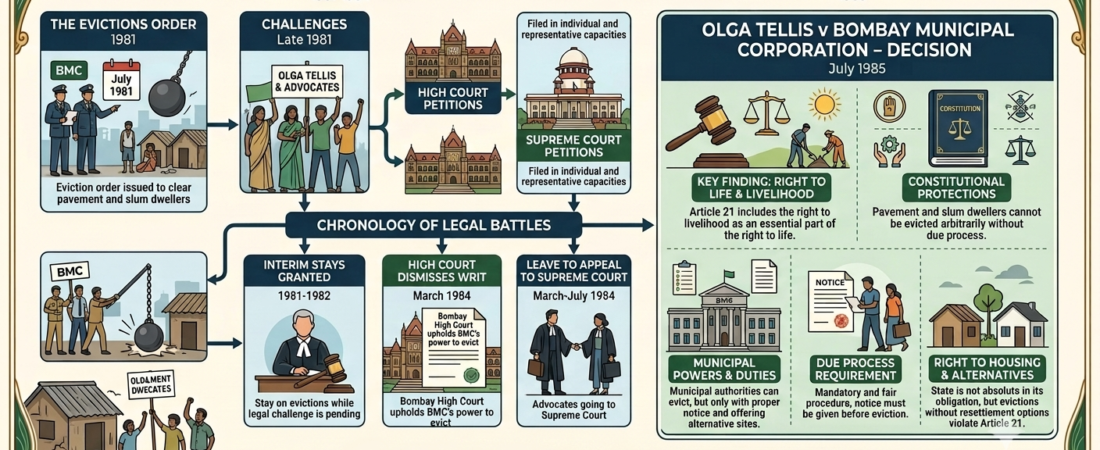
In the historic judgment of Olga Tellis v. Bombay Municipal Corporation, the Supreme Court evaluated urban poverty and eviction practices. Furthermore, this decision established that the constitutional right to life under Article 21 includes the right to livelihood.
Written by Kapil Balhara | Technically Reviewed for Accuracy | Last Updated: October 2026
Our legal analysis shows that this decision transformed fundamental rights jurisprudence. Specifically, the judgment prevented state authorities from executing summary demolitions without procedural safeguards.
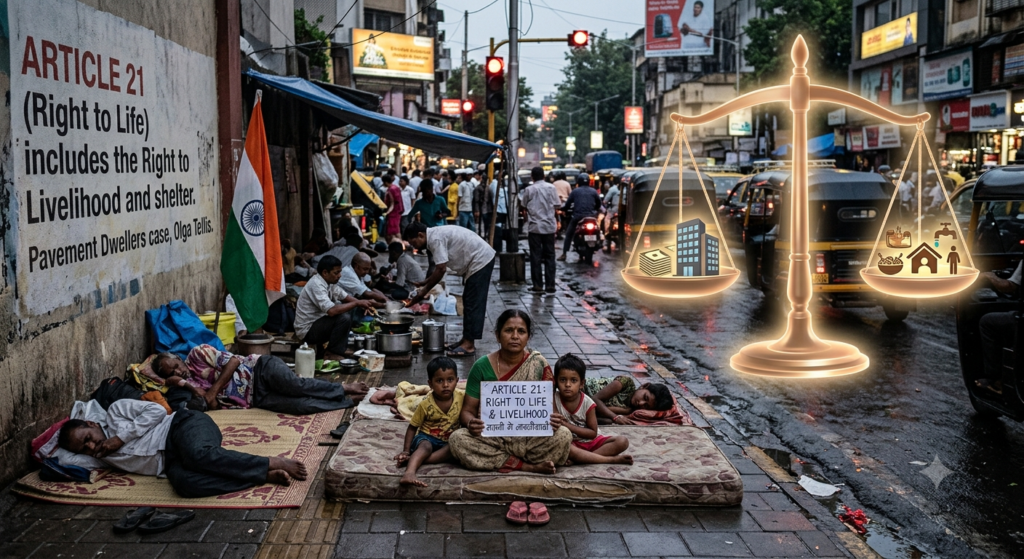
Key Takeaway: The Supreme Court expanded Article 21 by holding that depriving a person of their livelihood effectively deprives them of their life.
Background and Key Legal Issues
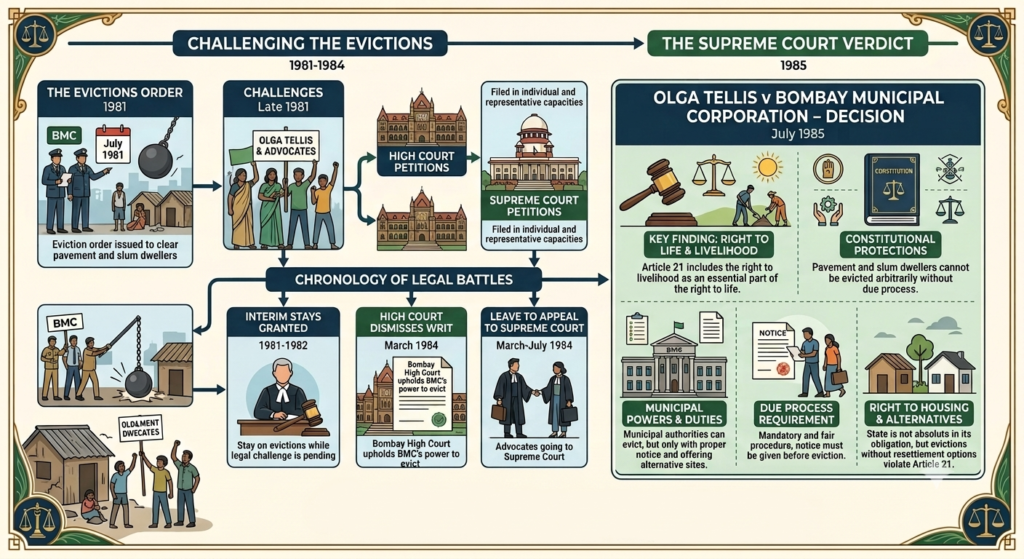
The dispute began in July 1981 when the Maharashtra State Government announced the eviction and deportation of pavement dwellers in Bombay. Subsequently, municipal officers demolished numerous makeshift shelters across the city using police forces.
In response, journalist Olga Tellis, along with civil liberty organizations and affected dwellers, filed writ petitions directly under Article 32. For instance, residents from Kamraj Nagar and Tulsi Pipe Road challenged the aggressive clearing drives.
Moreover, the petitioners challenged Section 314 of the Bombay Municipal Corporation Act, 1888. That section empowered the Municipal Commissioner to remove encroachments from public streets without prior notice.
Supreme Court Ruling on Article 21 and Right to Livelihood
In our evaluation, the Constitution Bench led by Chief Justice Y.V. Chandrachud delivered a monumental ruling. Furthermore, the court rejected the preliminary argument that dwellers were estopped from asserting fundamental rights due to previous High Court undertakings.
- No Estoppel Against the Constitution: The court affirmed that individuals cannot barter away or waive fundamental rights guaranteed under Part III.
- Expansion of Article 21: The bench recognized that the right to life extends beyond mere physical existence. Consequently, access to livelihood forms an integral component of Article 21.
- Role of Directive Principles: Articles 39(a) and 41 must guide fundamental rights interpretation. Therefore, state actions depriving livelihoods must undergo strict constitutional scrutiny.
Key Takeaway: The state cannot deprive citizens of their means of living except through a fair, just, and reasonable legal procedure.
Midway through reviewing these constitutional milestones, legal scholars can bookmark our repository to examine updated statutory insights.
Due Process, Natural Justice, and Section 314 Analysis
The court thoroughly examined Section 314 of the Bombay Municipal Corporation Act to assess its validity. Consequently, the bench read down the provision rather than striking it down entirely.
- Enabling vs. Compulsive Discretion: Section 314 grants discretion to act without notice only in emergency situations, rather than mandating notice exclusion in every situation.
- Audi Alteram Partem: Natural justice dictates that affected persons must receive an opportunity to present their case before eviction.
- Eviction and Resettlement Guidelines: The court mandated that dwellers enumerated in the 1976 census receive alternative plots at Malavani or nearby sites. Additionally, evictions were barred during the monsoon season.
Additionally, the bench acknowledged that public footpaths are meant for general pedestrian passage. However, forced evictions without alternative shelter merely aggravate human misery without solving urban congestion.
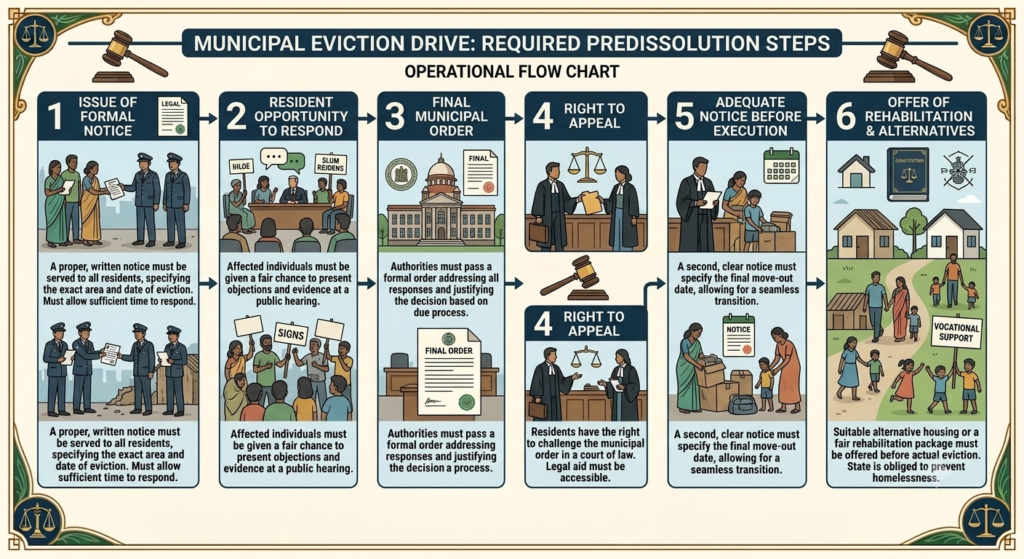
Key Takeaway: Procedural safeguards must exist to protect human dignity, ensuring that statutory powers are not exercised arbitrarily.
Comparative Analysis of Statutory and Rights Frameworks
To illustrate the legal transformation created by this ruling, we evaluated the constitutional standards before and after the judgment:
| Issue / Concept | Position Before Olga Tellis (1985) | Supreme Court Standard in Olga Tellis |
|---|---|---|
| Scope of Article 21 | Applied primarily to procedural protections against physical restraint. | Explicitly incorporates the Right to Livelihood as part of life. |
| Section 314 BMC Act | Used to remove public encroachments summarily without any prior notice. | Read down to require natural justice and notice as the general rule. |
| Fundamental Rights Waiver | Undertakings in court were sometimes treated as a bar to constitutional claims. | Established that no estoppel or waiver applies against the Constitution. |
Frequently Asked Questions
Q1. What was the central ratio decidendi of Olga Tellis v. BMC?
The core ratio decidendi is that the right to life under Article 21 includes the right to livelihood. Consequently, any state action depriving a person of their livelihood must conform to fair, just, and reasonable procedures.
Q2. Did the Supreme Court grant pavement dwellers an absolute right to occupy public footpaths?
No, the court held that public footpaths are meant for general pedestrian use and do not confer a right to erect private structures. However, evictions must follow humane procedures and rehabilitation schemes.
Q3. Can an individual waive their fundamental rights through a court undertaking?
No, the Supreme Court ruled that there can be no estoppel against the Constitution. An individual cannot waive or barter away fundamental rights conferred in the public interest.
Conclusion
Ultimately, Olga Tellis v. Bombay Municipal Corporation remains a foundational authority in socio-economic rights jurisprudence. By linking livelihood directly to the right to life, the Supreme Court ensured that administrative power must always yield to constitutional fairness and human dignity.